

Frequently Asked Questions

MTTD Basics & Measurement

What is Mean Time to Detect (MTTD) in cybersecurity?

Mean Time to Detect (MTTD) is the average time it takes for an organization to identify a security threat or incident. It measures how quickly a team can spot potential breaches, vulnerabilities, or attacks. A lower MTTD means threats are detected faster, reducing the risk of damage such as data breaches, system downtime, or financial losses.

How is MTTD calculated?

MTTD is calculated using the formula: MTTD = Total detection time / Number of incidents. For example, if a company experienced 5 cyberattacks in a month and took a total of 50 hours to detect them, MTTD would be 50 hours / 5 incidents = 10 hours per incident.

Why is a low MTTD important for organizations?

A low MTTD means threats are detected quickly, reducing potential damage. Early detection allows teams to act faster, minimize downtime, prevent breaches, and strengthen overall defenses. Conversely, a high MTTD gives attackers more time to exploit vulnerabilities, increasing the risk of financial loss, reputational damage, and operational disruptions.

What factors influence MTTD in a security environment?

Factors influencing MTTD include the effectiveness of monitoring tools, automation of threat detection, the skill level of the security team, alert fatigue, visibility across environments, and the rate of false positives. Optimizing these areas helps reduce MTTD and strengthens security posture.

How does MTTD vary across different types of security incidents?

MTTD can vary significantly by incident type. For example, phishing and malware infections are often detected quickly (e.g., 4 hours), while insider threats and ransomware attacks may take longer (e.g., 20 hours), making them more significant risks to an organization’s security posture.

What are the industry benchmarks for MTTD?

Top-performing security teams detect threats in minutes or hours, while most organizations take days or weeks. High-risk industries like finance and healthcare aim for MTTD under 24 hours to minimize risk and comply with regulations.

How does MTTD relate to overall security posture?

MTTD is a direct reflection of an organization's security posture. A lower MTTD indicates proactive detection and strong defenses, while a higher MTTD suggests detection gaps and increased vulnerability to attacks.

What challenges do organizations face in reducing MTTD?

Common challenges include alert fatigue, lack of visibility across hybrid or multi-cloud environments, and high rates of false positives. Addressing these issues with automation, better visibility, and refined detection strategies is key to reducing MTTD.

What are the consequences of a high MTTD?

A high MTTD allows attackers more time to steal data, install malware, or escalate privileges. This can lead to severe consequences such as financial loss, reputational damage, operational disruptions, and compliance risks due to delayed breach detection and reporting.

How can organizations monitor and improve their MTTD over time?

Organizations should regularly track MTTD metrics, analyze trends, and implement improvements such as automation, continuous monitoring, and staff training. Monitoring MTTD over time helps measure progress and identify areas needing attention.

Reducing MTTD & Best Practices

What strategies help reduce MTTD in cybersecurity operations?

Key strategies include implementing security automation, continuous monitoring, leveraging threat intelligence, reducing alert noise, and ensuring regular training for security teams. Automation and AI-driven analytics can identify threats faster and reduce manual errors.

How does automation impact MTTD?

Automation speeds up threat detection by instantly analyzing logs, triggering alerts, and identifying patterns faster than manual processes. Automated tools like SIEM and SOAR platforms help reduce MTTD by quickly spotting anomalies and minimizing human error.

Why is reducing false positives important for lowering MTTD?

Reducing false positives allows security teams to focus on real threats, speeding up detection and response. Too many false alerts waste time and delay action on actual incidents, increasing MTTD and operational risk.

How do training and team coordination affect MTTD?

Well-trained, coordinated teams detect threats faster and respond more effectively. Regular training keeps analysts prepared for new threats, while clear escalation procedures and collaboration between IT and security teams improve visibility and reduce MTTD.

What role does threat intelligence play in reducing MTTD?

Threat intelligence feeds help organizations stay ahead of emerging risks by providing real-time information on new threats. Integrating threat intelligence with monitoring tools enables faster detection and more accurate prioritization of alerts, reducing MTTD.

Cymulate Platform & MTTD

How does Cymulate help organizations reduce MTTD?

Cymulate helps reduce MTTD by continuously validating security controls, automating breach and attack simulations, and providing actionable insights. The platform identifies detection gaps, delivers detailed remediation guidance, and automates routine testing, enabling faster detection and response to threats. Learn more.

What features of Cymulate are most effective for improving MTTD?

Cymulate's most effective features for improving MTTD include continuous threat validation, automated breach and attack simulations, actionable reporting, and integration with SIEM and SOAR platforms. These capabilities ensure rapid identification and remediation of security gaps.

How does Cymulate identify gaps in detection capabilities?

Cymulate simulates real-world attacks to test how well an organization detects and responds to threats. It analyzes simulation results to pinpoint weak spots in security defenses, allowing teams to strengthen detection mechanisms and reduce MTTD.

Can Cymulate automate breach and attack simulations?

Yes, Cymulate continuously runs automated breach and attack simulations that replicate the latest threats. This provides immediate feedback on security posture and helps organizations respond faster to vulnerabilities, reducing MTTD.

How does Cymulate support security operations centers (SOCs) in reducing MTTD?

Cymulate enhances SOC efficiency by automating routine testing, freeing up analysts to focus on critical issues. The platform's actionable insights and continuous validation help SOCs detect and respond to threats more quickly, lowering MTTD.

What measurable results have customers achieved with Cymulate?

Customers have reported up to a 52% reduction in critical exposures, a 60% increase in team efficiency, and an 81% reduction in cyber risk within four months of using Cymulate. These outcomes demonstrate the platform's effectiveness in improving security posture and reducing MTTD. See the Hertz Israel case study.

How easy is it to implement Cymulate for reducing MTTD?

Cymulate is designed for quick and easy implementation, operating in agentless mode without the need for additional hardware or complex configurations. Customers can start running simulations almost immediately, with robust support and educational resources available for onboarding.

What feedback have customers given about Cymulate's ease of use?

Customers consistently praise Cymulate for its intuitive interface and ease of use. Testimonials highlight the platform's user-friendly dashboard, quick implementation, and accessible support, making it effective for users of all skill levels. Read customer quotes.

What types of organizations benefit most from Cymulate's MTTD reduction capabilities?

Cymulate is suitable for organizations of all sizes and industries, including finance, healthcare, retail, media, transportation, and manufacturing. It is especially valuable for CISOs, SecOps teams, Red Teams, and Vulnerability Management teams seeking to improve threat detection and response. Learn more about roles.

Features, Integrations & Security

What are the key features of the Cymulate platform?

Cymulate offers continuous threat validation, unified BAS and CART, exposure analytics, attack path discovery, automated mitigation, AI-powered optimization, complete kill chain coverage, and an extensive threat library with over 100,000 attack actions updated daily. See platform features.

What integrations does Cymulate support?

Cymulate integrates with a wide range of security technologies, including Akamai Guardicore, AWS GuardDuty, BlackBerry Cylance OPTICS, Carbon Black EDR, Check Point CloudGuard, Cisco Secure Endpoint, CrowdStrike Falcon, Wiz, SentinelOne, and more. For a complete list, visit the Partnerships and Integrations page.

What security and compliance certifications does Cymulate hold?

Cymulate holds several industry-leading certifications, including SOC2 Type II, ISO 27001:2013, ISO 27701, ISO 27017, and CSA STAR Level 1. These certifications demonstrate Cymulate's commitment to robust security and compliance standards. Learn more about security at Cymulate.

How does Cymulate ensure data security and privacy?

Cymulate ensures data security through encryption for data in transit (TLS 1.2+) and at rest (AES-256), secure AWS-hosted data centers, a tested disaster recovery plan, and compliance with GDPR. The platform also features 2FA, RBAC, IP restrictions, and a dedicated privacy and security team.

What is Cymulate's pricing model?

Cymulate operates on a subscription-based pricing model tailored to each organization's requirements. Pricing depends on the chosen package, number of assets, and scenarios selected. For a detailed quote, schedule a demo with the Cymulate team.

Use Cases, Benefits & Educational Resources

Who are the primary users of Cymulate?

Cymulate is designed for CISOs, security leaders, SecOps teams, Red Teams, and Vulnerability Management teams across organizations of all sizes and industries. The platform provides tailored solutions to address the unique needs of each role. See more about user roles.

What business impact can organizations expect from using Cymulate?

Organizations using Cymulate can expect improved security posture (up to 52% reduction in critical exposures), increased operational efficiency (60% increase in team efficiency), faster threat validation (40X faster), cost savings, and enhanced threat resilience (81% reduction in cyber risk within four months). See more business impact.

What are some real-world use cases for Cymulate?

Use cases include reducing fragmented security tools, addressing resource constraints, improving risk prioritization, securing cloud environments, enhancing communication with stakeholders, automating threat simulation, and supporting post-breach recovery. Explore case studies.

Does Cymulate provide educational resources like a blog, glossary, or resource hub?

Yes, Cymulate offers a Resource Hub, a regularly updated blog, and a comprehensive cybersecurity glossary. These resources provide insights, thought leadership, and explanations of key terms. Visit the Resource Hub | See the Glossary

Where can I find a glossary of cybersecurity terms?

Cymulate provides a continuously updated glossary explaining cybersecurity terms, acronyms, and jargon. You can access it at https://cymulate.com/cybersecurity-glossary/.

How does Cymulate's platform support compliance requirements?

Cymulate supports compliance by providing automated testing, continuous validation, and detailed reporting aligned with industry standards and regulations. Its certifications (SOC2 Type II, ISO 27001, CSA STAR Level 1) further demonstrate its commitment to compliance.

What is Cymulate's overarching mission and vision?

Cymulate's mission is to transform cybersecurity practices by enabling organizations to proactively validate their defenses, identify vulnerabilities, and optimize their security posture. The vision is to create a collaborative environment for lasting improvements in cybersecurity strategies. Learn more about Cymulate.

Cymulate named a Customers' Choice in 2025 Gartner® Peer Insights™
Learn More
New Case Study: Credit Union Boosts Threat Prevention & Detection with Cymulate
Learn More
New Research: Cymulate Research Labs Discovers Token Validation Flaw
Learn More
An Inside Look at the Technology Behind Cymulate
Learn More

Mean Time to Detect (MTTD)

Mean time to detect (MTTD) is the average time it takes for an organization to identify a security threat or incident. It measures how quickly a team can spot potential breaches, vulnerabilities, or attacks. 

A lower MTTD means threats are detected faster, reducing the risk of damage. In cybersecurity, speed is everything. The longer a threat goes undetected, the more harm it can cause—data breaches, system downtime, or financial losses. 

Organizations should aim to minimize MTTD to: 

  1. Reduce damage – the sooner an issue is found, the less impact it has. 
  2. Improve response time – early detection allows teams to act faster. 
  3. Strengthen security – quick detection helps prevent future attacks. 

Achieving a low MTTD requires strong monitoring tools, automated threat detection, and a well-trained security team. Companies that prioritize fast detection gain a major advantage—stopping threats before they escalate. 

How to Measure MTTD 

MTTD quantifies how long it takes an organization to detect security threats. It is calculated using the following formula: 

MTTD = Total detection time / Number of incidents. 

Each component in the formula matters: 

  1. Total detection time: The sum of the time taken to detect all incidents over a specific period. This starts from the moment an attack begins until it is identified. 
  2. Number of incidents: The total security breaches, attacks, or anomalies detected in that period. 

For example, if a company experienced 5 cyberattacks in a month and took a total of 50 hours to detect them, MTTD would be: 50 hours / 5 incidents = 10 hours per incident. This means, on average, it takes 10 hours to detect each incident. The goal is to reduce this time as much as possible. 

Let’s look at how MTTD varies across different security threats. The table below shows real-world security monitoring metrics of incident detection times for various incidents: 

Incident type Total incident detection time (hours) Number of incidents MTTD (hours) 
Phishing attack 24 
Malware infection 40 10 
Ransomware attack 60 20 
Insider threat 100 20 
DDoS attack 12 

This data highlights that some incidents, like phishing and malware infections, are detected relatively quickly. However, threats such as insider attacks and ransomware take longer to identify, making them more significant risks to an organization’s overall security posture. 

What Does MTTD Actually Indicate? 

MTTD is a direct reflection of an organization's security posture. A lower MTTD means threats are detected quickly, reducing potential damage. A higher MTTD suggests slow detection, giving attackers more time to exploit vulnerabilities. 

Why mean time to detect KPIs matter: 

  • A low MTTD means security teams are proactive. They use strong monitoring, automated alerts, and well-trained analysts. This prevents attacks from spreading, minimizes downtime, prevents breaches, and strengthens overall defenses. 
  • A high MTTD indicates gaps in detection. Attackers have more time to steal data, install malware, or escalate privileges. The longer an attack goes unnoticed, the harder it is to contain. The consequences can be severe—financial loss, reputational damage, and operational disruptions. 

Monitoring MTTD over time helps organizations measure progress. If MTTD improves, security is getting stronger. If it worsens, detection gaps need fixing. The goal is simple: keep MTTD low to stay ahead of evolving threats

How to Reduce MTTD 

Detecting threats faster is crucial for minimizing damage. The key is to streamline security processes and leverage the right tools. Here’s how to improve MTTD: 

Implement security automation 

Manual threat detection is slow and prone to errors. Automating key processes speeds up response times and improves accuracy.  

SIEM and SOAR platforms analyze logs and trigger alerts instantly. Automated detection tools quickly spot anomalies, while AI-driven analytics identify patterns faster than humans, ensuring threats are caught before they escalate. 

1. Continuous monitoring & threat intelligence 

A proactive approach helps detect threats early. Keep an eye on all network activity: 

  1. Deploy real-time monitoring for endpoints, cloud, and network traffic. 
  2. Use threat intelligence feeds to stay ahead of emerging risks. 
  3. Implement behavioral analytics to catch unusual activities before they escalate. 

Reduce noise for faster triage 

Too many false positives slow down detection. Optimize alerts by: 

  1. Fine-tuning detection rules to filter out irrelevant alerts
  2. Prioritizing alerts by risk level to focus on the biggest threats first
  3. Using machine learning to reduce redundant notifications

Optimizing tools and processes is crucial, but people play a key role in reducing MTTD. A well-trained, coordinated team detects threats faster. Regular training keeps analysts sharp and prepared for new threats.  

Also, clear escalation procedures ensure quick, confident decision-making during incidents. Strong collaboration between IT and security teams improves visibility, making it easier to spot and respond to threats in real time. 

Why Is It Important to Maintain a Low MTTD? 

Both mean time to detect and mean time to respond are crucial for minimizing damage and maintaining strong security. The faster you detect a threat, the quicker you can contain it and prevent serious consequences. 

Faster incident response 

The longer a threat stays undetected, the greater the risk. A low MTTD gives security teams the advantage, limiting the time attackers have to move through systems. Fast breach detection time leads to quicker containment, stopping breaches before they spread. It minimizes downtime, keeping business operations running smoothly.  

It also protects sensitive data, reducing the risk of theft or leaks. 

Cost of delayed detection 

The longer a threat lingers, the more damage it causes. Data loss can be costly, whether from theft or corruption, and may lead to legal consequences. Compliance risks increase, as failing to detect and report breaches on time can result in heavy fines.  

Operational disruptions are another threat—attacks can shut down critical systems, impacting productivity and revenue. 

Yet, every industry aims for rapid detection, but standards vary. On average: 

  1. Top-performing security teams detect threats in minutes or hours. 
  2. Most organizations take days or weeks to identify incidents. 
  3. High-risk industries, like finance and healthcare, aim for MTTD under 24 hours. 

Challenges in Reducing MTTD 

Many organizations struggle with inefficient detection due to overwhelming alerts, limited visibility, and false positives. Addressing these challenges is key to improving security response times. 

Alert fatigue 

Security teams often deal with too many alerts, making it hard to focus on real threats. Important signals get buried under noise, leading to delayed responses or missed incidents. To combat this: 

  1. Prioritize alerts based on severity and risk. 
  2. Use automation to filter and group related alerts. 
  3. Continuously refine detection rules to reduce unnecessary notifications. 

Lack of visibility across environments 

Threats can go unnoticed, especially in hybrid or multi-cloud environments. Without full visibility, security teams may miss critical signs of compromise. Strengthening visibility requires a centralized approach.  

Logging and monitoring should cover all systems. Extended detection and response (XDR) tools provide broader coverage, while real-time threat detection and monitoring ensures all endpoints, cloud services, and networks remain under watch. 

False positives slowing down response times 

Too many false positives waste time and delay action on real threats. Investigating harmless alerts reduces security operations efficiency. To minimize false positives: 

  1. Fine-tune detection rules to focus on real threats. 
  2. Implement machine learning to recognize normal activity and reduce false alarms. 
  3. Use threat intelligence to validate alerts before acting. 

By tackling these challenges with smarter automation, better visibility, and refined detection strategies, organizations can significantly reduce MTTD and strengthen their security posture. 

How Cymulate Helps Reduce MTTD 

Reducing mean time to detect is crucial for maintaining a robust security posture. Cymulate platform offers practical solutions to achieve this by enabling organizations to:  

Continuously validate security controls 

Regular validation ensures that security measures function effectively against evolving threats. Cymulate facilitates this by:  

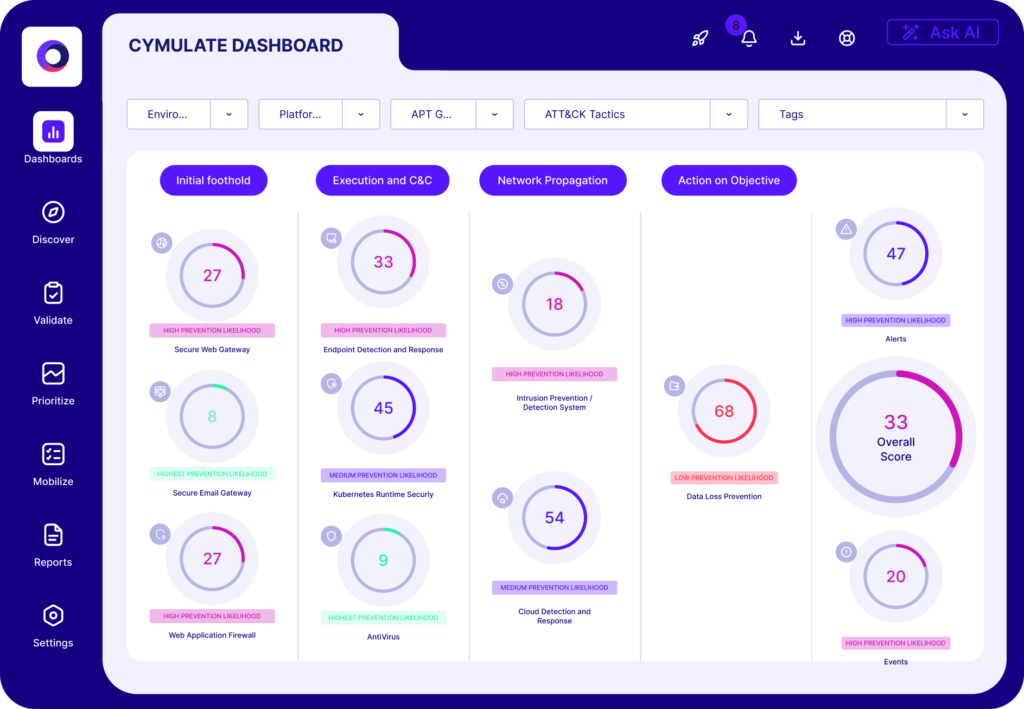
  • Automating security assessments: The platform conducts continuous, automated tests to evaluate the performance of security controls, ensuring they meet required standards.  
  • Providing actionable insights: After each assessment, Cymulate delivers detailed reports with remediation guidance, enabling security teams to address identified gaps promptly.  
cymulate dashboard

Identify gaps in detection capabilities 

Undetected vulnerabilities can slow down threat detection. Cymulate helps close these gaps by simulating real-world attacks, testing how well an organization detects and responds to threats. It also highlights detection failures by analyzing simulation results, pinpointing weak spots in security defenses. This insight allows teams to strengthen their detection mechanisms and improve overall security. 

Automate breach and attack simulations for faster insights 

Timely insights into security weaknesses are essential for rapid response. Cymulate accelerates this process through:  

  • Automated breach and attack simulations: The platform continuously runs simulations that replicate the latest threats, providing immediate feedback on security posture.  
  • Enhancing security operations centers (SOCs) efficiency: By automating routine testing, Cymulate frees up SOCs to focus on addressing critical issues, thereby reducing MTTD.  

Incorporating Cymulate into your security strategy ensures continuous threat validation, early detection of vulnerabilities, and swift insights through automation—all contributing to a reduced MTTD and a stronger security framework. 

Book a Demo