
Frequently Asked Questions

Security Control Validation Basics

What is security control validation?

Security control validation is the process of ensuring that security controls—such as firewalls, email gateways, endpoint and cloud security—are correctly implemented, configured, and able to mitigate risks as expected. It helps organizations identify potential problems with their security posture and address vulnerabilities detected during validation. (Source: Cymulate Security Control Validation Glossary)

Why is security control validation important for organizations?

Security control validation is crucial because investing in security controls does not automatically guarantee protection. Validation empowers organizations to maximize the effectiveness of their existing tools, continuously improve by implementing new detection rules, and ensure that controls are mitigating risks as intended. Without validation, organizations remain susceptible to risks such as financial loss, operational impact, and data leakage. (Source: Cymulate Security Control Validation Glossary)

What types of security controls should be validated?

All security controls should be continuously validated and tested, including email controls (phishing, malware detection), web controls (malicious links and payloads), network controls (firewalls, intrusion detection), endpoint controls (protection against targeted attacks), cloud controls (security gaps in cloud architecture), SIEM observability (detection and response), and data exfiltration protections. (Source: Cymulate Security Control Validation Glossary)

How are security controls tested and validated?

Security controls can be tested either by suffering a real attack or by simulating one. Manual methods include penetration testing and red teaming, where ethical hackers simulate attacks to identify weaknesses. Automated platforms like breach and attack simulation (BAS) tools provide ongoing assessments by simulating attack scenarios in controlled environments, ensuring controls are effective against evolving threats. (Source: Cymulate Security Control Validation Glossary)

What are the main benefits of automated security control validation?

Automated security control validation provides real-time insights, cost efficiency by reducing manual testing, consistency and reliability, adaptability to new threats, and improved compliance through continuous evidence of control effectiveness. (Source: Cymulate Security Control Validation Glossary)

How does security control validation differ from penetration testing and red teaming?

Penetration testing and red teaming are manual, resource-intensive, and provide point-in-time results. Security control validation is automated, continuous, and ensures key controls are tested and optimized regularly, providing ongoing visibility and improvement rather than a one-time snapshot. (Source: Cymulate Security Control Validation Glossary)

What risks remain if security controls are not continuously validated?

Without continuous validation, organizations remain susceptible to financial loss, operational impact, downtime, brand erosion, data leakage, and exploitation—even if they have invested in advanced security solutions. (Source: Cymulate Security Control Validation Glossary)

How does security control validation help manage drift in IT environments?

Security control validation helps detect and manage unknown changes to policies, controls, and applications—especially in dynamic cloud environments—by maintaining visibility and preventing potential ripple effects from undetected changes. (Source: Cymulate Security Control Validation Glossary)

How does security control validation support compliance efforts?

Continuous validation provides ongoing evidence of security control effectiveness, helping organizations maintain compliance with regulatory standards and frameworks. (Source: Cymulate Security Control Validation Glossary)

What are the key takeaways for organizations considering security control validation?

Key takeaways include the need for continuous testing and validation, the ability to optimize existing tools, measure improvements over time, and manage drift in dynamic environments. Automated validation is essential for staying ahead of evolving threats and maintaining a strong security posture. (Source: Cymulate Security Control Validation Glossary)

Features & Capabilities

What features does Cymulate offer for security control validation?

Cymulate offers continuous threat validation, a unified platform combining Breach and Attack Simulation (BAS), Continuous Automated Red Teaming (CART), and Exposure Analytics, attack path discovery, automated mitigation, AI-powered optimization, complete kill chain coverage, and an extensive threat library with over 100,000 attack actions updated daily. (Source: Cymulate Platform)

Does Cymulate integrate with other security technologies?

Yes, Cymulate integrates with a wide range of security technologies, including Akamai Guardicore, AWS GuardDuty, BlackBerry Cylance OPTICS, Carbon Black EDR, Check Point CloudGuard, Cisco Secure Endpoint, CrowdStrike Falcon, Wiz, SentinelOne, and more. For a complete list, visit the Partnerships and Integrations page. (Source: Cymulate Integrations)

How does Cymulate help organizations prioritize exposures?

Cymulate validates exploitability and ranks exposures based on prevention and detection capabilities, business context, and threat intelligence, enabling organizations to focus on the most critical vulnerabilities. (Source: EM Platform Message Guide.pdf)

What is the Cymulate threat library?

The Cymulate threat library is an advanced collection of over 100,000 attack actions aligned to MITRE ATT&CK, updated daily to ensure organizations can test against the latest threats. (Source: Cymulate Platform)

How does Cymulate support continuous improvement in security posture?

Cymulate enables organizations to set a baseline for their security posture, measure improvements over time, and implement new detection rules for emerging threats, ensuring ongoing optimization of security controls. (Source: Cymulate Security Control Validation Glossary)

What are the operational efficiency benefits of using Cymulate?

Cymulate automates processes, leading to a 60% increase in team efficiency and saving up to 60 hours per month in testing new threats. (Source: Cymulate Threat Resilience)

How quickly can Cymulate validate threats compared to manual methods?

Cymulate validates threats up to 40 times faster than manual methods, enabling organizations to respond rapidly to emerging risks. (Source: Cymulate Threat Resilience)

What is the implementation process for Cymulate?

Cymulate is designed for easy implementation, operating in agentless mode without the need for additional hardware or complex configurations. Customers can start running simulations almost immediately after deployment. (Source: manual, customer testimonials)

How easy is Cymulate to use for new users?

Cymulate is praised for its intuitive, user-friendly interface and dashboard. Customers report that it is easy to implement and use, with actionable insights available after just a few clicks. (Source: Customer Testimonials)

Use Cases & Benefits

Who can benefit from security control validation with Cymulate?

Cymulate is designed for CISOs, security leaders, SecOps teams, red teams, and vulnerability management teams in organizations of all sizes and industries, including finance, healthcare, retail, media, transportation, and manufacturing. (Source: EM Platform Message Guide.pdf, CISO/CIO Page)

What problems does Cymulate solve for security teams?

Cymulate addresses overwhelming threat volumes, lack of visibility, unclear risk prioritization, and resource constraints by providing continuous threat validation, exposure prioritization, improved resilience, operational efficiency, and collaboration across teams. (Source: EM Platform Message Guide.pdf)

How does Cymulate help organizations with fragmented security tools?

Cymulate integrates exposure data and automates validation, providing a unified view of the security posture and addressing gaps caused by disconnected tools. (Source: manual)

How does Cymulate support organizations facing resource constraints?

Cymulate automates manual processes, improving efficiency and operational effectiveness for security teams that are stretched thin. (Source: manual)

How does Cymulate help with risk prioritization?

Cymulate validates and prioritizes exposures based on exploitability, business context, and threat intelligence, enabling teams to focus on the most urgent vulnerabilities. (Source: EM Platform Message Guide.pdf)

What are some real-world results achieved with Cymulate?

Customers have reported measurable outcomes such as a 52% reduction in critical exposures, a 60% increase in team efficiency, and an 81% reduction in cyber risk within four months. (Source: Hertz Israel Case Study)

Are there case studies demonstrating Cymulate's effectiveness?

Yes, for example, Hertz Israel reduced cyber risk by 81% in four months, and a sustainable energy company scaled penetration testing cost-effectively with Cymulate. More case studies are available on the Cymulate Customers page.

How does Cymulate address cloud security validation?

Cymulate secures hybrid and cloud infrastructures through automated compliance and regulatory testing, helping organizations manage new attack surfaces and validation challenges introduced by the cloud. (Source: manual)

How does Cymulate help with post-breach recovery?

Cymulate enhances visibility and detection capabilities after a breach, ensuring faster recovery and improved protection by replacing manual processes with automated validation. (Source: manual, Nedbank Case Study)

Pricing & Plans

What is Cymulate's pricing model?

Cymulate operates on a subscription-based pricing model tailored to each organization's requirements. Pricing depends on the chosen package, number of assets, and scenarios selected for testing and validation. For a detailed quote, schedule a demo with the Cymulate team. (Source: manual)

Competition & Comparison

How does Cymulate differ from other security validation platforms?

Cymulate stands out with its unified platform combining BAS, CART, and Exposure Analytics, continuous 24/7 threat validation, AI-powered optimization, complete kill chain coverage, ease of use, and proven customer results. It also offers the most advanced threat library with daily updates. (Source: Cymulate vs Competitors)

What advantages does Cymulate offer for different user segments?

CISOs benefit from quantifiable metrics and strategic alignment, SecOps teams gain operational efficiency, red teams access automated offensive testing, and vulnerability management teams can automate validation and prioritization. (Source: CISO/CIO Page, SecOps Page, Red Teaming Page, Vulnerability Management Page)

Security & Compliance

What security and compliance certifications does Cymulate hold?

Cymulate holds SOC2 Type II, ISO 27001:2013, ISO 27701, ISO 27017, and CSA STAR Level 1 certifications, demonstrating adherence to industry-leading security and privacy standards. (Source: Security at Cymulate)

How does Cymulate ensure data security and privacy?

Cymulate uses encryption for data in transit (TLS 1.2+) and at rest (AES-256), hosts data in secure AWS data centers, and follows a strict Secure Development Lifecycle (SDLC) with continuous vulnerability scanning and annual third-party penetration tests. (Source: Security at Cymulate)

Is Cymulate GDPR compliant?

Yes, Cymulate incorporates data protection by design and has a dedicated privacy and security team, including a Data Protection Officer (DPO) and Chief Information Security Officer (CISO), ensuring GDPR compliance. (Source: Security at Cymulate)

Support & Resources

What support options are available for Cymulate customers?

Cymulate offers email support, real-time chat support, a knowledge base with technical articles and videos, webinars, e-books, and an AI chatbot for quick answers and summaries. (Source: manual)

Does Cymulate provide educational resources like a blog, glossary, or resource hub?

Yes, Cymulate provides a Resource Hub, blog, and a continuously updated cybersecurity glossary. These resources offer insights, thought leadership, and explanations of cybersecurity terms. (Source: Resource Hub, Blog, Glossary)

Where can I find a glossary of cybersecurity terms?

You can find a glossary of cybersecurity terms, acronyms, and jargon on the Cymulate glossary page, which is continuously updated. (Source: Glossary)

Where can I find Cymulate's case studies and reports?

Cymulate's case studies and reports are available in the Resource Hub and on the Customers page. Notable reports include the Threat Exposure Validation Impact Report 2025. (Source: Resource Hub, Customers)

Company & Vision

What is Cymulate's mission and vision?

Cymulate's mission is to transform cybersecurity practices by enabling organizations to proactively validate their defenses, identify vulnerabilities, and optimize their security posture. The vision is to create a collaborative environment for lasting improvements in cybersecurity strategies. (Source: About Us)

What is Cymulate's track record and market recognition?

Cymulate is recognized as a market leader in automated security validation by Frost & Sullivan and was named a Customers' Choice in the 2025 Gartner Peer Insights. (Source: Press Release, Gartner Choice Blog)

Cymulate named a Customers' Choice in 2025 Gartner® Peer Insights™
Learn More
New Case Study: Credit Union Boosts Threat Prevention & Detection with Cymulate
Learn More
New Research: Cymulate Research Labs Discovers Token Validation Flaw
Learn More
An Inside Look at the Technology Behind Cymulate
Learn More

Security Control Validation Explained: Ensuring Your Cyber Defenses Actually Work

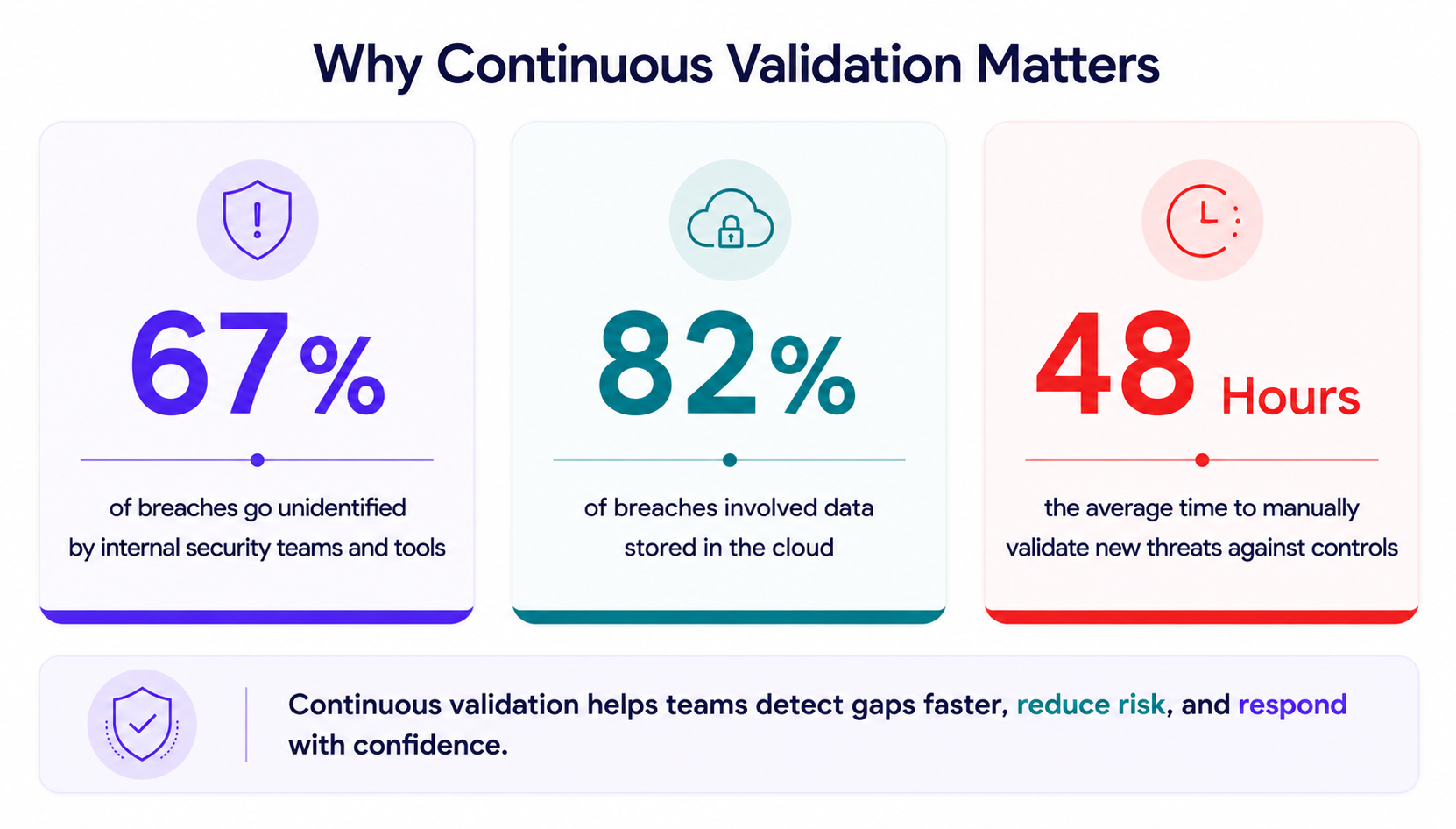
Global spending on cybersecurity is nearly $200 billion annually, with software and security controls accounting for about half. However, investing in security controls does not automatically mean your security is under control. Security control validation empowers organizations to maximize the effectiveness of their existing security tools while continuously improving by implementing new detection rules to counter the latest threats.

What is security control validation?

Security control validation is not a tool or a framework, but rather the process of making sure that security controls such as firewalls, email gateways, data exfiltration, endpoint and cloud security etc., are correctly implemented, configured, and able to mitigate risks as expected. It’s a way for organizations to identify potential problems with their security posture and mitigate potential vulnerabilities detected in the validation process.
security control validation breaches

How are security controls tested and validated?

There are two main ways to find out if your security controls are working as they should: you can suffer an attack, or you can simulate one.

Manual methods, including penetration testing and red teaming, involve ethical hackers and security professionals simulating attacks to identify weaknesses and evaluate the effectiveness of defense mechanisms.

Security validation platforms such as breach and attack simulation (BAS) tools provide ongoing assessments by simulating attack scenarios in controlled environments.

With a breach and attack simulation, you’re testing whether the controls are set up and working properly in an environment that is dynamic and constantly changing, as the threat landscape ebbs and flows, and as threat actors become more sophisticated with new techniques.

What controls are validated?

All security controls an organization has in place should be continuously validated and tested to ensure their effectiveness and to identify potential problems. These controls include:

  • Email controls: Are your email servers capable of detecting a phishing, malware or social engineering attack?
  • Web controls: Are your web gateways and proxies up to the task of preventing or detecting malicious links and payloads?
  • Network controls: Can you confirm that your firewalls are optimally designed to guard against a malicious actor? This might include validating that detection systems are robust enough to guard against intrusive activity.
  • Endpoint controls: Will your endpoints survive a targeted attack from a sophisticated threat actor?
  • Cloud controls: Does your cloud architecture contain security gaps and redundancies that could provide a portal for malicious actors to steal or exploit your vital assets?
  • SIEM observability: Can your security operations team detect and respond to malicious activity in your environment?
  • Data exfiltration: Are you confident that your critical and sensitive data is protected from unauthorized access?

Security control validation vs pen-testing and red teaming

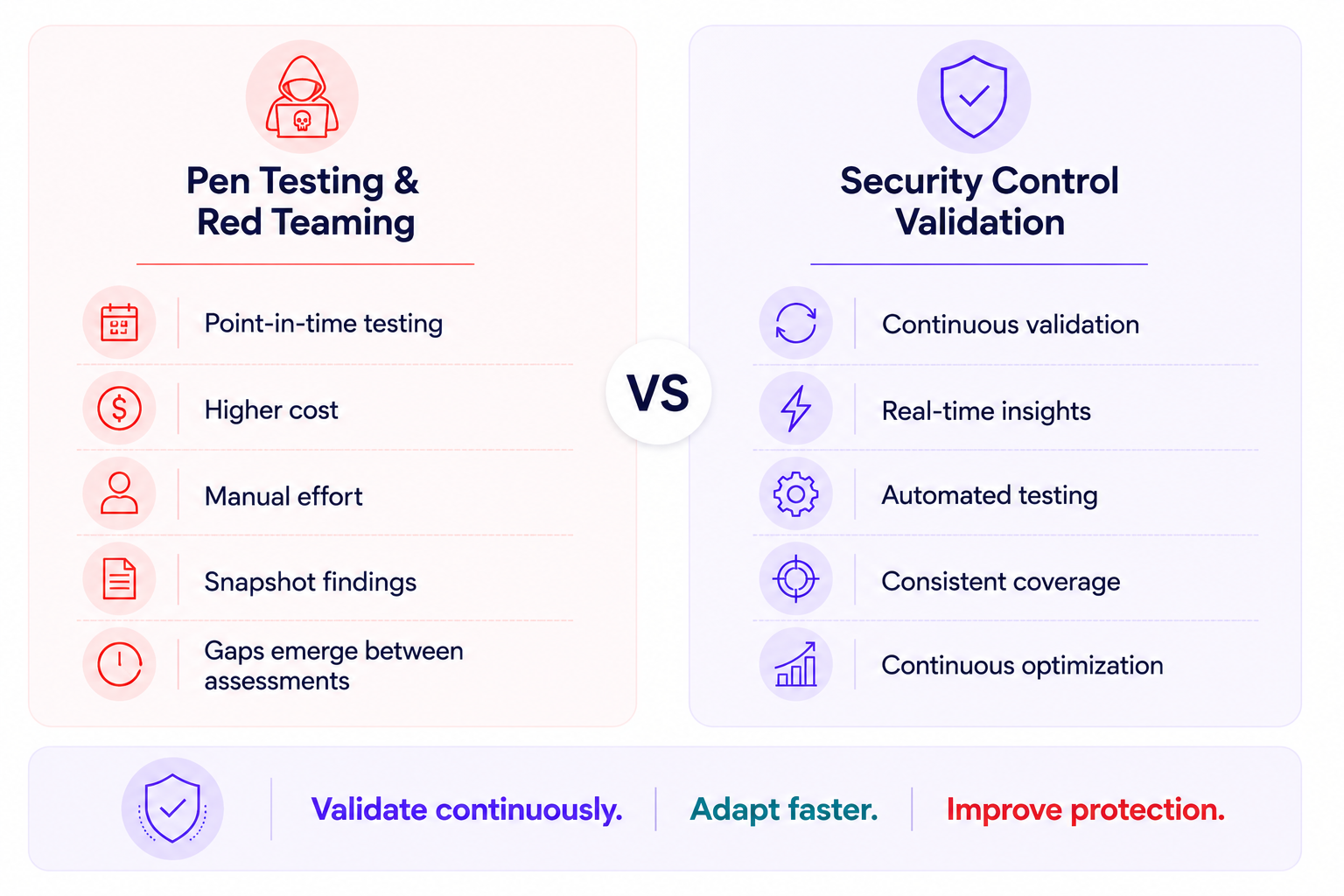
Manual cyber security testing methods such as pen-testing and red teaming are often resource-intensive and expensive. The results of pen-testing and red teaming tend to only reflect threats discovered at a set point in time or related to a specific security control or vulnerability.

While ticking through the list of misconfigurations, malicious payloads and links from the last report, new ones will likely emerge – and could go undetected for months. All of this means that you may not be as secure today as you were six months ago.

Security Control Validation, on the other hand, is automated and ensures key security controls in your environment are tested and validated on a continuous basis while optimizing the controls for better protection. Some of the key benefits are:

  • Real-Time Insights: Automated security control validation provides real-time insights into the effectiveness of security measures, allowing for prompt identification and remediation of vulnerabilities.
  • Cost Efficiency: By automating the validation process, organizations can reduce the need for frequent, costly manual testing, thus optimizing their security budgets.
  • Consistency and Reliability: Automated validation ensures that security controls are consistently and reliably tested, minimizing the risk of human error and oversight.
  • Adaptability: As new threats emerge, automated systems can quickly adapt by updating detection rules and validation procedures, ensuring that security measures are always current and effective.
  • Improved Compliance: Continuous validation helps organizations maintain compliance with regulatory standards by providing ongoing evidence of security control effectiveness.
security control validation

Key Takeaways

Even if the most expensive endpoint and cloud solutions have been deployed, without continuous testing and validation of security controls and running breach-and-attack simulations, there is still susceptibility to risks such as financial loss, operational impact and downtime, brand erosion, data leakage and exploitation, and more.

Security Control Validation is the answer to manual, point-in-time pen-testing. It’s automated and ensures key security controls are tested and validated on a continuous basis while optimizing the controls for better protection. It allows organizations to: 

  1. Optimize what you have. Security Control Validation enables making the most of the tools already in place while continuing to make improvements on a consistent basis by implementing new detection rules for the latest threats. This also applies to MSPs. 
  2. Measure continuous improvements. Understand the current security posture and identify areas needing improvement. Set a baseline of how secure the organization is today and measure changes and improvements over time. This can be impacted by factors like the efficacy of tools and the changing threat landscape.  
  3. Manage Drift. The IT environment, including controls, doesn’t remain static, especially in the cloud. With the constantly changing threat landscape, it’s crucial to maintain visibility to detect and manage any unknown changes to policies, controls, and applications, preventing potential ripple effects if left undetected. 
Book a Demo