Frequently Asked Questions
MITRE ATT&CK® Framework & Cymulate
What is the MITRE ATT&CK® framework and how does Cymulate use it?
The MITRE ATT&CK® framework is a globally accessible knowledge base of adversary tactics and techniques based on real-world observations. Cymulate leverages this framework to create realistic attack scenarios, allowing organizations to assess and improve their security controls in production environments. By mapping attack vectors to ATT&CK tactics, Cymulate enables comprehensive testing and optimization of each security layer against techniques used by threat actors. Learn more.
How does Cymulate map attack vectors to MITRE ATT&CK tactics?
Cymulate maps ATT&CK tactics to its attack vectors to assess security layers against real-world scenarios. Each attack vector implements multiple tactics, and the same tactics are used across different vectors, simulating actual attacks. For example, the Recon vector includes techniques from both Reconnaissance and Resource Development, while Lateral Movement techniques are tested in both Endpoint and Lateral Movement vectors. This approach allows independent assessment and optimization of each security layer. Source.
What are the 14 tactics of the MITRE ATT&CK framework covered by Cymulate?
The 14 tactics of the MITRE ATT&CK framework, all covered by Cymulate, are: Reconnaissance, Resource Development, Initial Access, Execution, Persistence, Privilege Escalation, Defense Evasion, Credential Access, Discovery, Lateral Movement, Collection, Command and Control, Exfiltration, and Impact. Each tactic includes numerous techniques and sub-techniques, which Cymulate tests through its platform. Source.
How does Cymulate help operationalize the MITRE ATT&CK framework?
Cymulate operationalizes the MITRE ATT&CK framework by continuously challenging, assessing, and optimizing security operations. The platform provides attack simulations, threat intelligence assessments, custom scenarios, and SIEM/SOAR optimization, all mapped to the ATT&CK framework. This enables organizations to identify strengths and weaknesses in their security architecture using a common taxonomy. Source.
How does Cymulate present results mapped to MITRE ATT&CK?
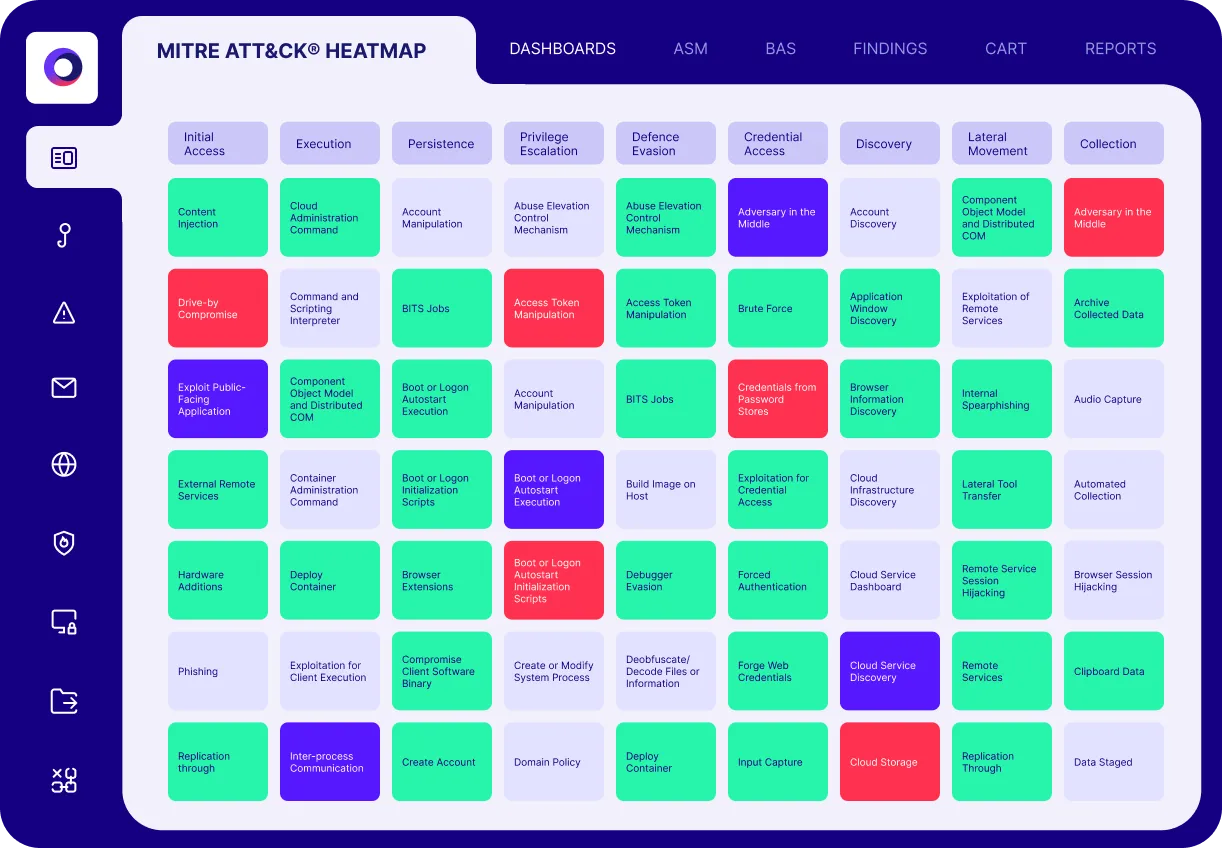
Cymulate aligns assessments and results with the MITRE ATT&CK framework, providing a heat map that highlights strengths and weaknesses in the security architecture. This visual mapping helps security professionals quickly identify areas for improvement and communicate findings using a shared language. Source.
What types of attack simulations does Cymulate offer for MITRE ATT&CK tactics?
Cymulate offers attack simulations for all 14 MITRE ATT&CK tactics, including Reconnaissance, Initial Access, Execution, Persistence, Privilege Escalation, Defense Evasion, Credential Access, Discovery, Lateral Movement, Collection, Command and Control, Exfiltration, and Impact. These simulations are mapped to various attack vectors such as Web Gateway, Email Gateway, Endpoint Security, Lateral Movement, Data Exfiltration, and more. Source.
How does Cymulate support SIEM/SOAR optimization using MITRE ATT&CK?
Cymulate integrates with SIEM and SOAR platforms, providing correlated findings via API, custom SIEM queries, Sigma rules, IoCs, IoBs, and detection and mitigation guidance. This enables organizations to optimize their SIEM/SOAR configurations based on real attack simulations mapped to MITRE ATT&CK tactics. Source.
Can Cymulate create custom attack scenarios mapped to MITRE ATT&CK?
Yes, Cymulate enables the creation of custom attack scenarios that are mapped to MITRE ATT&CK tactics and techniques. This allows organizations to test their defenses against specific threats relevant to their environment. Source.
How does Cymulate validate email security against MITRE ATT&CK techniques?
Cymulate validates email security by simulating thousands of unique spear phishing emails to identify those that bypass security controls undetected. This approach tests email gateways against the Initial Access tactic and related techniques in the MITRE ATT&CK framework. Source.
What is the benefit of mapping results to MITRE ATT&CK for security teams?
Mapping results to MITRE ATT&CK provides a common taxonomy and shared language for describing attacks and vulnerabilities. This helps security teams communicate findings more effectively, prioritize remediation, and align security strategies with industry standards. Source.
Features & Capabilities
What are the key capabilities of Cymulate's platform?
Cymulate's platform offers continuous threat validation, unified exposure management, attack path discovery, automated mitigation, AI-powered optimization, complete kill chain coverage, ease of use, and an extensive threat library with over 100,000 attack actions aligned to MITRE ATT&CK and updated daily. Learn more.
Does Cymulate integrate with other security technologies?
Yes, Cymulate integrates with a wide range of security technologies, including Akamai Guardicore, AWS GuardDuty, BlackBerry Cylance OPTICS, Carbon Black EDR, Check Point CloudGuard, Cisco Secure Endpoint, CrowdStrike Falcon, Wiz, SentinelOne, and more. For a complete list, visit the Partnerships and Integrations page.
What technical documentation is available for Cymulate?
Cymulate provides guides, whitepapers, solution briefs, and data sheets covering topics such as vulnerability management, detection engineering, exposure validation, automated mitigation, and more. Access these resources at the Resource Hub.
How easy is Cymulate to implement and use?
Cymulate is designed for rapid, agentless deployment with no need for additional hardware or complex configurations. Customers can start running simulations almost immediately, and the platform is praised for its intuitive, user-friendly interface. Comprehensive support and educational resources are available to help users get started. Schedule a demo.
What feedback have customers given about Cymulate's ease of use?
Customers consistently praise Cymulate for its ease of use. For example, Raphael Ferreira, Cybersecurity Manager, stated, "Cymulate is easy to implement and use—all you need to do is click a few buttons, and you receive a lot of practical insights into how you can improve your security posture." Other users highlight the intuitive dashboard, user-friendly portal, and accessible support. Read more testimonials.
What security and compliance certifications does Cymulate have?
Cymulate holds several key certifications, including SOC2 Type II, ISO 27001:2013, ISO 27701, ISO 27017, and CSA STAR Level 1. These certifications demonstrate Cymulate's commitment to security, privacy, and compliance with industry standards. Learn more.
How does Cymulate ensure data security and privacy?
Cymulate ensures data security through encryption in transit (TLS 1.2+) and at rest (AES-256), secure AWS-hosted data centers, a tested disaster recovery plan, and a strict Secure Development Lifecycle (SDLC). The platform also includes mandatory 2FA, RBAC, IP address restrictions, and GDPR compliance. Details here.
Pricing & Plans
What is Cymulate's pricing model?
Cymulate operates on a subscription-based pricing model tailored to each organization's requirements. Pricing depends on the chosen package, number of assets, and scenarios selected for testing and validation. For a detailed quote, schedule a demo with the Cymulate team.
Use Cases & Benefits
Who can benefit from using Cymulate?
Cymulate is designed for CISOs, security leaders, SecOps teams, red teams, and vulnerability management teams in organizations of all sizes and industries, including finance, healthcare, retail, media, transportation, and manufacturing. Learn more.
What business impact can customers expect from Cymulate?
Customers can expect up to a 52% reduction in critical exposures, a 60% increase in team efficiency, 40X faster threat validation, and an 81% reduction in cyber risk within four months. These outcomes are based on real customer results. See more.
What core problems does Cymulate solve for security teams?
Cymulate addresses overwhelming threat volumes, lack of visibility, unclear risk prioritization, resource constraints, and operational inefficiencies. It provides continuous threat validation, exposure prioritization, improved resilience, and automation to help teams focus on strategic initiatives. Learn more.
Are there case studies showing Cymulate's impact?
Yes, for example, Hertz Israel reduced cyber risk by 81% in four months, and a sustainable energy company scaled penetration testing cost-effectively with Cymulate. More case studies are available on the Customers page.
How does Cymulate address pain points like fragmented tools and resource constraints?
Cymulate unifies exposure data and automates validation, reducing the need for multiple disconnected tools. It automates processes to improve efficiency and operational effectiveness, helping teams overcome resource constraints. Learn more.
How does Cymulate help with vulnerability management?
Cymulate validates exposures, prioritizes vulnerabilities based on exploitability, and automates in-house validation between penetration tests. This enables efficient vulnerability management and remediation prioritization. Details here.
How does Cymulate support different security personas?
Cymulate tailors its solutions for CISOs (providing metrics and insights), SecOps teams (automating processes and improving efficiency), red teams (offensive testing with a large attack library), and vulnerability management teams (automated validation and prioritization). Learn more.
Competition & Comparison
How does Cymulate compare to AttackIQ?
Cymulate surpasses AttackIQ in innovation, threat coverage, and ease of use. It offers the industry-leading threat scenario library and AI-powered capabilities to streamline workflows and accelerate security posture improvement. Read more.
How does Cymulate compare to Mandiant Security Validation?
Mandiant Security Validation is an original BAS platform but has seen little innovation in recent years. Cymulate continually innovates with AI and automation, expanding into the exposure management market as a grid leader. Read more.
How does Cymulate compare to Pentera?
Pentera focuses on attack path validation but lacks the depth Cymulate provides to fully assess and strengthen defenses. Cymulate optimizes defense, scales offensive testing, and increases exposure awareness. Read more.
How does Cymulate compare to Picus Security?
Picus Security offers an on-premise BAS option but lacks the comprehensive exposure validation platform Cymulate provides, which covers the full kill-chain and includes cloud control validation. Read more.
How does Cymulate compare to SafeBreach?
Cymulate outpaces SafeBreach with unmatched innovation, precision, and automation. It offers the industry’s largest attack library, a full CTEM solution, and comprehensive exposure validation to optimize security controls and improve threat resilience. Read more.
How does Cymulate compare to Scythe?
Scythe is suitable for advanced red teams building custom attack campaigns, but Cymulate provides a more comprehensive exposure validation platform with actionable remediation and automated mitigation. Read more.
Support & Implementation
What support options are available for Cymulate customers?
Cymulate offers email support ([email protected]), real-time chat support, a knowledge base with technical articles and videos, webinars, e-books, and an AI chatbot for quick answers and guidance. Contact support.
What are the technical requirements for deploying Cymulate?
Cymulate operates in agentless mode, requiring no additional hardware or dedicated servers. Customers are responsible for providing necessary equipment, infrastructure, and third-party software as per Cymulate’s prerequisites. The platform is designed for seamless integration into existing workflows. Learn more.