Frequently Asked Questions
Product Information & Exposure Validation Overview
What is Cymulate Exposure Validation?
Cymulate Exposure Validation is an automated solution that continuously tests your organization's defenses across the full cyber kill chain using the latest adversarial techniques. It provides empirical proof of threat resilience through live, offensive testing powered by Breach and Attack Simulation (BAS) and Continuous Automated Red Teaming (CART).
How does Cymulate Exposure Validation work?
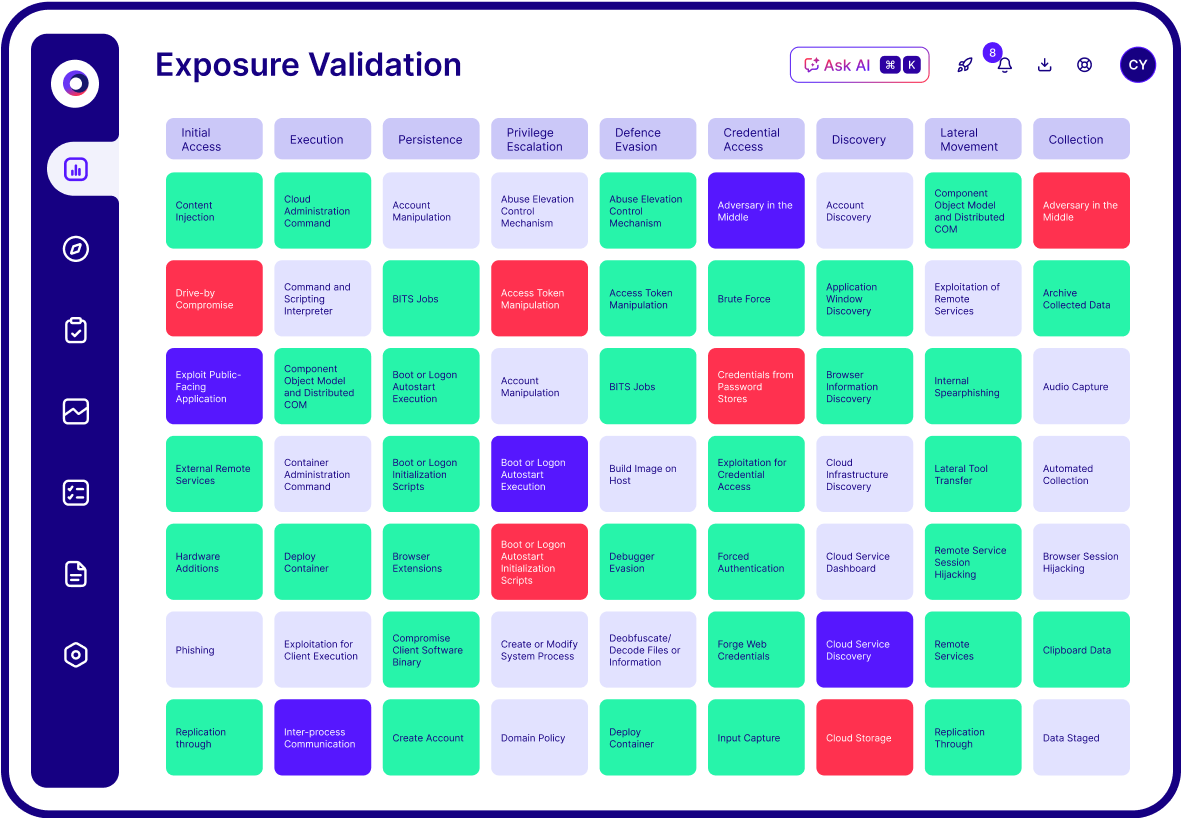
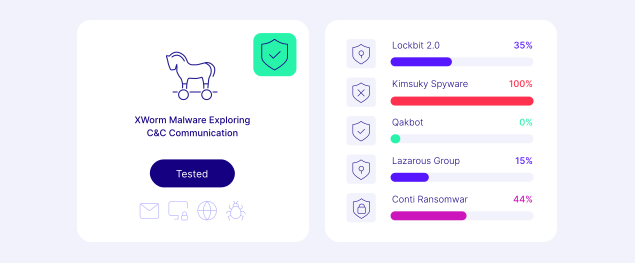
The platform automates real-world attack scenarios to evaluate your security posture and verify defenses against the latest threats. It uses both pre- and post-exploitation simulations to test detection and runtime security controls across endpoints, identities, networks, and cloud environments.
What is the primary purpose of exposure validation?
The primary purpose is to help organizations proactively validate their cybersecurity defenses, identify vulnerabilities, and optimize their security posture before an attack occurs. It enables teams to stay ahead of emerging threats and improve overall resilience.
How does exposure validation differ from exposure management?
Exposure management is a broad strategy that includes identifying, assessing, prioritizing, and mitigating exposures. Exposure validation is a tactical, evidence-based component that confirms whether detected exposures are exploitable and if defenses respond effectively, providing actionable insights for risk decisions.
What technologies power Cymulate Exposure Validation?
Cymulate Exposure Validation is powered by Breach and Attack Simulation (BAS) and Continuous Automated Red Teaming (CART), enabling automated, scalable, and realistic security validation using real-world techniques.
How does Cymulate Exposure Validation support cloud security?
Cymulate provides both pre- and post-exploitation simulations to test and validate threat detection and runtime security controls for different layers of your cloud architecture, helping organizations optimize their cloud defenses.
What is the difference between automated pen testing and exposure validation?
Automated pen testing provides point-in-time assessments, while exposure validation offers continuous, automated testing with daily updates, ensuring defenses are validated against the latest threats and attack techniques. For more, see the guide The Truth About Pen Testing.
How does exposure validation help with compliance and reporting?
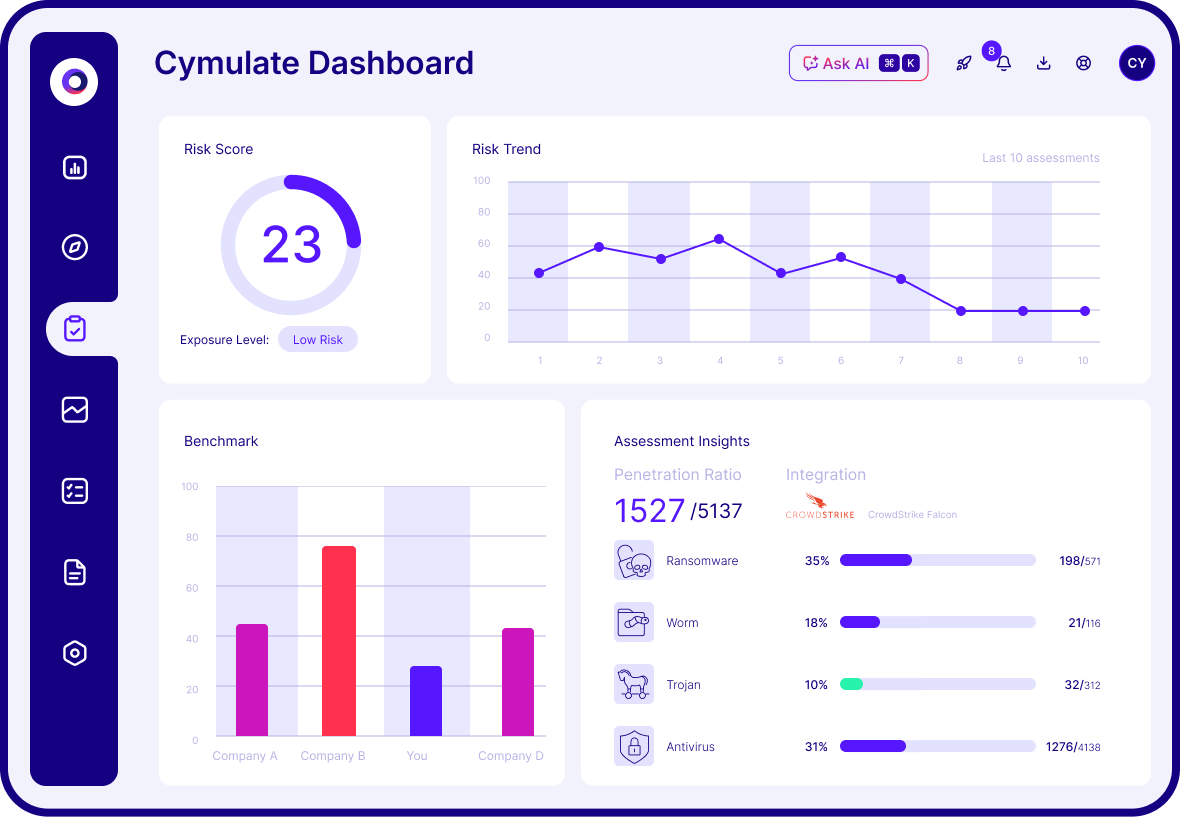
Exposure validation provides operational metrics, board-ready reports, and benchmarking against industry peers, making it easier to demonstrate compliance and communicate risk posture to stakeholders.
How does exposure validation integrate with other Cymulate solutions?
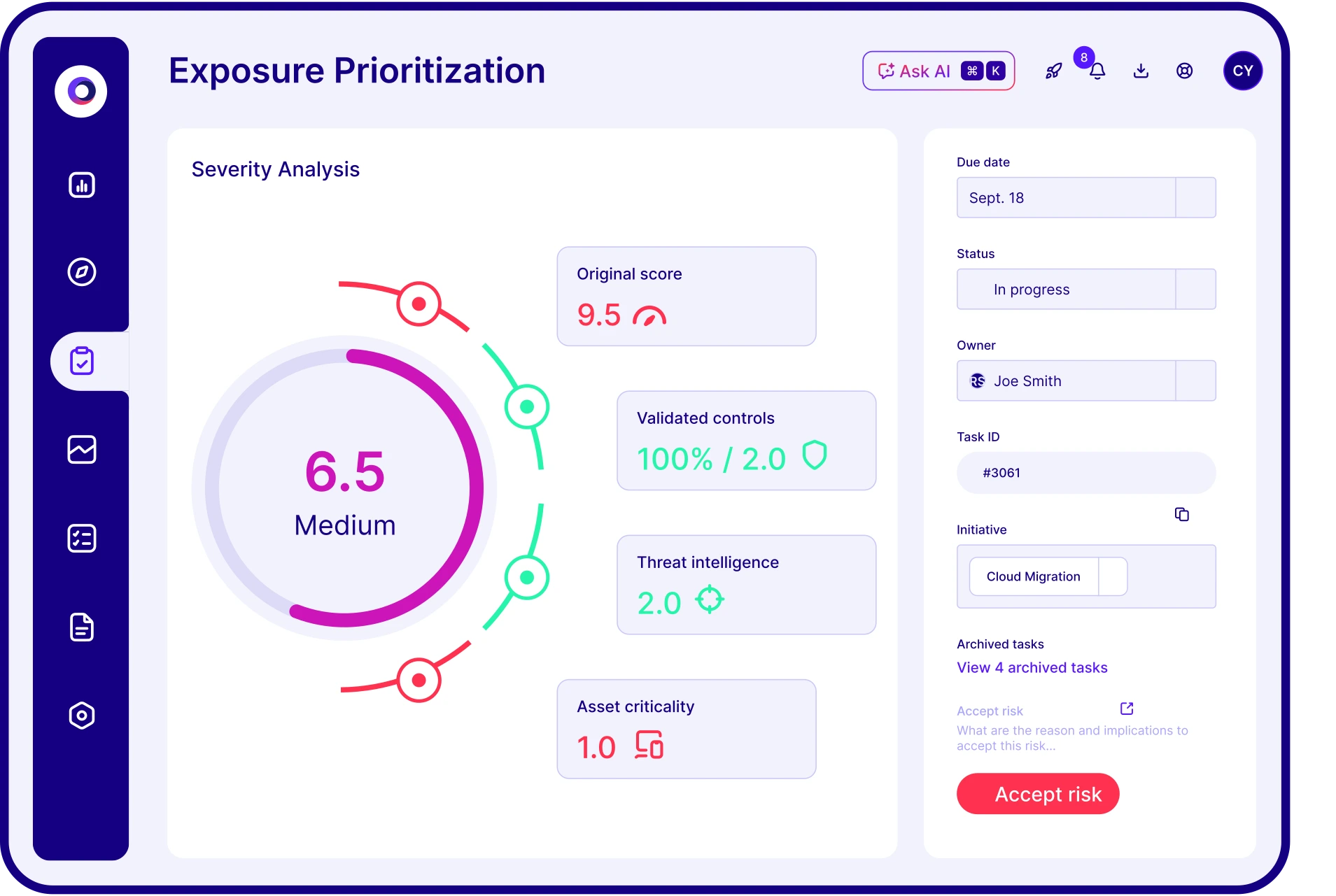
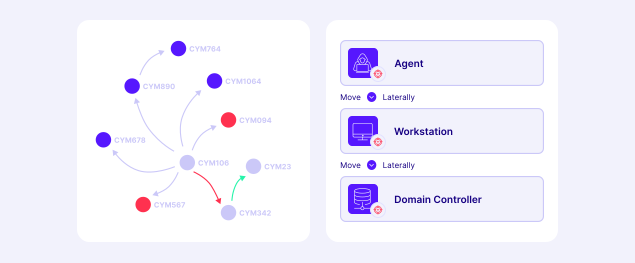
Exposure Validation is a core component of the Cymulate Exposure Management Platform and can be seamlessly expanded to include Exposure Prioritization, Attack Path Discovery, Automated Mitigation, and more for a unified approach to security validation and management.
Where can I find more resources about exposure validation?
You can access the Exposure Validation data sheet, guides, and e-books in the Cymulate Resource Hub. Featured resources include the Exposure Validation Data Sheet, 'The Truth About Pen Testing' guide, and '10 Real-World Exposures' e-book.
Features & Capabilities
What are the key features of Cymulate Exposure Validation?
Key features include automated exposure validation, AI-assisted custom testing, detection and prevention optimization, cyber resilience metrics and benchmarking, and seamless expansion to full exposure management. The platform also supports daily updates of new attacks and campaigns.
How does Cymulate Exposure Validation help optimize threat resilience?
It continuously tests defenses against the latest threats, identifies weaknesses, and provides actionable insights to optimize security controls, resulting in measurable improvements in threat prevention and detection.
How quickly can Cymulate Exposure Validation test new threats?
Cymulate Exposure Validation can automate continuous validation of threats and test new threats in less than one hour, thanks to daily updates of new attacks and campaigns.
What measurable outcomes can organizations expect from using Cymulate Exposure Validation?
Organizations can achieve a 30% increase in threat prevention, a 3X increase in threat detection, and a 60% increase in team efficiency by automating and streamlining critical security tasks.
How does Cymulate Exposure Validation support detection engineering?
It enables organizations to build, test, and tune new threat detections in hours, not weeks, with rules specific to SIEM, EDR, and XDR platforms, accelerating detection engineering and improving mean time to detect.
Does Cymulate Exposure Validation provide benchmarking against industry peers?
Yes, the platform offers cyber resilience metrics and benchmarking, allowing organizations to compare their security posture with industry peers and demonstrate progress to stakeholders.
How does Cymulate Exposure Validation use AI?
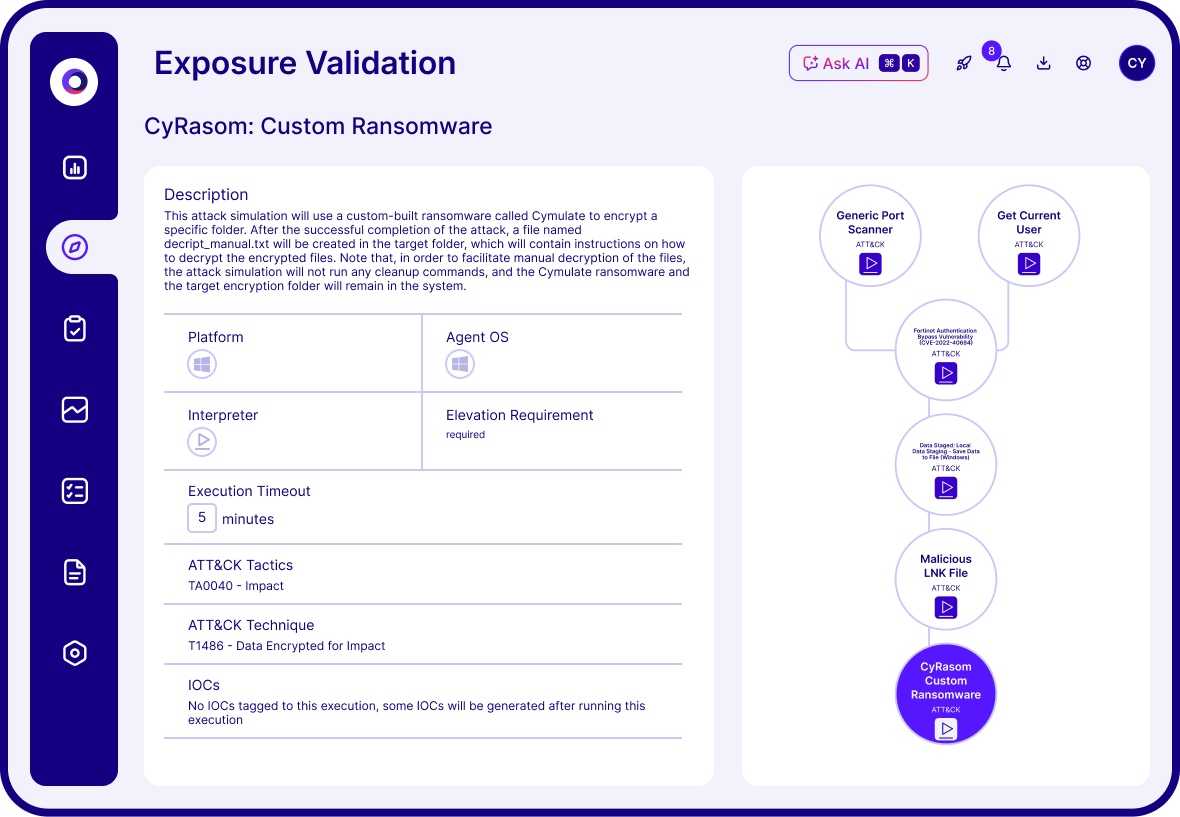
The platform uses AI-assisted custom testing to generate realistic, multi-stage attack chains from user-supplied threat advisories, technical articles, and plain language prompts, enhancing the realism and relevance of simulations.
Can Cymulate Exposure Validation be expanded to full exposure management?
Yes, organizations can upgrade to the complete Cymulate Exposure Management Platform to consolidate validation, prioritization, and mobilization for a unified approach to exposure management.
Use Cases & Benefits
Who can benefit from Cymulate Exposure Validation?
Organizations of all sizes and industries, including finance, healthcare, retail, media, transportation, and manufacturing, can benefit. It is designed for CISOs, security leaders, SecOps teams, red teams, and vulnerability management teams.
How does exposure validation help with red and purple teaming?
Exposure validation measures the effectiveness of both offensive and defensive operations. In red teaming, it confirms whether simulated attacks bypass defenses. In purple teaming, it validates if the blue team detects and responds to attacks in real-time, providing measurable feedback to both teams.
What customer outcomes have been achieved with Cymulate Exposure Validation?
Customers have reported outcomes such as a 52% reduction in critical exposures, a 60% increase in team efficiency, and an 81% reduction in cyber risk within four months. See the Hertz Israel case study for details.
How does exposure validation help organizations with resource constraints?
By automating and streamlining critical and resource-heavy tasks, Cymulate Exposure Validation enables security teams to focus on strategic initiatives, improving operational efficiency and reducing manual workload.
How does exposure validation support vulnerability management?
It validates exposures by confirming exploitability and prioritizes vulnerabilities based on prevention and detection capabilities, business context, and threat intelligence, helping teams focus on the most critical risks.
How does exposure validation help with communication to stakeholders?
It delivers quantifiable metrics and actionable insights, enabling CISOs and security leaders to justify investments, communicate risks, and demonstrate progress to boards and regulators.
What are some real-world use cases for Cymulate Exposure Validation?
Use cases include validating security controls, optimizing threat resilience, accelerating detection engineering, supporting compliance, and enabling continuous threat exposure management. Case studies are available on the Cymulate Customers page.
How does exposure validation help reduce cyber risk?
By identifying and closing security gaps before adversaries can exploit them, exposure validation enables organizations to focus resources on the most exploitable paths, minimizing the attack surface and lowering breach risk.
How does exposure validation improve threat detection?
It continuously tests whether security controls are functioning as intended against real-world attack techniques, helping identify blind spots, misconfigurations, and detection gaps, and enabling teams to fine-tune alerts and improve rule sets for earlier, more accurate threat identification.
Security, Compliance & Integrations
What security and compliance certifications does Cymulate hold?
Cymulate holds SOC2 Type II, ISO 27001:2013, ISO 27701, ISO 27017, and CSA STAR Level 1 certifications, demonstrating adherence to industry-leading security and privacy standards. Details are available on the Security at Cymulate page.
How does Cymulate ensure data security and privacy?
Cymulate uses encryption for data in transit (TLS 1.2+) and at rest (AES-256), hosts data in secure AWS data centers, and follows a strict Secure Development Lifecycle (SDLC) with continuous vulnerability scanning and annual third-party penetration tests. The platform is GDPR-compliant and includes mandatory 2FA, RBAC, and IP address restrictions.
What integrations are available with Cymulate Exposure Validation?
Cymulate integrates with a wide range of security technologies, including Akamai Guardicore, AWS GuardDuty, BlackBerry Cylance OPTICS, Carbon Black EDR, Check Point CloudGuard, Cisco Secure Endpoint, CrowdStrike Falcon, Wiz, SentinelOne, and more. For a full list, visit the Partnerships and Integrations page.
Is Cymulate Exposure Validation GDPR compliant?
Yes, Cymulate incorporates data protection by design, is GDPR-compliant, and has a dedicated privacy and security team, including a Data Protection Officer (DPO) and Chief Information Security Officer (CISO).
How does Cymulate support secure development and HR security?
The platform is developed using a strict Secure Development Lifecycle (SDLC), including secure code training, continuous vulnerability scanning, and annual third-party penetration tests. Employees undergo ongoing security awareness training and phishing tests.
Implementation, Support & Ease of Use
How easy is it to implement Cymulate Exposure Validation?
Cymulate Exposure Validation is designed for quick and easy implementation. It operates in agentless mode, requires no additional hardware or complex configurations, and can be deployed rapidly with minimal resources. Customers can start running simulations almost immediately after deployment.
What support options are available for Cymulate Exposure Validation?
Cymulate offers comprehensive support, including email support ([email protected]), real-time chat support, a knowledge base with technical articles and videos, webinars, e-books, and an AI chatbot for quick answers and guidance.
What feedback have customers given about Cymulate's ease of use?
Customers consistently praise Cymulate for its intuitive, user-friendly interface and ease of use. Testimonials highlight quick implementation, actionable insights, and accessible support. For example, Raphael Ferreira, Cybersecurity Manager, said, "Cymulate is easy to implement and use—all you need to do is click a few buttons, and you receive a lot of practical insights into how you can improve your security posture."
How long does it take to implement Cymulate Exposure Validation?
Implementation is rapid—customers can start running simulations almost immediately after deployment, thanks to agentless operation and minimal setup requirements.
Pricing & Plans
What is Cymulate's pricing model for Exposure Validation?
Cymulate operates on a subscription-based pricing model tailored to each organization's requirements. Pricing depends on the chosen package, number of assets, and scenarios selected. For a detailed quote, schedule a demo with the Cymulate team.
Competition & Differentiation
How does Cymulate Exposure Validation compare to other exposure validation solutions?
Cymulate stands out with its unified platform that integrates BAS, CART, and Exposure Analytics, continuous 24/7 threat validation, AI-powered optimization, and the most advanced library of attack simulations with daily updates. It is recognized for ease of use, measurable outcomes, and rapid innovation.
What industry recognition has Cymulate received?
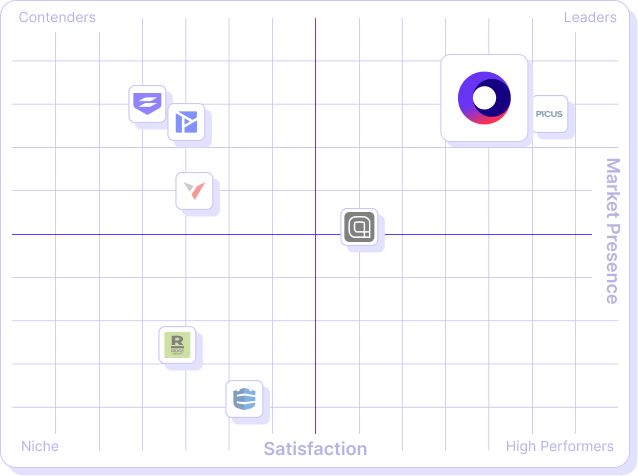
Cymulate has been named a Market Leader for Automated Security Validation by Frost & Sullivan and a Customers' Choice in the 2025 Gartner Peer Insights for Adversarial Exposure Validation. See the Frost & Sullivan press release and Gartner Peer Insights for details.