
Frequently Asked Questions

Ransomware Fundamentals

What is ransomware and how does it work?

Ransomware is a type of malicious software (malware) designed to block access to a computer system or data until a ransom is paid. It can encrypt files, lock access to entire systems, or exfiltrate sensitive data with threats of publication. Ransomware attacks typically involve unbreakable encryption, dead man's switches, and payment demands in cryptocurrency to avoid detection. (Source: Cymulate Ransomware Glossary)

What are the main phases of a ransomware attack lifecycle?

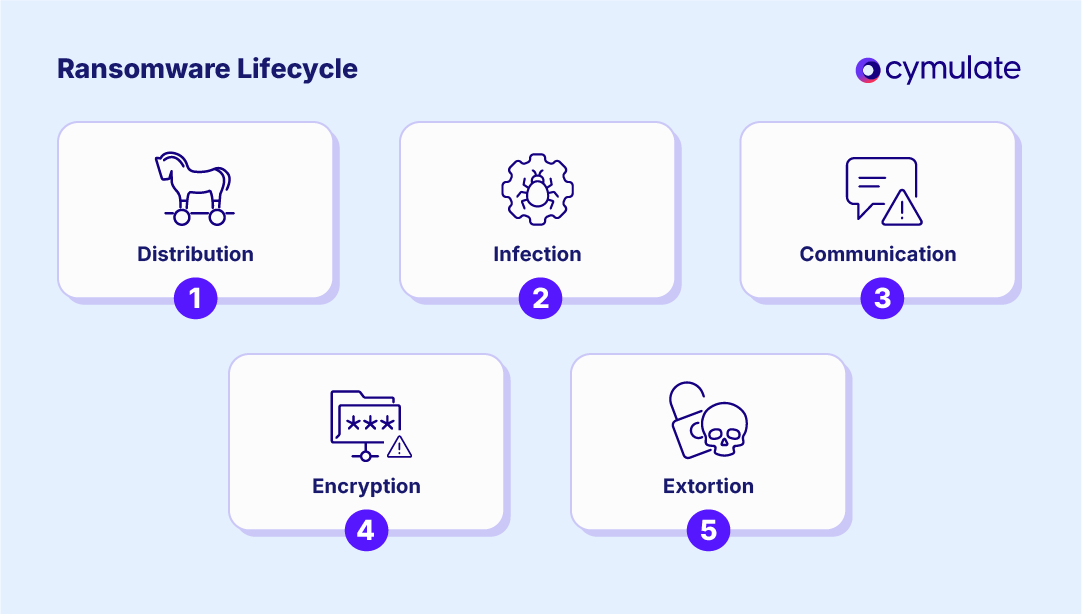
The ransomware attack lifecycle usually follows five phases: Distribution (initial infection), Infection (malware installs and spreads), Communication (contacts attacker and exfiltrates data), Encryption (files are encrypted), and Extortion (ransom demand and threats). (Source: Cymulate Ransomware Glossary)

Why is ransomware considered such an effective cyber threat?

Ransomware is highly effective because it uses unbreakable encryption, dead man's switches (data deletion or leakage if unpaid), evasion techniques to bypass antivirus, and demands payment via anonymous cryptocurrency. These features make recovery difficult and increase pressure on victims to pay. (Source: Cymulate Ransomware Glossary)

What are the most common types of ransomware?

Major ransomware types include Encrypting Ransomware, Locker Ransomware, MBR Ransomware, Scareware, Doxware/Leakware, Wiping Ransomware, and Ransomware as a Service (RaaS). Each type uses different tactics, such as encryption, system locking, blackmail, or data wiping. (Source: Cymulate Ransomware Glossary)

What is the average cost of a ransomware attack?

According to the Sophos State of Ransomware Survey 2024, organizations that paid ransom reported an average payment of million USD, with the average cost of recovery reaching .73 million USD. (Source: Sophos State of Ransomware Survey 2024, cited by Cymulate)

Who are the primary targets of ransomware attacks?

Ransomware attackers target all sectors, with frequent attacks on Banking, Financial Services, Utilities, and Retail. However, every sector is vulnerable, and smaller organizations are especially at risk due to limited cybersecurity resources. (Source: Cymulate Ransomware Glossary)

What are the main impacts of a ransomware attack?

Ransomware attacks can cause business interruption, data loss, legal and regulatory costs, reputational damage, blackmail risks, insurance complications, and complex recovery processes. Even if the ransom is paid, decryption is not guaranteed. (Source: Cymulate Ransomware Glossary)

How do ransomware attackers demand payment?

Attackers typically display a ransom note with payment instructions, often requiring payment in cryptocurrency to avoid traceability. The ransom amount is often tailored to the victim's perceived ability to pay. (Source: Cymulate Ransomware Glossary)

What is Ransomware as a Service (RaaS)?

Ransomware as a Service (RaaS) is an off-the-shelf ransomware software that can be purchased as a service, similar to SaaS for legitimate services. RaaS has enabled many less technically skilled attackers to launch ransomware attacks. (Source: Cymulate Ransomware Glossary)

What best practices help reduce ransomware damage?

Best practices include updating all systems and software, keeping IDS and antivirus up to date, applying least privilege, segmenting networks, avoiding open RDP/SMB ports, using MFA, maintaining encrypted offline backups, and developing incident response playbooks. (Source: Cymulate Ransomware Glossary)

Why is continuous security validation important for ransomware defense?

Annual or biannual penetration testing is no longer sufficient due to evolving threats and rapid infrastructure changes. Continuous security validation tests resilience against real-world ransomware payloads, emulates ransomware behaviors, and identifies detection gaps. (Source: Cymulate Ransomware Glossary)

How does Cymulate help organizations defend against ransomware?

Cymulate provides a platform that simulates the full ransomware kill-chain with production-safe payloads, includes daily threat intelligence updates, evaluates breach feasibility, and provides real-time detection feedback. It runs multi-step attack scenarios, correlates outcomes with detection tools, and generates detailed reports for mitigation and planning. (Source: Cymulate Ransomware Glossary)

What Cymulate modules are relevant for ransomware defense?

Cymulate's XSPM modules relevant for ransomware defense include Red Teaming Automation (end-to-end adversarial campaigns), Breach and Attack Simulation (BAS), Advanced Purple Teaming (custom attack chains on MITRE ATT&CK), and Attack-Based Vulnerability Management (prioritizes patching based on exploitability). (Source: Cymulate Ransomware Glossary)

How does Cymulate empower security teams against ransomware?

Cymulate empowers security teams by providing actionable, data-driven insights, enabling them to make informed decisions, strengthen their security posture, and reduce exposure to ransomware and other attack types. (Source: Cymulate Ransomware Glossary)

Where can I find more resources on ransomware defense?

You can find more resources such as case studies, blog posts, and technical guides on ransomware defense in Cymulate's Resource Hub, including articles like "7 Essential Steps to Becoming Ransomware Resilient" and "Akira Ransomware: How to Test and Validate Your Exposure." (Source: Cymulate Featured Resources)

What glossary resources does Cymulate provide for cybersecurity terms?

Cymulate provides a continuously updated Cybersecurity Glossary that explains terms, acronyms, and jargon. You can access it at https://cymulate.com/cybersecurity-glossary/. (Source: Cymulate Glossary)

How does Cymulate simulate ransomware attacks safely?

Cymulate simulates the full ransomware kill-chain using production-safe payloads, ensuring that testing does not disrupt business operations while providing realistic assessments of defenses. (Source: Cymulate Ransomware Glossary)

How does Cymulate integrate with detection tools for ransomware defense?

Cymulate correlates simulation outcomes with detection tools such as EDR and XDR systems to identify detection gaps and improve overall ransomware defense. (Source: Cymulate Ransomware Glossary)

Features & Capabilities

What are Cymulate's key features for ransomware defense?

Cymulate offers continuous threat validation, a unified platform combining Breach and Attack Simulation (BAS), Continuous Automated Red Teaming (CART), and Exposure Analytics, attack path discovery, automated mitigation, AI-powered optimization, and an extensive threat library with over 100,000 attack actions updated daily. (Source: Cymulate Platform Overview)

Does Cymulate integrate with other security tools for ransomware defense?

Yes, Cymulate integrates with a wide range of security technologies, including EDR, XDR, vulnerability management, and cloud security tools such as Akamai Guardicore, AWS GuardDuty, BlackBerry Cylance OPTICS, Carbon Black EDR, Check Point CloudGuard, CrowdStrike Falcon, Wiz, and SentinelOne. (Source: Cymulate Integrations)

How does Cymulate prioritize vulnerabilities related to ransomware?

Cymulate validates exploitability and ranks exposures based on prevention and detection capabilities, business context, and threat intelligence, helping organizations focus on the most critical vulnerabilities for ransomware defense. (Source: Cymulate Platform Overview)

What reporting capabilities does Cymulate offer for ransomware simulations?

Cymulate generates detailed technical and executive reports after ransomware simulations, providing mitigation guidance and strategic planning insights. (Source: Cymulate Ransomware Glossary)

How often is Cymulate's threat library updated?

Cymulate's threat library is updated daily with new attack actions and threat intelligence, ensuring organizations can test against the latest ransomware and cyber threats. (Source: Cymulate Platform Overview)

What certifications does Cymulate hold for product security and compliance?

Cymulate holds several industry-leading certifications, including SOC2 Type II, ISO 27001:2013, ISO 27701, ISO 27017, and CSA STAR Level 1. These certifications cover security, availability, confidentiality, privacy, and cloud security controls. (Source: Security at Cymulate)

How does Cymulate ensure data security and privacy?

Cymulate ensures data security through encryption for data in transit (TLS 1.2+) and at rest (AES-256), secure AWS-hosted data centers, a tested disaster recovery plan, and compliance with GDPR. (Source: Security at Cymulate)

Use Cases & Benefits

Who can benefit from using Cymulate for ransomware defense?

Cymulate is designed for CISOs, security leaders, SecOps teams, red teams, and vulnerability management teams in organizations of all sizes and industries, including finance, healthcare, retail, media, transportation, and manufacturing. (Source: Cymulate Target Audience)

What measurable outcomes have customers achieved with Cymulate?

Customers have reported outcomes such as an 81% reduction in cyber risk (Hertz Israel, four months), a 52% reduction in critical exposures, a 60% increase in team efficiency, and an 81% reduction in cyber risk within four months. (Source: Cymulate Case Studies)

How does Cymulate address the pain points of fragmented security tools?

Cymulate integrates exposure data and automates validation to provide a unified view of the security posture, addressing the challenge of fragmented security tools. (Source: Cymulate Pain Points)

How does Cymulate help organizations with resource constraints?

Cymulate automates processes, improving efficiency and operational effectiveness for security teams that are stretched thin and need to prioritize remediation. (Source: Cymulate Pain Points)

How does Cymulate support communication between security leaders and stakeholders?

Cymulate delivers quantifiable metrics and insights tailored to different roles, helping CISOs and security leaders justify investments and communicate risks effectively. (Source: Cymulate Pain Points)

How easy is it to implement Cymulate for ransomware defense?

Cymulate is designed for quick and easy implementation, operating in agentless mode without the need for additional hardware or complex configurations. Customers can start running simulations almost immediately after deployment. (Source: Cymulate Implementation)

What support resources does Cymulate offer for new users?

Cymulate offers email and chat support, a knowledge base with technical articles and videos, webinars, e-books, and an AI chatbot to help users get started and optimize their use of the platform. (Source: Cymulate Implementation)

What feedback have customers given about Cymulate's ease of use?

Customers consistently praise Cymulate for its intuitive, user-friendly dashboard and ease of use. Testimonials highlight quick implementation, accessible support, and immediate value in identifying security gaps. (Source: Cymulate Customer Feedback)

How does Cymulate compare to traditional penetration testing for ransomware defense?

Cymulate offers continuous, automated attack simulations and validation, providing real-time insights and faster threat validation compared to traditional, point-in-time manual penetration testing. (Source: Cymulate Platform Overview)

Pricing & Plans

What is Cymulate's pricing model?

Cymulate operates on a subscription-based pricing model tailored to each organization's requirements. Pricing depends on the chosen package, number of assets, and scenarios selected. For a detailed quote, you can schedule a demo with Cymulate. (Source: Cymulate Pricing Model)

Competition & Comparison

How does Cymulate differ from other ransomware defense solutions?

Cymulate stands out with its unified platform combining BAS, CART, and Exposure Analytics, continuous threat validation, AI-powered optimization, complete kill chain coverage, ease of use, and measurable outcomes such as significant reductions in cyber risk and increased team efficiency. (Source: Cymulate vs. Competitors)

What advantages does Cymulate offer for different user segments?

CISOs and security leaders benefit from quantifiable metrics and strategic alignment; SecOps teams gain operational efficiency; red teams get automated offensive testing; and vulnerability management teams can automate validation and prioritize vulnerabilities. (Source: Cymulate Target Audience)

Cymulate named a Customers' Choice in 2025 Gartner® Peer Insights™
Learn More
New Case Study: Credit Union Boosts Threat Prevention & Detection with Cymulate
Learn More
New Research: Cymulate Research Labs Discovers Token Validation Flaw
Learn More
An Inside Look at the Technology Behind Cymulate
Learn More

Ransomware

From Infection to Extortion: Breaking Down the Ransomware Threat

Ransomware is a form of malicious software (malware) designed to block access to a computer system or data until a ransom is paid. It can encrypt files, lock access to entire systems, or exfiltrate sensitive data with threats of publication. Ransomware has evolved from a disruptive annoyance to one of the most severe threats facing organizations of all sizes across every sector. 

All companies are susceptible to ransomware attacks, regardless of the organization’s size or industry. The Sophos State of Ransomware Survey 2024 report found that organizations who paid ransom reported an average payment of $2 million USD. Additionally, the average cost of recovery was $2.73 million USD. 

Ransomware campaigns are designed for maximum impact, using increasingly advanced tactics to ensure victims feel they have no choice but to pay. For example: 

  • They feature unbreakable encryption, preventing victims from decrypting the files on their own. 
  • They have a dead man’s switch; once the ransom is not paid on time, either the data is destroyed forever or stolen data is published, further tarnishing the brand image of the targeted organization or the individual reputation. 
  • They can encrypt all kinds of files, including documents, pictures, videos and audio files. 
  • They can scramble file names, preventing victims from knowing which data was affected. 
  • It uses a complex set of evasion techniques to bypass traditional antivirus. 
  • They display a ransom note message with payment instructions in cryptocurrency to avoid detection.

Ransomware Attack Lifecycle 
Ransomware Lifecycle

Ransomware attacks usually follow a five-phase lifecycle. Despite variations in delivery methods and malware code, the kill chain often unfolds as follows: 

1. Distribution 

Typically, the ransomware attacker successfully tricks its target into clicking an infected link, downloading an attachment, or accessing a compromised website, and the malware gains access to the target’s endpoint. They also resort to other distribution techniques, such as acquiring Remote Desktop Protocol (RDP) either through direct attack or by purchasing stolen ones, through exploiting unpatched vulnerabilities, or even through brute force attempts. 

2. Infection 

The distributed malware installs itself on the infected endpoint, launches new processes, and attempts to progress laterally and vertically within the organization’s network. Depending on the specific degree of malware sophistication, this step might include a stealth phase designed to maximize its reach across a network or immediately proceed to the next step. 

3. Communication 

In some, still rare cases, the malicious code contacts the attacker’s server and begins exfiltrating as much content and data as possible. At the same time, it scans your content with a view to encrypt it and sometimes also attempts to uncover access to accessible backups it could also infect. 

4. Encryption 

Having ascertained that it has reached its maximum possible reach prior to detection, the attack proceeds by encrypting files as widely as possible. 

5. Extortion

The attacker ensures that the only content accessible from the infected network or endpoint is the message requiring payment, typically in cryptocurrency, in exchange for a decryption key. Today, double and triple extortion processes are becoming the norm. From a technical perspective, the additional extortion steps leverage the data acquired during the communication phase, so extortion is the last step of the cyber part of the attack. 

Why Ransomware Is So Effective 

Ransomware is designed with features that make it highly effective and difficult to counter, because it: 

  • Uses unbreakable encryption, leaving victims unable to recover data without the attacker’s key 
  • Employs “dead man’s switches”: if the ransom is unpaid, data is deleted or leaked 
  • Encrypts all file types, including documents, images, videos and executables 
  • Scrambles file names, making identification and triage difficult 
  • Uses evasion techniques to bypass antivirus and security controls 
  • Demands payment via anonymous cryptocurrency to avoid traceability 

The Devastating Impact of Ransomware

The impact of ransomware attacks goes far beyond the ransom itself: 

  • Business interruption: Systems are paralyzed during and after the attack 
  • Data loss: Even when paid, decryption is not guaranteed 
  • Legal and regulatory costs: Disclosure obligations and breach response create liability 
  • Reputational damage: Customers and stakeholders lose trust 
  • Blackmail risks: Stolen data may be used to further extort victims 
  • Insurance complications: Claims may be denied if coverage terms were not strictly followed 
  • Recovery complexity: Restoring systems is time-consuming and may require rebuilding environments from scratch 

The Primary Targets of Ransomware 

Ransomware attackers do not discriminate. While Banking, Financial Services, Utilities, and Retail have been historically frequent targets, every sector is vulnerable.  

Smaller organizations are especially at risk due to limited cybersecurity resources and a lower likelihood of mounting a defense or forensic investigation.  

Attackers often tailor ransom amounts to victims’ perceived ability to pay, with smaller ransoms for easier targets and multimillion-dollar demands for larger entities. 

Typology: 7 Major Ransomware Types 

Modern ransomware falls into several categories, based on tactics and goals: 

  1. Encrypting Ransomware uses advanced encryption algorithms to block system files. Ransom demand is shown on the screen, demanding that the user pays for the decryption key to unblock the files.
  2. Locker Ransomware locks the victim out of the operating system, which makes it impossible to access the desktop, applications, and files. Although the files are not encrypted, the attackers still ask for a ransom to unlock the infected computer.
  3. MBR Ransomware is a type of locker ransomware that infects the Master Boot Record (MBR), preventing the operating system from booting up. Failure of the boot process prompts a ransom note to be displayed on the screen, demanding a ransom to unlock the MBR.
  4. Scareware is a different type of ransomware that falsely claims to have uncovered an issue on your device and requires payment to fix it.
  5. Doxware or Leakware, is the blackmailing version of ransomware, where the attacker threatens to reveal compromising information about the victim organization or individual unless payment is sent. Now also used as a second-tier attack to encrypting ransomware, as attackers either threaten to publish the stolen data or approach the victim organization’s users directly to make them pressure the organization into paying.
  6. Wiping Ransomware is a type of ransomware attack where the data is totally erased. In some rare cases, the attackers also demand payment to restore it, even if they have no intention to do so.
  7. RaaS (Ransomware as a Service) is an off-the-shelf ransomware software that can be purchased as a service, in the same way as a SaaS (Software as a Service) for regular services. The emergence of RaaS has given access to ransomware technology to thousands of wannabe hackers who, until then, lacked the technological capability to launch a ransomware attack.

Best Practices for Reducing Ransomware Damage 

To minimize the consequences of a ransomware breach, organizations should adopt the following practices: 

  • Update all systems and software regularly 
  • Keep IDS and antivirus systems up to date 
  • Apply the principle of least privilege 
  • Segment IT and OT networks 
  • Avoid open access to RDP (port 3389) and SMB (port 445) 
  • Use MFA extensively 
  • Maintain encrypted, offline backups and test recovery procedures regularly 
  • Develop and test incident response playbooks 

Proactive Measures Against Ransomware 

While hygiene practices help, proactive validation of defenses is essential to prevent breaches: 

  • Annual or biannual pen-testing is no longer sufficient due to evolving threats and rapid infrastructure changes 
  • Continuous security validation can test resilience against real-world ransomware payloads 
  • Emulation of ransomware behaviors-file scanning, asymmetric encryption, exfiltration-is critical 
  • Integration with EDR and XDR systems enables detection vs. execution gap analysis 

How Cymulate Helps Organizations Defend Against Ransomware 

Cymulate provides a comprehensive platform for assessing and strengthening an organization’s ransomware resilience, including: 

Assessment Capabilities 

  • Simulates full ransomware kill-chain with production-safe payloads 
  • Includes daily threat intelligence updates to assess new and emerging ransomware threats 
  • Evaluates breach feasibility and provides real-time detection feedback 

Validation & Reporting 

  • Runs multi-step attack scenarios across vectors: Email Gateway, Web Gateway, Endpoint, WAF and more 
  • Correlates simulation outcomes with detection tools to identify gaps 
  • Generates detailed technical and executive reports for mitigation guidance and strategic planning 

Integrated XSPM Modules 

  • Red Teaming Automation: Simulates end-to-end adversarial campaigns 
  • Breach and Attack Simulation (BAS): Tests and tunes controls in real-world conditions 
  • Advanced Purple Teaming: Custom attack chains built on MITRE ATT&CK for response exercises 
  • Attack-Based Vulnerability Management (ABVM): Prioritizes patching based on actual exploitability 
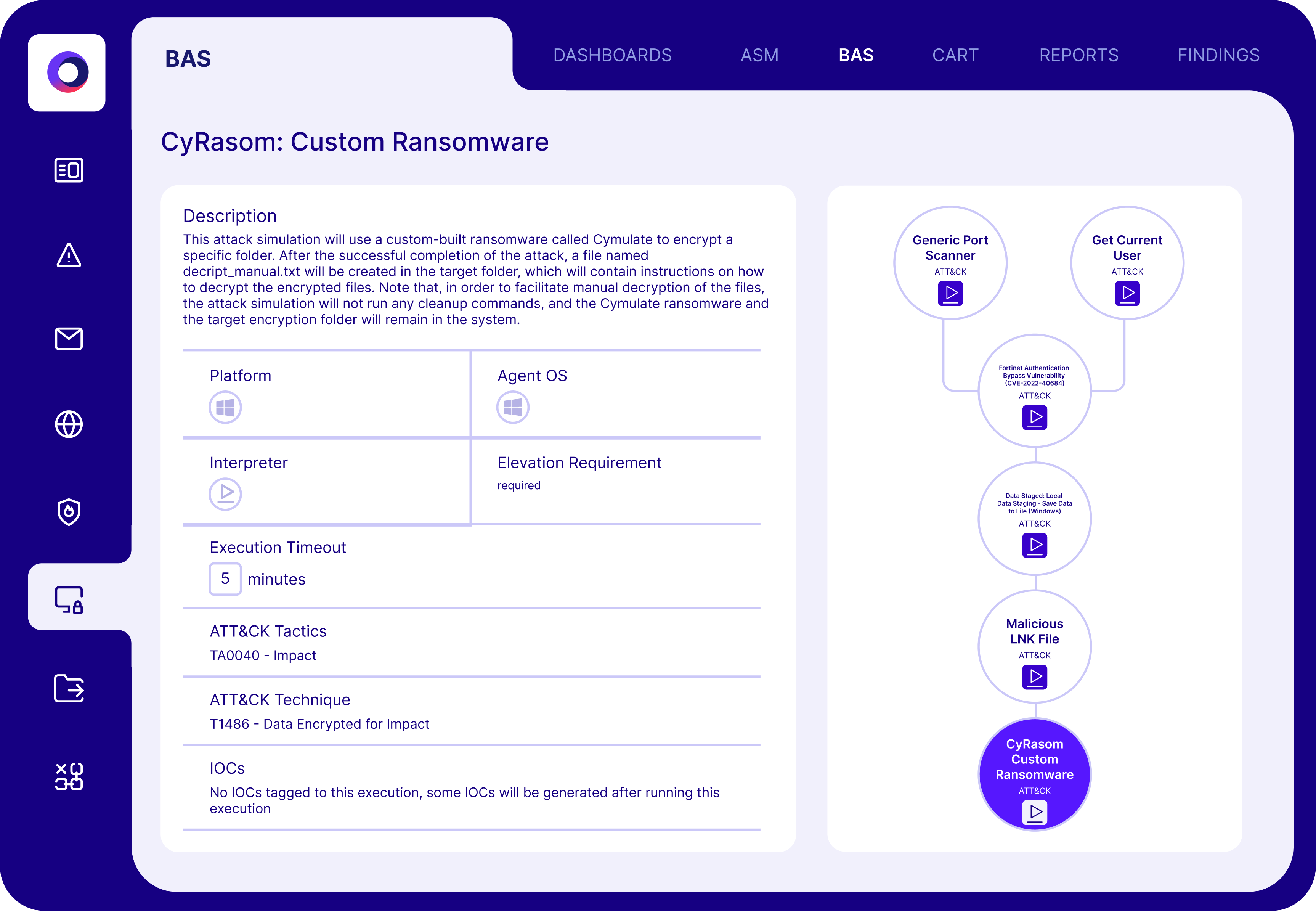
Cymulate empowers security teams, regardless of maturity level, to make informed, data-driven decisions, strengthen their security posture and reduce exposure to ransomware and other attack types. 

Book a Demo