

Frequently Asked Questions

Endpoint Security Validation: Fundamentals & Best Practices

What is endpoint security validation?

Endpoint security validation is the process of systematically testing and verifying that antivirus (AV) and endpoint detection and response (EDR) solutions function as designed against real threats. Unlike passive monitoring or log reviews, validation involves actively simulating attack techniques and malicious behaviors to assess detection and prevention capabilities. The scope includes coverage (detecting known and emerging threats), configuration (ensuring controls are properly tuned and updated), and effectiveness (verifying tools can stop real attacks, not just identify them after the fact).

Why is endpoint security important for organizations?

Endpoint security is critical because endpoint devices are primary targets for attackers seeking initial access to a network. Once compromised, these devices can be used for privilege escalation, lateral movement, and data theft. Security controls like AV and EDR solutions must be properly configured and regularly updated to remain effective against evolving threats. Without validation, organizations cannot be sure their defenses will catch new or sophisticated attacks.

What are the best practices for endpoint security validation?

The six core best practices for endpoint security validation are: 1) Test your controls weekly, 2) Test detection of known malware files, 3) Validate detection of malicious behaviors, 4) Detect system-level manipulation (rootkits), 5) Catch malicious DLL loading, and 6) Stop code injection attacks. These practices ensure both AV and EDR solutions are effective against a wide range of threats and evasion techniques.

How often should endpoint security controls be tested?

Endpoint security controls should be tested weekly. Regular testing helps identify weaknesses before attackers do and ensures that controls remain effective against new attack techniques and emerging threats.

What types of attacks should be simulated during endpoint security validation?

Simulations should include known malware files, malicious behaviors (such as ransomware, worms, and trojans), system-level manipulation (rootkits), DLL side-loading, and code injection attacks. This comprehensive approach ensures both signature-based and behavior-based threats are addressed.

How does Cymulate automate endpoint security validation?

Cymulate automates endpoint security validation by providing an automated platform that continuously tests AV and EDR controls. The platform offers over 490 test scenarios against attack techniques, production-safe testing, automated assessment reports with risk scores, actionable mitigation guidance, and integration with leading EDR solutions like Microsoft Defender, CrowdStrike, and SentinelOne.

What is the benefit of production-safe testing in endpoint security validation?

Production-safe testing ensures that validation exercises do not disrupt business operations or compromise the integrity of live systems. Cymulate's platform is designed to safely test endpoint security controls in production environments, allowing organizations to validate defenses without risk to their environment.

How does Cymulate help with actionable mitigation guidance?

Cymulate provides automated assessment reports that include risk scores, penetration ratios, and specific mitigation guidance. The platform also offers EDR-specific rules to help security teams quickly address and remediate identified gaps in their endpoint security controls.

Which EDR solutions does Cymulate integrate with for endpoint security validation?

Cymulate integrates with leading EDR solutions including Microsoft Defender, CrowdStrike, SentinelOne, BlackBerry Cylance OPTICS, Carbon Black EDR, Cisco Secure Endpoint, and Cybereason. For a full list, visit the Cymulate Partnerships and Integrations page.

How does endpoint security validation help prevent lateral movement attacks?

By validating endpoint security controls against advanced evasion techniques like privilege escalation, DLL side-loading, and code injection, organizations can detect and block attempts at lateral movement. Cymulate's platform simulates these attack paths to ensure defenses are effective. For more, see the blog post Stopping Attackers in Their Tracks.

What is the difference between AV and EDR validation?

AV validation focuses on detecting and preventing known, signature-based malware, while EDR validation tests the ability to detect and respond to more sophisticated, behavior-based attacks that may bypass traditional AV. Effective endpoint security validation should cover both AV and EDR capabilities.

How does Cymulate's endpoint security validation support different operating systems?

Cymulate's endpoint security validation supports a variety of endpoint devices, including Windows, Mac, Linux, desktops, laptops, and servers. This ensures comprehensive coverage across diverse IT environments.

What resources are available to learn more about endpoint security validation?

Resources include the Endpoint Security Validation Solution Brief, the Security Validation Best Practices eBook, and the Cymulate blog for best practices and technical insights.

How does Cymulate's endpoint security validation differ from manual testing?

Cymulate automates the validation process, eliminating the need for manual test scenario creation and spreadsheet tracking. The platform continuously validates AV and EDR controls with a comprehensive library of attack techniques, providing faster, more consistent, and actionable results than manual methods.

What metrics does Cymulate provide in endpoint security validation reports?

Cymulate provides automated assessment reports that include Risk Scores, Penetration Ratios, and detailed mitigation guidance. These metrics help organizations quantify their security posture and track improvements over time.

How does endpoint security validation help with compliance requirements?

Regular endpoint security validation helps organizations demonstrate due diligence and continuous improvement in their security posture, which is often required by compliance frameworks and industry regulations. Automated reports from Cymulate can be used as evidence during audits.

How does Cymulate support continuous improvement in endpoint security?

Cymulate enables continuous improvement by providing ongoing, automated validation of endpoint security controls, actionable insights for remediation, and regular updates to its threat simulation library. This ensures organizations stay ahead of emerging threats and maintain effective defenses.

What customer feedback is available about Cymulate's endpoint security validation?

Customers consistently praise Cymulate for its ease of use, intuitive dashboard, and actionable insights. For example, a Senior Security Analyst in retail noted, "[The] product has been great and easy to use. Cymulate support is always easily accessible and they are a main contributing factor to why the tool is so easy to use." More testimonials are available on the Cymulate Customers page.

How can I schedule a demo of Cymulate's endpoint security validation?

You can schedule a personalized demo of Cymulate's endpoint security validation solution by visiting the Book a Demo page on the Cymulate website.

Features & Capabilities

What features does Cymulate offer for endpoint security validation?

Cymulate offers over 490 test scenarios against attack techniques, production-safe testing, automated assessment reports with risk scores and penetration ratios, actionable mitigation guidance, EDR-specific rules, and integration with leading EDR solutions. The platform is designed for ease of use and continuous validation.

Does Cymulate support integration with other security tools?

Yes, Cymulate integrates with a wide range of security technologies, including Akamai Guardicore, AWS GuardDuty, BlackBerry Cylance OPTICS, Carbon Black EDR, Check Point CloudGuard, Cisco Secure Endpoint, CrowdStrike Falcon, SentinelOne, Wiz, and more. For a complete list, visit the Partnerships and Integrations page.

How does Cymulate ensure data security and compliance?

Cymulate holds several industry-leading certifications, including SOC2 Type II, ISO 27001:2013, ISO 27701, ISO 27017, and CSA STAR Level 1. Data is encrypted in transit (TLS 1.2+) and at rest (AES-256), and the platform is hosted in secure AWS data centers. Application security includes a secure development lifecycle, vulnerability scanning, and third-party penetration testing. For more, see Security at Cymulate.

What compliance certifications does Cymulate have?

Cymulate is certified for SOC2 Type II, ISO 27001:2013 (Information Security Management), ISO 27701 (Privacy Information Management), ISO 27017 (Cloud Services Security Controls), and CSA STAR Level 1. These certifications demonstrate Cymulate's commitment to industry-leading security and compliance standards. Details are available on the Security at Cymulate page.

How does Cymulate help organizations meet GDPR requirements?

Cymulate incorporates data protection by design and has a dedicated privacy and security team, including a Data Protection Officer (DPO) and Chief Information Security Officer (CISO). The platform's compliance with ISO 27701 and robust security controls support GDPR requirements.

What is Cymulate's pricing model for endpoint security validation?

Cymulate operates on a subscription-based pricing model tailored to each organization's requirements. Pricing depends on the chosen package, number of assets, and scenarios selected. For a detailed quote, schedule a demo with the Cymulate team.

How easy is it to implement Cymulate's endpoint security validation?

Cymulate is designed for rapid, agentless deployment with no need for additional hardware or complex configurations. Customers can start running simulations almost immediately after deployment. The platform integrates seamlessly into existing workflows and offers comprehensive support and educational resources.

What support options are available for Cymulate customers?

Cymulate provides email support ([email protected]), real-time chat support, a knowledge base with technical articles and videos, webinars, e-books, and an AI chatbot for quick answers and guidance. These resources help customers maximize the value of the platform.

What are the key benefits of using Cymulate for endpoint security validation?

Key benefits include improved security posture (up to 52% reduction in critical exposures), operational efficiency (60% increase in team efficiency), faster threat validation (40X faster than manual methods), cost savings, enhanced threat resilience (81% reduction in cyber risk within four months), and better decision-making with actionable insights and quantifiable metrics.

How does Cymulate compare to traditional endpoint security validation methods?

Traditional methods like manual penetration testing are often costly, time-consuming, and provide only point-in-time assessments. Cymulate offers continuous, automated validation with a comprehensive attack simulation library, actionable insights, and measurable outcomes, making it more efficient and effective for modern security needs.

What types of organizations benefit most from Cymulate's endpoint security validation?

Cymulate's solutions are designed for organizations of all sizes and industries, including finance, healthcare, retail, media, transportation, and manufacturing. Roles that benefit include CISOs, SecOps teams, Red Teams, and Vulnerability Management teams. The platform is suitable for both small enterprises and large corporations with over 10,000 employees.

Where can I find case studies about Cymulate's endpoint security validation?

Case studies are available on the Cymulate Customers page. Examples include Hertz Israel reducing cyber risk by 81% in four months and a credit union boosting threat prevention and detection with Cymulate.

How does Cymulate support continuous threat exposure management (CTEM)?

Cymulate integrates exposure validation, prioritization, and remediation into a unified platform, enabling organizations to continuously manage and reduce their threat exposure. The platform supports collaboration across teams and provides quantifiable metrics for ongoing improvement.

Where can I find more resources, reports, and webinars from Cymulate?

You can access a combination of insights, thought leadership, and product information in the Cymulate Resource Hub. The hub includes whitepapers, reports, blogs, and webinars.

Cymulate named a Customers' Choice in 2025 Gartner® Peer Insights™
Learn More
New Case Study: Credit Union Boosts Threat Prevention & Detection with Cymulate
Learn More
New Research: Cymulate Research Labs Discovers Token Validation Flaw
Learn More
An Inside Look at the Technology Behind Cymulate
Learn More

Endpoint Security Best Practices: How to Validate Your Controls

By: Brian Moran, VP of Product Marketing

Last Updated: January 29, 2026

cymulate blog article

Endpoint devices are a primary target of attackers seeking initial access to your network. Once compromised, the devices become launch points for privilege escalation, lateral movement and data theft. Yet many organizations rely on endpoint security tools without ever verifying they actually work.

This article covers best practices for endpoint security validation to ensure your defenses are properly configured and ready for real-world threats.

Key highlights:

  • Endpoint security validation is the continuous measurement of how well your endpoint controls detect and prevent threats.
  • Endpoint detection and response (EDR) best practices establish a baseline of defense that requires continuous testing to ensure policies remain effective against evolving threats.
  • Cymulate enables continuous endpoint security validation with an automated platform that identifies weaknesses and tests your controls.

What is endpoint security validation?

Endpoint security validation is the process of systematically testing and verifying that antivirus (AV) and endpoint detection and response (EDR) solutions function as designed against real threats. Unlike passive monitoring or log reviews, validation involves actively simulating attack techniques and malicious behaviors to assess detection and prevention capabilities.

The scope of endpoint security validation encompasses three pillars: 

  • Coverage: If your solution detects both known threats and new, emerging ones.
  • Configuration: If your controls are properly tuned, updated with the latest threat intelligence and set up correctly for your environment. 
  • Effectiveness: If your tools can actually stop real attacks when they happen on your devices, not just identify them after the fact.
image
Further reading
Endpoint Security Validation

Learn how Cymulate validates endpoint security controls against the latest attack types and methods.

Read More

Why is endpoint security important?

Endpoint security is often identified as the most critical control point, as endpoint devices are the primary targets of attackers. Threat actors are looking to gain initial access to an endpoint, escalate their privileges and then move laterally across other endpoints on the network in search of systems and data of value (or your IT crown jewels).

Security controls include legacy signature-based AV solutions and more sophisticated behavior-based EDR solutions within a broader endpoint protection platform (EPP).  But having endpoint security tools installed is not enough.

Malicious actors constantly evolve their attack techniques, and security tools require proper configuration and regular updates to stay effective. Without validation, you have no way to know if your AV or EDR solution will actually catch an invasion. A tool that worked well six months ago may fail against new threats today. Validation reveals gaps in detection, misconfigured settings and outdated threat signatures before an attacker exploits them.

Best practices for endpoint security validation

An effective approach to cybersecurity validation is to simulate real threats, including ransomware, rootkits, DLL side-loading, code injection and other advanced evasion techniques.

Here are the six core endpoint security best practices designed to validate both AV and EDR solutions:

1. Test your controls weekly

Given the role that endpoints play in day-to-day business operations and the diversity of endpoint devices (Windows, Mac, Linux, Desktops, Laptops, Servers, etc), weekly testing helps you identify weaknesses before attackers do. Your security controls need regular validation to ensure they remain effective against new attack techniques and emerging threats.

2. Test detection of known malware files

Security teams should conduct validation tests using a comprehensive suite of the latest known malware file samples to determine the detection and prevention capabilities of the antivirus solution and verify that the signature database is up to date and that the software is properly configured to scan all relevant files and data streams.

These tests simulate the dropping of signature-based malware samples to disk to test the response of traditional antivirus and anti-malware software running on the endpoint.

3. Validate detection of malicious behaviors

Today’s threat actors have moved beyond signature-based attacks, which are easily detected by endpoint security controls, to more behavior-based attacks that are harder to detect because they often leverage legitimate system processes and user behavior to bypass security controls. These types of attacks require more sophisticated EDR solutions to detect and prevent attacks based on suspicious and malicious behaviors.

Security teams should simulate a wide range of adversary behaviors using different execution methods and payloads covering the latest malware, ransomware, worms and trojan samples to validate their EDR detection and prevention capabilities fully.

4. Detect system-level manipulation (rootkits)

Rootkits are a type of malware that typically runs at low levels in the operating system to avoid detection. They often manipulate core system functions and substitute system calls to try to disguise their malicious actions.

Security teams should test their endpoint security controls to validate the integrity of system binaries and determine if the controls can detect when system functions have been altered by a threat actor.

5. Catch malicious DLL loading

DLL side-loading is another method used by threat actors to load malicious files into the memory space of legitimate applications to evade detection.

Security teams should simulate these attacks to verify their endpoint security solution can detect and block this evasion technique before it compromises systems or data.

6. Stop code injection attacks

Code injection is a method used to exploit the applications that are running on the endpoint devices with the goal of compromising systems, applications and data.

Security teams should simulate the injection of malicious code into input fields of their trusted applications running on their endpoints.

Follow the best practices for endpoint security validation with Cymulate

The Cymulate Endpoint Security Validation solution removes the manual work from EDR testing. Instead of building custom test scenarios or struggling with spreadsheets, your security team gets an automated platform that continuously validates your AV and EDR controls.
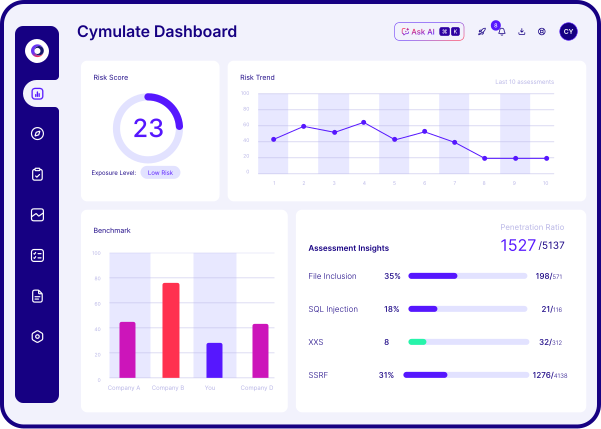
screenshot of cymulate dashboard use for endpoint security control

Our platform offers:

  • More than 490 test scenarios against attack techniques
  • Production-safe testing with no risk to your environment
  • Automated assessment reports with Risk Scores and Penetration Ratios
  • Actionable mitigation guidance and EDR-specific rules to fix gaps
  • Integration with leading EDR solutions (Microsoft Defender, CrowdStrike, SentinelOne, and more)

Schedule a demo to see how Cymulate automates endpoint security best practices, from continuous threat simulation to immediate gap remediation.

Cymulate Exposure Validation makes advanced security testing fast and easy. When it comes to building custom attack chains, it's all right in front of you in one place.
Mike Humbert, Cybersecurity Engineer
DARLING INGREDIENTS INC.
Learn More
Book a Demo