

External Attack Surface Management (EASM)
External Attack Surface Management (EASM) is a cybersecurity practice of continuously discovering, monitoring and securing an organization’s internet-facing assets to reduce exposure to external threats.
It provides an “outside-in” view of your digital footprint by identifying all publicly accessible systems (websites, cloud services, APIs, etc.) and assessing them for vulnerabilities.
As organizations increasingly rely on cloud services and remote networks beyond the traditional perimeter, EASM plays a critical role in illuminating external risk. Gartner reports that cloud adoption and hybrid work have “accelerated the expansion of enterprises’ external attack surfaces,” leading to more exposures that security teams must manage.
By giving security teams the same view an attacker has, EASM allows businesses to find and fix weaknesses before hackers can exploit them.
What is External Attack Surface Management (EASM)?
External Attack Surface Management (EASM) is a proactive cybersecurity approach focused on identifying, managing, and reducing risks tied to an organization’s public-facing assets—such as websites, cloud storage, APIs and SaaS apps.
Unlike traditional security tools that concentrate on internal networks, EASM views the organization from an attacker’s perspective, continuously mapping what’s visible and vulnerable on the internet.
EASM differs from general Attack Surface Management (ASM) by zeroing in solely on assets accessible from the public internet. While internal ASM protects systems within your network, EASM exposes blind spots outside the firewall that traditional tools might miss.
It also differs from Cyber Asset Attack Surface Management (CAASM), which aims to provide a complete view of all assets (both internal and external) by aggregating data across systems. In contrast, EASM focuses strictly on external-facing assets—making it a key component of broader exposure management strategies.
How External Attack Surface Management Identifies Risks
External Attack Surface Management (EASM) functions as a continuous, automated process that identifies and reduces risks tied to an organization’s internet-facing assets. It mimics an attacker’s view of your infrastructure, constantly scanning for exposures and enabling faster response.
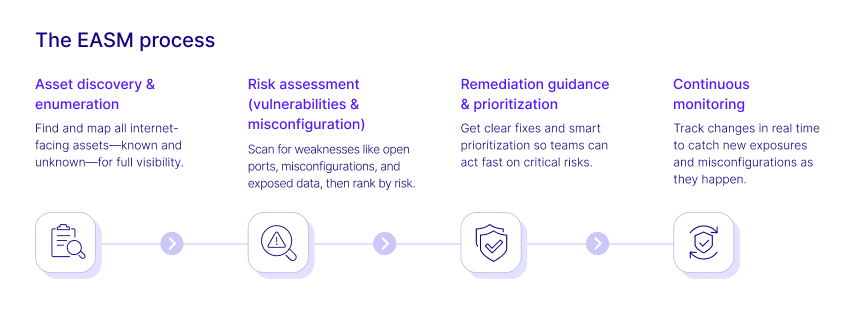
1. Asset discovery & enumeration
The first and foundational step of EASM is discovering all external-facing assets and enumerating their technical details. This includes domains, subdomains, IP addresses, cloud instances, APIs, web applications and other internet-exposed resources.
EASM platforms use a variety of techniques to uncover assets—DNS scanning, certificate transparency logs, cloud provider APIs, search engine indexing, and open-source intelligence (OSINT). These tools often detect assets created outside of IT’s purview (known as shadow IT), as well as forgotten systems that still pose a risk.
As Forrester describes, EASM tools continually scan for, identify, and fingerprint known and unknown assets, highlighting potential exposures. The result is a comprehensive, real-time inventory of public-facing systems that attackers could target.
2. Risk assessment (vulnerabilities & misconfigurations)
Once assets are discovered, EASM platforms evaluate them for weaknesses. They conduct non-intrusive scans and run configuration and vulnerability checks to uncover:
- Open ports and services
- Unpatched software or outdated libraries
- Misconfigured cloud storage (e.g., exposed S3 buckets)
- Expired SSL certificates
- Leaked credentials or sensitive data
- Exposed administrative panels or development tools
Importantly, modern EASM solutions enrich this raw data with threat intelligence—highlighting, for instance, whether a vulnerability is being actively exploited in the wild. Findings are then risk-ranked based on severity, exposure level, and exploitability.
This risk-based assessment model helps security teams cut through the noise and focus on what matters most, rather than being overwhelmed with raw scan results.
3. Remediation guidance & prioritization
After identifying risks, EASM platforms help teams prioritize and act. Each exposure is scored based on its severity and potential impact, with critical findings pushed to the top. For example, a misconfigured server hosting sensitive data would take precedence over a low-risk informational disclosure.
EASM tools often provide:
- Remediation guidance (e.g., patching instructions or config changes)
- Risk context (business impact, asset classification)
- Integration with ticketing tools like Jira or ServiceNow
- Workflow automation via SIEM or SOAR platforms
Some advanced solutions enable automated incident creation, firewall rule updates, or alert escalations when high-risk exposures are detected. While EASM platforms generally don’t remediate issues directly, they ensure the right people are alerted and supported with actionable data.
4. Continuous monitoring
A core advantage of EASM is its ongoing vigilance. The external attack surface is highly dynamic—new apps are deployed, cloud assets are spun up, and changes occur across domains and partner integrations. A one-time scan is insufficient.
EASM platforms conduct continuous or periodic scanning, tracking changes in real time and detecting:
- Newly exposed services
- Policy drift or misconfigurations
- Vulnerability re-emergence after updates
- Unauthorized changes to public-facing systems
This persistent monitoring acts like a digital watchtower—flagging security gaps as they emerge, not weeks or months later. For instance, if a developer accidentally exposes a staging database to the internet, EASM alerts security teams within hours.
The Lifecycle Approach
Together, these components form a closed-loop, proactive lifecycle:
- Discover assets
- Enumerate and assess exposures
- Prioritize and guide remediation
- Monitor continuously for changes
- Repeat
This loop enables organizations to reduce exposure windows, identify vulnerabilities before threat actors do, and continuously harden their external perimeter. When implemented effectively, EASM provides a scalable and strategic way to manage external risk and supports broader exposure management efforts.
Why External Attack Surface Management is Critical for Cybersecurity
As organizations increasingly operate in the cloud and rely on digital services, their attack surface extends far beyond the internal network.
EASM is essential because it provides visibility and control over these external-facing assets—those most visible and vulnerable to threat actors. Here’s why it matters:
Expanding digital footprint
Modern businesses deploy countless public-facing endpoints—from cloud services and SaaS apps to IoT devices and third-party integrations.
This expansion, fueled by remote work and cloud adoption, dramatically increases exposure to external threats. Without EASM, unknown or forgotten assets can go undetected until exploited. EASM ensures continuous discovery and tracking of these assets, helping teams stay ahead of their ever-growing digital footprint.
Blind spots in traditional security
Conventional tools like firewalls and vulnerability scanners are designed for internal environments. They often overlook assets deployed outside the network perimeter, such as an outdated subdomain or an unsecured cloud server.
EASM fills this gap by identifying shadow IT and unmanaged external infrastructure, giving security teams visibility into what attackers can already see online.
Preventing breaches and data leaks
External exposures are a common entry point for attackers. Misconfigured cloud storage, unpatched web servers, or compromised credentials can quickly lead to data breaches.
EASM minimizes this risk by detecting vulnerabilities early—before they can be exploited—making it a proactive line of defense that significantly reduces the likelihood of cyber incidents.
Compliance and trust
Regulations and cybersecurity frameworks increasingly demand up-to-date asset inventories and prompt vulnerability management.
EASM helps organizations meet these requirements by documenting external assets and demonstrating continuous risk monitoring. It also strengthens third-party risk oversight and shows due diligence in audits, improving customer and stakeholder trust.
EASM vs. Other Security Approaches
External Attack Surface Management (EASM) complements and enhances other cybersecurity practices by focusing on discovering and managing unknown, internet-facing assets. Here's how it compares to other common approaches:
EASM vs. vulnerability management (VM)
Vulnerability Management targets known internal systems, scanning them periodically for vulnerabilities and applying patches. In contrast, EASM begins with discovery, identifying unknown or unmanaged external assets before assessing their risks.
- VM = focuses on known assets within defined scopes.
- EASM = uncovers unknown, external assets outside traditional inventories.
Together, they create a comprehensive risk picture—EASM feeds findings into the VM process for deeper remediation.
EASM vs. attack surface reduction (ASR)
Attack Surface Reduction is about minimizing potential entry points by disabling or removing unnecessary assets, services, or permissions. EASM supports ASR by mapping the external environment and flagging misconfigured or unnecessary assets.
- EASM = discovers what’s exposed.
- ASR = reduces and hardens what’s exposed.
They work hand-in-hand—EASM finds vulnerabilities; ASR eliminates them.
EASM vs. exposure management
Exposure Management is a broader strategy that continuously identifies and prioritizes cyber risks across internal, external, and identity-based attack surfaces. EASM plays a critical role within Exposure Management by focusing on public-facing assets.
- Exposure Management = full-spectrum visibility and risk prioritization.
- EASM = focuses on external exposure, feeding critical data into the broader exposure landscape.
If Exposure Management is the whole chessboard, EASM is a key piece that monitors the external side.
Key Benefits of EASM
Implementing External Attack Surface Management (EASM) offers organizations significant advantages in proactively securing their internet-facing assets.
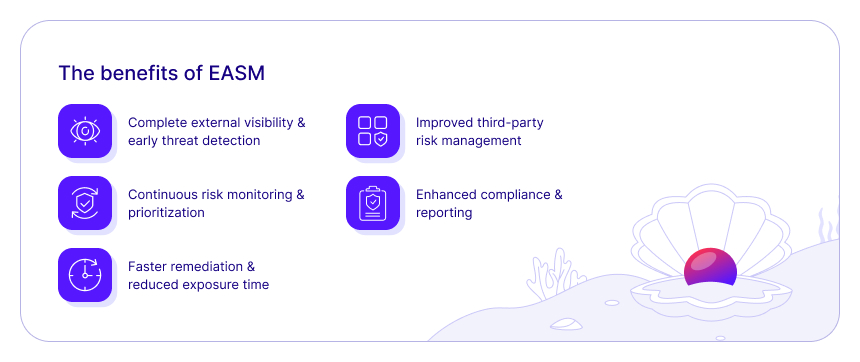
- Complete external visibility & early threat detection: EASM delivers a real-time, comprehensive map of all external-facing assets—known and unknown—giving security teams the same view as attackers. By uncovering shadow IT, outdated systems, and forgotten websites, it surfaces potential threat vectors often missed by traditional tools. This early warning capability allows for proactive mitigation before vulnerabilities are exploited.
- Continuous risk monitoring & prioritization: Unlike point-in-time assessments, EASM continuously monitors for changes across the external attack surface. It tracks new exposures, misconfigurations, and asset additions, updating dashboards and risk scores in real time. By enriching findings with context (e.g., asset criticality, active threats), EASM highlights the risks that truly matter, helping teams focus efforts and avoid alert fatigue.
- Faster remediation & reduced exposure time: EASM shortens the window between exposure and remediation by alerting teams quickly—sometimes within hours of a change. This enables faster patching and configuration fixes, reducing the time vulnerabilities remain exploitable. Risk-based prioritization ensures the most critical issues are addressed first, transforming emergency incidents into routine remediation workflows.
- Improved third-party risk management: An organization’s external attack surface often includes assets from subsidiaries, vendors, or partners. EASM sheds light on these third-party exposures, such as insecure vendor systems or inherited vulnerabilities from acquisitions. This visibility is vital as supply chain attacks continue to surge, allowing teams to evaluate and manage risks beyond their direct control.
- Enhanced compliance & reporting: While not its primary goal, EASM supports compliance efforts by providing audit-ready asset inventories and risk trend reports. Security leaders can demonstrate continuous risk management and measurable improvement over time—building trust with regulators, auditors, and stakeholders through clear, data-backed insights into their external security posture.
EASM Tools & Solutions
The growing importance of External Attack Surface Management (EASM) has led to the development of a wide range of tools, many of which share common capabilities designed to help organizations gain control over their internet-facing assets.
Automated, AI-powered discovery
Leading EASM platforms use automation and AI/ML to continuously scan the internet for exposed assets. They analyze data sources like DNS records, cloud metadata, and certificate logs to identify domains, IPs, and infrastructure associated with an organization.
AI improves attribution accuracy and reduces false positives by filtering out unrelated assets. These tools are typically agentless and scalable, operating externally without impacting internal systems—making deployment fast and non-intrusive.
Centralized asset inventory & classification
EASM solutions maintain a dynamic, categorized inventory of discovered assets—grouped by type (e.g., domains, web apps, IoT devices). This inventory is presented through interactive dashboards, often allowing tagging by business unit or asset criticality.
Some tools integrate with internal CMDBs to reconcile asset data and support IT governance. A comprehensive inventory forms the foundation for risk monitoring and strategic remediation.
Vulnerability & exposure analysis
Beyond discovery, EASM tools assess each asset’s risk posture using port scans, vulnerability databases, configuration checks, and SSL analysis. They often integrate threat intelligence to detect if specific vulnerabilities are actively being exploited. Some also offer web application scanning.
The result is a clear picture of which assets are risky—and why—allowing teams to prioritize based on real-world threats, not just raw findings.
Real-time alerting & reporting
EASM platforms deliver alerts when critical exposures or new assets are found, through email, Slack, or integrated dashboards.
They also provide scheduled reports, executive summaries, and trend charts to track changes in the external attack surface. Customizable alert thresholds help reduce noise and ensure high-priority risks are acted upon quickly.
Integration with existing security ecosystem
Top EASM tools integrate with SIEMs (like Splunk), XDR, SOAR platforms, and IT ticketing systems (e.g., Jira, ServiceNow). These integrations enable seamless incident handling, automated remediation workflows, and better correlation between external exposures and internal threat signals.
Integration ensures EASM fits into an organization's existing processes, enhancing operational efficiency.
Digital risk protection (DRP) capabilities
Some EASM solutions extend into brand and threat monitoring by detecting typosquatted domains, leaked credentials, and mentions in dark web forums.
These features enhance traditional EASM by flagging indicators of external abuse or impersonation. While not core to all EASM tools, this convergence with DRP strengthens overall threat awareness and defense.
Beyond External Asset Discovery: Cymulate Exposure Validation
EASM provides visibility into external-facing assets and exposures. Cymulate does not perform external asset discovery; instead, it helps organizations validate whether identified exposures represent meaningful risk by continuously testing security controls against real-world attack techniques.
Continuous Exposure Validation
Discovering external-facing assets is only the first step. Once exposures have been identified through EASM or other discovery tools, Cymulate continuously validates whether they can be successfully targeted by real-world attack techniques and whether existing security controls provide effective protection.
By safely emulating adversary behavior, security teams can:
- Validate whether preventive and detective controls stop attacks targeting internet-facing assets
- Identify security gaps before attackers can exploit them
- Prioritize remediation based on validated exposure and control effectiveness rather than theoretical severity alone
- Continuously verify that security controls remain effective as environments evolve
Risk-Based Prioritization
Not every external exposure represents the same level of risk. Cymulate helps organizations distinguish between theoretical findings and exposures that pose meaningful business risk by validating attack scenarios against their own security controls. This enables security teams to focus remediation efforts on the issues most likely to impact the organization.
Continuous Validation and Remediation
When Exposure Validation identifies security gaps, Cymulate provides actionable remediation guidance to strengthen defenses. With Auto Mitigation, organizations can generate vendor-specific detection content and, where supported, automate security control updates to accelerate remediation. After changes are implemented, Cymulate continuously revalidates the environment to confirm that security improvements remain effective.
Exposure Validation Within the Broader Attack Surface
EASM solutions provide valuable visibility into external assets and potential exposures. Cymulate extends that value by validating which identified exposures can be leveraged by real-world attack techniques and whether security controls successfully prevent or detect those attacks. This additional layer of validation helps organizations prioritize remediation based on proven risk rather than potential exposure alone.
Seamless Integration
As a cloud-native platform, Cymulate integrates with SIEM, EDR, vulnerability management, ticketing, and other security technologies. It also complements EASM and broader exposure management workflows by validating identified exposures and supporting remediation within existing security operations processes.
From Discovery to Validation
EASM identifies external assets and potential exposures. Cymulate Exposure Validation determines whether those exposures can be successfully leveraged using real-world attack techniques and whether security controls effectively stop those attacks. Together, these capabilities help organizations prioritize the risks that matter most, validate remediation efforts, and continuously strengthen their cyber resilience.
Key Takeaways
- External Attack Surface Management (EASM) provides continuous visibility into internet-facing assets and potential external exposures.
- Visibility alone is not enough—organizations also need to understand which exposures represent meaningful operational risk.
- Cymulate complements EASM by continuously validating whether identified exposures can be leveraged by real-world attack techniques and whether existing security controls effectively prevent or detect those attacks.
- Exposure Validation enables security teams to prioritize remediation based on validated outcomes rather than theoretical severity scores alone.
- With actionable remediation guidance and Auto Mitigation, Cymulate helps accelerate remediation efforts and continuously verify that security improvements remain effective as environments evolve.
Featured Resources
View More Resources
CTEM: From Theory to Implementation
Explore how CTEM bridges the gap between technical and business priorities, offering a step-by-step guide to implementation.

A Practical Guide to Exposure Management
The five steps to a sustainable CTEM program, with tools, industry insights and guidance.

Utility Organization Validates Protection Against Emerging Threats with Cymulate
Discover how this organization tests against emergent threats and APT attacks.