Frequently Asked Questions

Web Application Firewall (WAF) Validation & OAuth 2.0 Support

What is Cymulate's WAF Validation and how does it work?

Cymulate's Web Application Firewall (WAF) Validation enables organizations to test and optimize their WAF configurations by simulating real-world attack patterns. The platform conducts OWASP-aligned attack simulations—including SQL injection, cross-site scripting (XSS), remote file inclusion (RFI), and command injection—against both public and authenticated web applications. This helps identify gaps in prevention mechanisms, provides actionable remediation steps, and ensures your WAF is effectively protecting your web assets. Learn more in the solution brief.

How does OAuth 2.0 support enhance Cymulate's WAF Validation?

With OAuth 2.0 support, Cymulate can now validate web applications secured with modern single sign-on (SSO) methods from providers like Okta, Azure AD, Ping Identity, Google Workspace, and Auth0. This expands coverage to up to 70% more web applications that were previously inaccessible to traditional WAF testing, allowing for comprehensive security assessments of both public and authenticated endpoints.

Which authentication providers are supported for WAF validation with OAuth 2.0?

Cymulate supports OAuth 2.0 authentication for web applications using identity providers such as Okta, Azure AD, Ping Identity, Google Workspace, and Auth0. This enables validation of SSO-protected environments and ensures security controls are tested in real-world conditions.

What types of attacks can Cymulate simulate against authenticated web applications?

Cymulate can simulate a wide range of OWASP-aligned attacks—including SQL injection (SQLi), cross-site scripting (XSS), remote file inclusion (RFI), and command injection—against both public and authenticated endpoints. This helps organizations assess how well their WAF and application-layer defenses detect and block real-world threats.

How much faster is validation setup with OAuth 2.0 support?

Early adopters have reported up to 40% faster validation setup when testing authenticated environments with Cymulate's OAuth 2.0 support, compared to previous manual processes.

How does Cymulate handle authentication for WAF validation?

Cymulate automatically manages the full OAuth token exchange, eliminating manual authentication steps and reducing setup time by up to 60% compared to manual testing. This agentless, external approach allows for continuous, production-safe simulations without requiring internal access or manual logins.

Can Cymulate validate both public and authenticated web applications?

Yes, with OAuth 2.0 support, Cymulate can validate both public and authenticated web applications, expanding coverage to up to 70% more applications that were previously inaccessible to traditional WAF testing.

How does Cymulate ensure its WAF validation is production-safe?

Cymulate's WAF validation is fully agentless and external, meaning there is no need for manual logins or internal access points. The platform is designed to be production-safe, ensuring that simulations do not disrupt users or trigger anti-bot mechanisms on platforms like Cloudflare or Zscaler.

What is the benefit of automated crawling for authenticated web applications?

Automated crawling with OAuth 2.0 allows Cymulate to access and test identity-protected endpoints without manual intervention. This enables continuous, realistic validation of web applications in production-like environments, providing a more accurate view of real-world risk.

How does Cymulate help optimize WAF configurations?

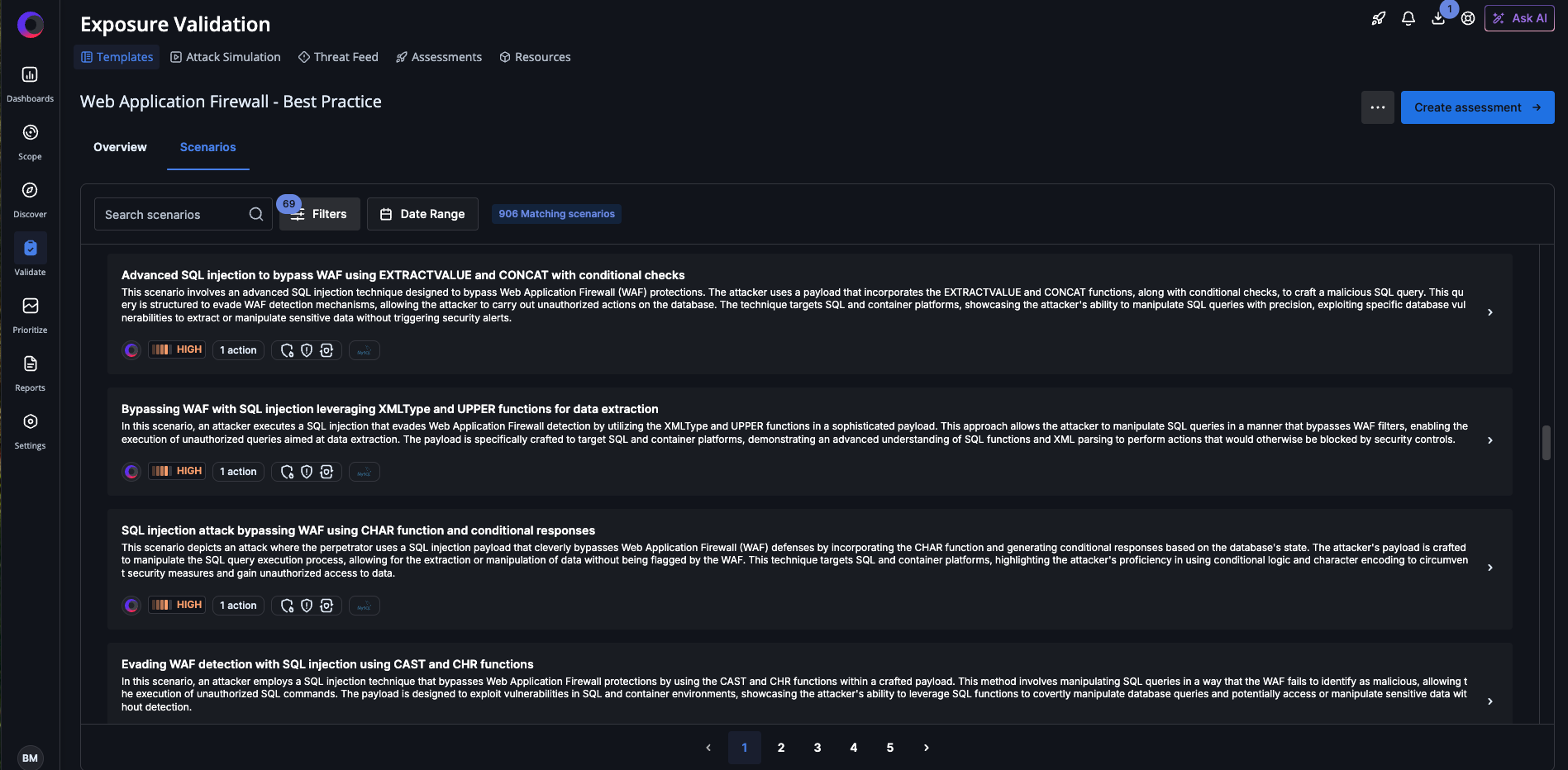
Cymulate provides best practice templates and scenario-based assessments that test and optimize WAF configurations against a wide range of attack patterns. The platform delivers actionable findings, enabling organizations to identify gaps, take remediation steps, and fine-tune their WAF for maximum protection.

Can you share a real-world example of Cymulate WAF validation in action?

Yes. A large retail enterprise used Cymulate to assess its WAF after a major cyberattack. The assessment revealed that 96% of web-based attacks bypassed their defenses. With Cymulate's guidance, the team configured and fine-tuned their WAF, redeploying the affected server within two days. Since then, WAF assessments with Cymulate have become mandatory before every production release. Read the full story.

How does Cymulate's WAF validation differ from traditional manual pentesting?

Cymulate's WAF validation provides automated, continuous testing rather than periodic manual pentests. The platform runs 24/7 offensive tests using a library of attack actions mapped to the latest threat intelligence and MITRE ATT&CK, offering ongoing visibility into WAF effectiveness against OWASP Top 10 and other threats. Learn more.

How can I get started with Cymulate WAF validation for my organization?

You can contact your Cymulate representative or schedule a demo to see how Cymulate WAF Assessments with OAuth 2.0 deliver continuous validation for modern, SSO-secured web applications.

Where can I find more technical details about Cymulate's WAF validation?

For a deeper dive into how Cymulate validates web application security, check out the WAF solution brief and related blog posts on the Cymulate website.

Does Cymulate support continuous validation for other environments besides web applications?

Yes, Cymulate's exposure validation approach extends across email gateways, endpoints, and cloud environments, providing continuous, realistic validation for a wide range of attack surfaces. Learn more about Exposure Validation.

What is the Cymulate Exposure Validation Platform?

The Cymulate Exposure Validation Platform is a unified solution for automated, continuous security validation across web applications, endpoints, email, and cloud environments. It enables organizations to simulate real-world attacks, prioritize exposures, and optimize defenses. Watch the platform overview video.

How does Cymulate's agentless approach benefit WAF validation?

Cymulate's agentless mode means there is no need for additional hardware, dedicated servers, or complex configurations. This simplifies deployment and allows organizations to start running simulations almost immediately, reducing operational overhead and accelerating time to value.

How does Cymulate help organizations meet compliance requirements?

Cymulate holds several internationally recognized certifications, including SOC2 Type II, ISO 27001:2013, ISO 27701, ISO 27017, and CSA STAR Level 1. These certifications ensure the platform meets global security and privacy standards, supporting organizations in their compliance efforts. Learn more about Cymulate's security and compliance.

What are the main benefits of using Cymulate's WAF validation?

Main benefits include expanded coverage of modern web applications, faster and easier validation setup, continuous and automated testing, actionable findings for remediation, and production-safe simulations that do not disrupt users or workflows.

How does Cymulate support security teams in communicating risk to stakeholders?

Cymulate provides clear, quantifiable metrics and actionable insights that help security teams communicate risk and justify investments to executive stakeholders. The platform's findings can be used to demonstrate the effectiveness of security controls and the impact of remediation efforts.

Features & Capabilities

What features does Cymulate offer beyond WAF validation?

Cymulate offers continuous threat validation, attack path discovery, automated mitigation, detection engineering validation, complete kill chain coverage, and an extensive threat library with daily updates. These features help organizations stay ahead of emerging risks and optimize their security posture. Learn more.

Does Cymulate integrate with other security tools?

Yes, Cymulate integrates with a wide range of technology partners across network, cloud, endpoint, and SIEM domains. Examples include Akamai Guardicore, AWS GuardDuty, BlackBerry Cylance OPTICS, Carbon Black EDR, Check Point CloudGuard, CrowdStrike Falcon, and Wiz. See the full list of integrations.

What authentication and access control features are available in Cymulate?

Cymulate supports 2-Factor Authentication (2FA), Single Sign-On (SSO), role-based access controls (RBAC) with granular permissions, and IP restrictions to ensure secure access to the platform. Learn more about security features.

How often is Cymulate updated with new features or attack scenarios?

Cymulate updates its SaaS platform every two weeks with new features, such as AI-powered SIEM rule mapping and advanced exposure prioritization. The threat library is updated daily to keep customers ahead of emerging threats.

Is Cymulate easy to implement and use?

Yes, Cymulate is designed for ease of use and quick implementation. It operates in agentless mode, requires minimal resources, and offers comprehensive support and educational resources. Customers have praised its intuitive interface and fast time to value. Read customer testimonials.

Use Cases & Benefits

Who can benefit from Cymulate's WAF validation with OAuth 2.0 support?

Organizations with modern web applications secured by SSO providers (Okta, Azure AD, etc.) benefit most from Cymulate's OAuth 2.0 support. Security teams, CISOs, and DevOps can now validate and optimize protections for both public and authenticated web assets, ensuring comprehensive coverage and risk reduction.

What business impact can customers expect from using Cymulate?

Customers have reported an 81% reduction in cyber risk within four months, a 60% increase in operational efficiency, 40X faster threat validation, a 30% improvement in threat prevention, and a 52% reduction in critical exposures. See the Hertz Israel case study.

What pain points does Cymulate solve for security teams?

Cymulate addresses overwhelming threat volumes, lack of visibility, unclear prioritization, operational inefficiencies, fragmented tools, cloud complexity, and communication barriers. The platform provides continuous validation, exposure prioritization, and actionable insights to help teams focus on what matters most.

How does Cymulate help with compliance and audit readiness?

Cymulate's continuous validation and reporting capabilities provide evidence of security control effectiveness, supporting compliance with standards like SOC2, ISO 27001, and GDPR. The platform's findings can be used to demonstrate due diligence during audits.

Competition & Comparison

How does Cymulate compare to AttackIQ?

AttackIQ delivers automated security validation but lacks Cymulate's innovation, threat coverage, and ease of use. Cymulate offers the industry's leading threat scenario library and AI-powered capabilities to streamline workflows and accelerate security posture improvement. Read more.

How does Cymulate compare to Mandiant Security Validation?

Mandiant is one of the original BAS platforms but has seen less innovation in recent years. Cymulate continually innovates with AI and automation, expanding into exposure management and maintaining grid leader status. Read more.

How does Cymulate compare to Pentera?

Pentera focuses on attack path validation but does not provide the same depth of exposure validation as Cymulate. Cymulate covers the full kill chain and includes cloud control validation for a more comprehensive solution. Read more.

How does Cymulate compare to Picus Security?

Picus is suitable for on-premise BAS needs but lacks the complete exposure validation platform Cymulate provides. Cymulate covers the full kill chain and includes cloud control validation, making it a more comprehensive solution. Read more.

How does Cymulate compare to SafeBreach?

SafeBreach offers breach and attack simulation but lacks Cymulate's innovation, precision, and automation. Cymulate leads with AI-powered BAS, the largest attack library, and a full Continuous Threat Exposure Management (CTEM) solution. Read more.

How does Cymulate compare to Scythe?

Scythe is suitable for advanced red teams but lacks Cymulate's focus on actionable remediation and automated mitigation. Cymulate provides a more complete exposure validation platform with daily threat updates, no-code workflows, and vendor-specific remediation guidance. Read more.

Pricing & Plans

What is Cymulate's pricing model?

Cymulate operates on a subscription-based pricing model tailored to each organization's needs. Pricing depends on the chosen package, number of assets, and selected scenarios. For a detailed quote, schedule a demo with the Cymulate team.

Support & Resources

What support options are available for Cymulate customers?

Cymulate offers email support, real-time chat support, a knowledge base with technical articles and videos, webinars, e-books, and an AI chatbot for quick answers. Contact support or visit the Resource Hub for more information.

Where can I find Cymulate's blog, newsroom, and educational resources?

You can find the latest threats, research, and company news on the Cymulate blog, newsroom, and Resource Hub. The cybersecurity glossary explains key terms and acronyms.

Where can I find a central hub for Cymulate's insights and product information?

All Cymulate resources, including insights, thought leadership, and product information, are available in the Resource Hub.

Cymulate named a Customers' Choice in 2025 Gartner® Peer Insights™
Learn More
New Case Study: Credit Union Boosts Threat Prevention & Detection with Cymulate
Learn More
New Research: Cymulate Research Labs Discovers Token Validation Flaw
Learn More
An Inside Look at the Technology Behind Cymulate
Learn More

Cymulate Expands WAF Validation with OAuth 2.0 Support
By: Avigayil Stein

Last Updated: January 26, 2026

cymulate blog article

Validating modern web applications just got easier 

Cymulate now supports OAuth 2.0 authentication for web application firewall (WAF) assessments, enabling organizations to validate web applications secured with modern single sign-on (SSO) methods from identity providers such as Okta, Azure AD, Ping Identity, Google Workspace and Auth0. 

This new capability significantly expands the platform’s ability to test modern web applications that use advanced authentication methods. With OAuth 2.0 support, enterprises can now validate up to 70% more web applications that were previously inaccessible. Early adopters have also reported up to 40% faster validation setup when testing authenticated environments. 

Until now, WAF validation was limited to web applications using basic authentication. With OAuth 2.0, Cymulate customers can now assess authenticated, SSO-protected environments – a critical need for enterprises securing high-value applications behind modern identity systems. 

Highlights 

  • Cymulate adds OAuth 2.0 support to WAF validation, enabling assessments of modern web applications using SSO authentication from providers like Okta, Azure AD and Auth0. 
  • Validate both public and authenticated web apps, expanding coverage to up to 70% more applications that were previously inaccessible to traditional WAF testing. 
  • OWASP-aligned attack simulations now extend to identity-protected endpoints, testing real-world exploits such as SQLi, XSS, RFI and command injection. 
  • Cymulate is one of the only exposure validation platforms that supports OAuth 2.0 for automated crawling of authenticated, SSO-protected web applications. 

Why OAuth 2.0 support changes the game 

By supporting OAuth 2.0, the Cymulate WAF validation can now test the security and effectiveness of protections within authenticated areas of web applications. This provides deeper, more accurate testing of protected assets that were previously inaccessible without advanced authentication capabilities. 

Enterprises using secure SSO platforms can now seamlessly include their protected applications in Cymulate simulations. This expansion makes Cymulate compatible with a broader range of real-world environments, positioning it as one of the only exposure validation platforms that support OAuth for automated crawling. 

OAuth 2.0 also aligns with how modern enterprises authenticate users and systems. 
Instead of passing around credentials, authentication flows through secure token exchange, enabling fully automated and secure simulations without manual logins or redirects. Security teams can now continuously test WAF defenses in production-like environments without disrupting users or triggering anti-bot mechanisms on platforms like Cloudflare or Zscaler. 

Breaking through authentication barriers with automated OAuth validation 

With OAuth 2.0, Cymulate WAF simulations can now test authenticated web applications; the areas attackers are most likely to target once past login controls. Using secure token exchange, the platform accesses OAuth-protected endpoints and launches OWASP-aligned exploit payloads, such as SQLi, XSS, RFI and command injection, to measure how effectively web application firewalls and application-layer defenses respond. 

Cymulate automatically handles the full OAuth token exchange, eliminating manual authentication steps and reducing setup time by up to 60% compared to manual testing. Because Cymulate WAF assessments remain fully agentless and external, there’s no need for manual logins or internal access points. The result is a realistic, continuous simulation that evaluates whether your WAF detects, blocks, or allows malicious activity on both public and authenticated routes. 

These insights reveal which threats are prevented, which slip through and where fine-tuning is needed to harden protections. It’s the same continuous exposure validation approach Cymulate customers already rely on across email, endpoint and cloud environments, now extended to the web applications that power their business. 
screenshot of cymulate exposure validation platform web application firewall

Cymulate WAF best practice template contains scenarios that test and optimize WAF configurations against a wide range of attack patterns. 
screenshot of cymulate exposure validation platform web application firewall

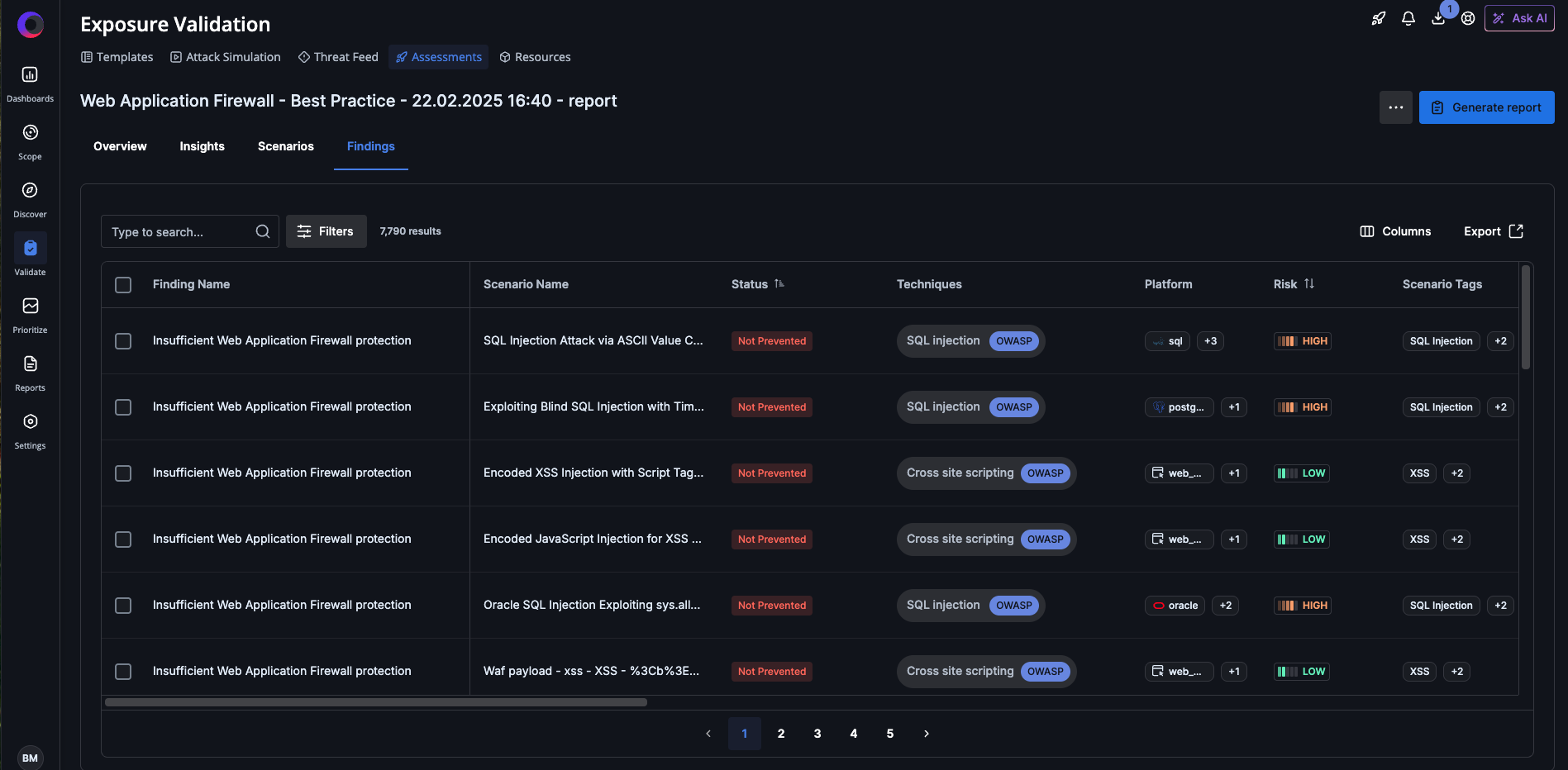
WAF findings enable you to identify gaps in prevention mechanisms, take remediation steps and optimize your organization's WAF. 

Customer spotlight: Execs wanted speed, security demanded a WAF 

A large retail enterprise learned the hard way that speed without security can be costly. After suffering a major cyberattack that took a revenue-critical server offline, the executive team wanted the system back in production immediately. However, the security team knew it needed to strengthen its WAF defenses before reestablishing the server that was affected.  

The team conducted a Cymulate assessment, which revealed that 96% of web-based attacks successfully bypassed the organization’s defenses. Armed with this data, the security team quickly gained executive buy-in to deploy and tune a proper WAF. 

Cymulate guided the customer in configuring the WAF, fine-tuned the rules and redeployed the server within two days. Since then, the organization has made Cymulate WAF assessments a mandatory step before every production release, ensuring every public-facing web service is protected before it goes live.  

The bigger picture: Continuous, realistic validation for modern apps 

With OAuth 2.0 support, Cymulate can now simulate how attacks behave in identity-driven environments, providing a more accurate view of real-world risk across authenticated web assets. Enterprises using OAuth or SSO authentication can now ensure their WAFs are equipped to withstand real-world attack techniques without compromising security or workflow. 

For Cymulate customers already leveraging Exposure Validation across email gateways, endpoints, or cloud environments, this is the perfect time to expand into WAF testing. Modern web applications are often the most exposed, and now, validating them is simpler, safer and more comprehensive than ever. 

Ready to test your WAF in real-world conditions? 

See how the Cymulate WAF Assessments with OAuth 2.0 deliver continuous validation for modern, SSO-secured web applications. Contact your Cymulate representative or schedule a demo to get started.

Book a Demo