

How to Prioritize Vulnerabilities in 2026: From CVSS to Real Risk
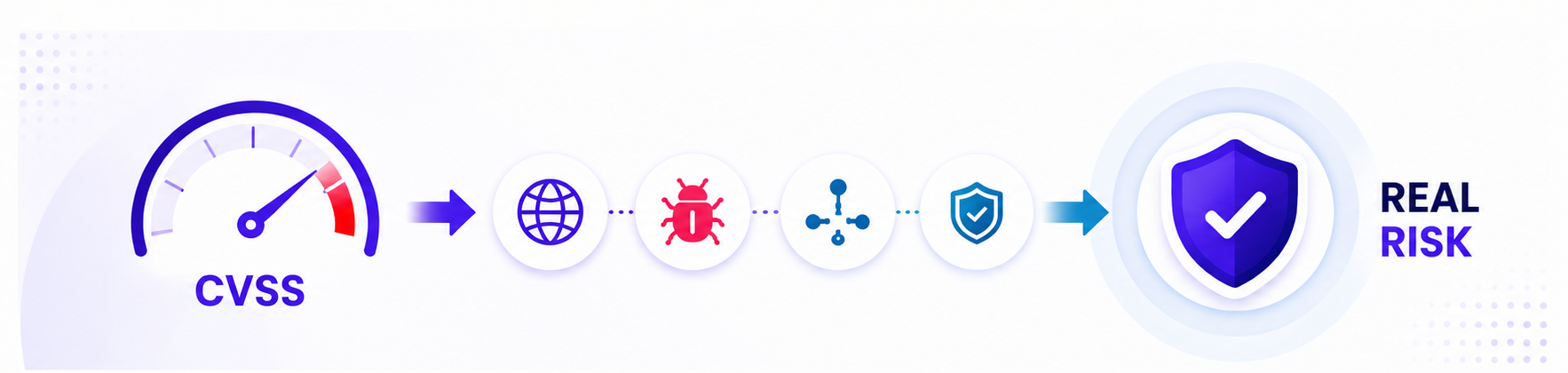
Security teams have more vulnerability data than ever. Scanners find exposures across endpoints, cloud assets, applications, identities and third-party tools. The problem is no longer finding issues. The problem is determining which exposures pose the greatest risk and deserve immediate attention.
For years, many teams relied on Common Vulnerability Scoring System (CVSS) scores to guide remediation. CVSS still has value because it gives teams a common way to understand technical severity. But severity alone does not equal real risk. A critical vulnerability on an isolated test system may matter less than a medium vulnerability on an internet-facing server that attackers are actively targeting. Without context, CVSS scores can help identify what is severe, but not necessarily what is most dangerous to the organization.
As the next evolution, the Exploit Prediction Scoring System (EPSS), which estimates the likelihood that a vulnerability will be exploited in the wild, was introduced. EPSS adds an important layer of insight by helping security teams distinguish between vulnerabilities that are merely severe and those that are likely to be weaponized by attackers. However, exploitability is only another piece of the puzzle.
Now, Anthropic's Mythos further emphasizes why organizations can no longer rely on severity and exploitability scores alone to drive remediation. In its first month, Mythos identified more than 23,000 potential vulnerabilities across open-source projects, with researchers estimating that over 6,200 would be high or critical severity. This demonstrates that security teams cannot remediate everything and must focus on the vulnerabilities that are truly exploitable and impactful within their specific environments.
As AI accelerates vulnerability discovery and exploitation, prioritization becomes more important than ever. Effective vulnerability prioritization builds on CVSS and EPSS scores by incorporating business impact and the coverage of prevention and detection by compensating security controls. The goal is simple: fix what matters most first in your specific environment.
Key takeaways
- Not all critical vulnerabilities pose the same level of risk. Asset criticality, exposure, attack paths and existing security controls significantly influence the potential impact of a vulnerability.
- Exploitability and exposure often matter more than severity scores alone.
- Attack-based validation helps teams identify which vulnerabilities can actually be leveraged by attackers.
- Modern vulnerability prioritization is continuous, not point-in-time.
- Risk changes as environments evolve, new threats emerge, assets become exposed and security controls are updated.
- Cymulate helps teams validate real-world risk and focus remediation where it has the greatest impact to reducing risk and strengthening threat resilience.
What is vulnerability prioritization?
Vulnerability prioritization is the process of ranking vulnerabilities based on the risk they pose to an organization. It helps security teams decide which issues to remediate first, which ones to monitor and which ones can wait.
This process sits inside broader vulnerability management. Scanning identifies weaknesses. Prioritization turns those findings into an action plan. Remediation then fixes or mitigates the most important issues.
Good vulnerability prioritization does more than sort by severity and is likely to be exploited. It combines technical data with business and environmental context. In addition to criticality and exploitability scores, it considers asset value, impact on business and existing controls for prevention and detection. Organizations must implement risk and contextual-based vulnerability validation, prioritization and remediation to reduce cyber risk.
Why traditional prioritization methods fall short
CVSS-based prioritization helped standardize vulnerability management, but it was never meant to carry the full weight of risk decisions.
The CVSS v4.0 specification explains that CVSS captures the principal technical characteristics of each vulnerability. The base score reflects intrinsic severity and assumes a reasonable worst-case impact across deployed environments. That makes CVSS useful as a baseline, but incomplete as a real-world risk measure.
Traditional methods fall short for five common reasons.
- Teams often over-rely on CVSS base scores. This creates long queues of “critical” and “high” vulnerabilities without enough context to know which ones are actually critical and high (i.e., the ones that must be addressed immediately).
- Many programs lack environmental context. A scanner may know that a vulnerability exists, but not whether the asset is internet-facing, business-critical or protected by compensating controls.
- Traditional approaches often skip exploitability validation. A high severity score does not prove attackers can exploit the vulnerability in a specific environment. Some organizations combined EPSS scores with CVSS for likelihood of exploitability, but still lacks exposure validation.
- Security tool overload complicates prioritization. Teams are forced to manage and reconcile findings across vulnerability scanners, cloud security tools, endpoint platforms, ticketing systems and SIEMs, creating operational inefficiencies, overwhelming amount of data and alert fatigue.
- Many vulnerability management programs still rely on static assessments that struggle to keep pace with rapidly evolving threats. Point-in-time prioritization quickly becomes outdated as new exploits, assets, configuration changes and attacker advancements and campaigns emerge daily.
- Key factors for prioritizing vulnerabilities
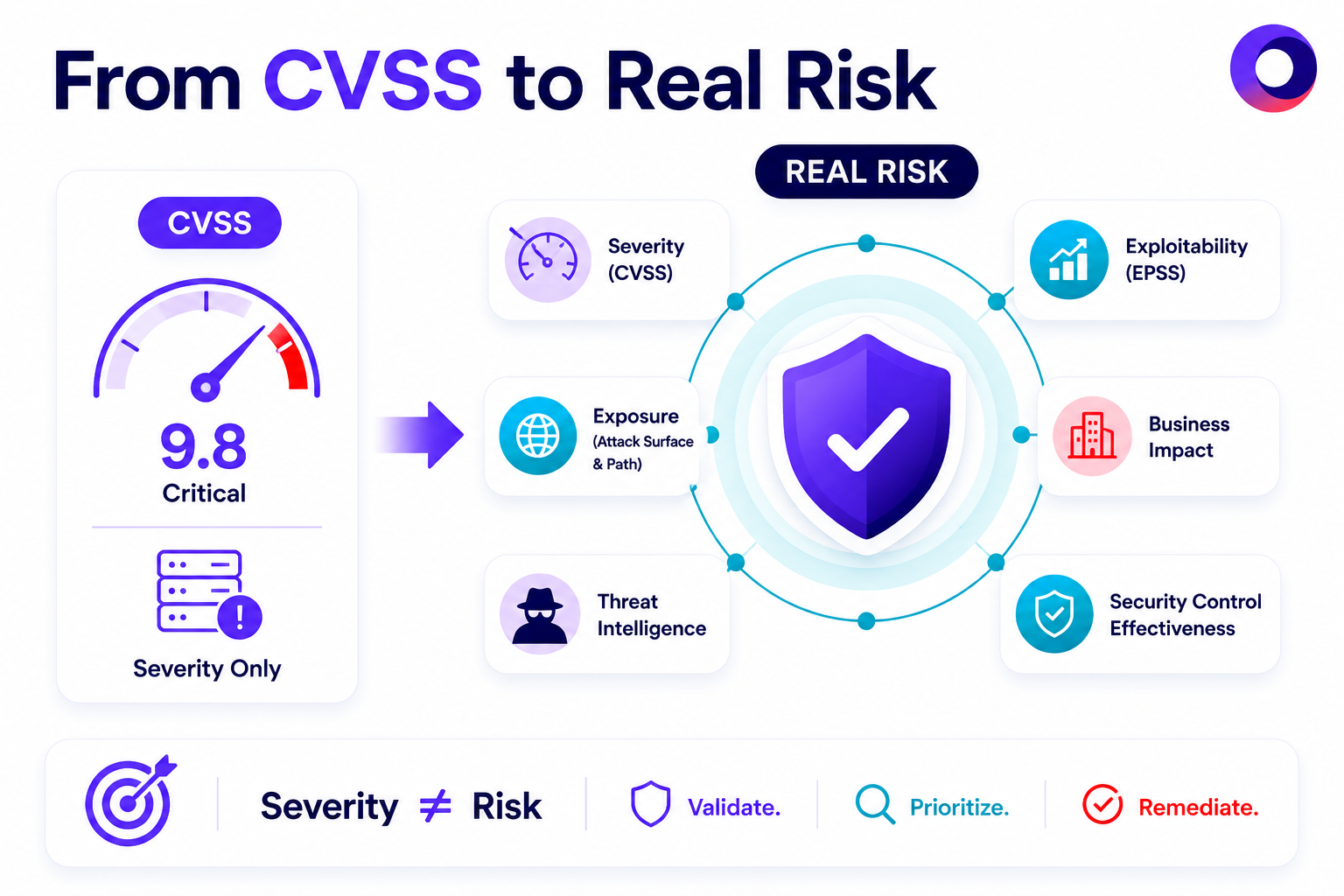
Severity (CVSS)
CVSS should remain part of the process. It gives teams a consistent technical starting point and helps compare vulnerabilities in terms of technical severity across vendors, systems and tools. But CVSS should not be the final decision. A strong vulnerability prioritization framework treats severity as one component of a broader contextual and risk-based approach
Exploitability (EPSS)
Exploitability data shows whether attackers are likely to use a vulnerability. Sources like the CISA Known Exploited Vulnerabilities Catalog and the Exploit Prediction Scoring System (EPSS) help teams measure this signal.
CISA KEV tracks vulnerabilities with evidence of active exploitation. EPSS estimates the probability that a vulnerability will be exploited. EPSS adds data-driven likelihood to prioritization, but it should not replace asset exposure, business impact or compensating security control validation.
Exposure attack surface and path
Exposure and attack surface shows whether an attacker can reach the vulnerable asset. Assets are part of the external attack surface, such as an internet-facing application, exposed remote access service or cloud workload with public access carries different risk than the same vulnerability on a restricted internal system or isolated environment. The broader and more accessible the attack surface, the greater the opportunity for attackers to target and exploit vulnerabilities.
Exposure also encompasses attack path context. A lower-severity vulnerability may warrant immediate attention if it provides a viable path to sensitive data, enables access by unauthenticated users, facilitates lateral movement or creates an opportunity for privilege escalation. Understanding how a vulnerability fits within potential attack paths helps organizations prioritize remediation based on actual technical cyber risk rather than severity and likelihood of exploitability alone.
Business impact
Security teams should prioritize vulnerabilities based on the potential business impact of a successful attack. A vulnerability on a revenue-generating application, identity provider, production database or healthcare system generally requires more immediate attention than the same vulnerability on a low-value asset.
Some critical systems require maintenance windows, testing or compensating controls before patching. Prioritization should account for both risk reduction and operational impact.
Threat intelligence
Threat intelligence helps teams understand attacker behavior. Active campaigns, malware usage, ransomware targeting, public exploit code and industry-specific threats should all influence priority.
A vulnerability used in active attacks against financial services, healthcare or government targets may move higher in the queue for organizations in those sectors.
Security control effectiveness
Security controls can reduce or increase the priority of vulnerability remediation. A critical or high vulnerability may exist, but there could already be existing prevention and detections in place with compensating controls. These include endpoint detection and response (EDR), web application firewall (WAF), ISD/IPS and SIEM. This would generally lower the priority. The opposite can also happen. A medium vulnerability can become urgent when there are no existing prevention and detection measures in place, especially when impacting critical business assets.
This is why security control validation is essential. Security teams need to verify which vulnerabilities require immediate remediation and which are effectively mitigated by existing security controls. Validating control effectiveness helps organizations prioritize based on actual risk and maintain security coverage while patches are being evaluated, scheduled and deployed.
Step-by-step: how to prioritize vulnerabilities
1. Aggregate and normalize vulnerability data
Start by centralizing vulnerability data from scanners, cloud security tools, endpoint platforms, application security tools and asset inventories.
Normalize findings so teams can remove duplicates, map vulnerabilities to assets and create a single working view. Each vulnerability should also map to a system owner, application team or infrastructure group. Understand the original technical severity and exploitability scores.
2. Add context to each vulnerability
Next, enrich each finding with asset and environment context.
Add asset criticality, system role, business unit, data sensitivity, internet exposure, network location, cloud configuration and identity access. A vulnerability on a public-facing authentication system should not receive the same treatment as one on a retired internal asset.
This context helps teams understand where the vulnerability sits in the business and how much damage exploitation could cause.
3. Assess exploitability
After adding context, assess exploitability. Look for known exploitation, proof-of-concept code, weaponization, attacker chatter, ransomware usage and EPSS probability.
CISA KEV should carry strong weight because it reflects active exploitation. EPSS can help prioritize vulnerabilities that are not yet in KEV but show a higher likelihood of exploitation.
Exploitability turns prioritization from “what looks severe” into “what attackers are more likely to use.”
4. Validate real-world risk
Validation is where modern prioritization becomes more accurate. Instead of assuming a vulnerability is exploitable, teams test whether an attack can succeed in their environment and where security controls are or are not providing security coverage.
Attack simulation and exposure validation help prove whether a vulnerability creates a real path to impact. This includes testing exploit paths, lateral movement, control prevention and detection coverage.
Validation also reveals compensating controls. A vulnerability may exist, but segmentation, endpoint protection or detection logic may reduce risk. It can also reveal the opposite: a lower-severity issue may become high priority because controls fail.
5. Rank based on actual risk, not just severity
Once teams combine severity, exploitability, exposure, business impact, threat intelligence and validation, they can create a practical ranking model.
A useful patch prioritization strategy can group findings into three tiers:
- Immediate remediation: Actively exploited vulnerabilities on exposed or business-critical assets, especially when existing controls are not providing coverage.
- Scheduled remediation: High-risk vulnerabilities with exploit potential, meaningful exposure or business impact, but no immediate proof of active exploitation.
- Monitor or defer: Vulnerabilities with low exploitability, limited exposure, lower business impact or strong compensating controls.
This model helps teams explain priorities clearly and gives leadership a better view of risk reduction, not just ticket volume.
6. Continuously reassess
Vulnerability prioritization is dynamic. A vulnerability that ranks low today can become urgent tomorrow if exploit code appears, an asset becomes exposed or attackers start using it in campaigns.
Continuous reassessment should update rankings as new information arrives. This includes scanner changes, asset changes, threat intelligence, EPSS movement, KEV additions and validation results.
This is where continuous threat exposure management (CTEM) becomes important. CTEM turns prioritization into an ongoing cycle of scoping, discovery, prioritization, validation and mobilization.
Vulnerability prioritization frameworks
CVSS-based prioritization
CVSS-based prioritization ranks vulnerabilities mainly by severity. It is simple, familiar and useful for baseline triage. Its weakness is context. CVSS does not automatically prove that attackers can reach or exploit the vulnerability in a specific environment.
EPSS
EPSS (Exploit Prediction Scoring System) is a data-driven model that estimates the likelihood a vulnerability will be exploited in the wild within the next 30 days. Unlike CVSS, which measures technical severity, EPSS helps security teams prioritize vulnerabilities based on their probability of exploitation, enabling a more risk-focused approach to remediation.
Risk-based vulnerability management (RBVM)
Risk-based vulnerability management adds more context to vulnerability decisions. It considers asset value, exploitability, business impact and threat intelligence. RBVM helps teams focus remediation on meaningful risk.
Threat-informed prioritization
Threat-informed prioritization uses attacker behavior to guide remediation. It considers active campaigns, known exploited vulnerabilities, malware usage and tactics mapped to frameworks like the MITRE ATT&CK® Framework. This approach helps teams align patching with relevant threats.
Attack-based vulnerability management (ABVM)
Attack-based vulnerability management validates vulnerabilities through real attack behavior. Instead of ranking findings only by score or likelihood, ABVM tests whether attackers can exploit weaknesses and whether controls prevent or detect the attack.
This is the evolution point. CVSS tells teams how severe a vulnerability could be. RBVM adds business and threat context. ABVM adds proof.
What is attack-based vulnerability prioritization?
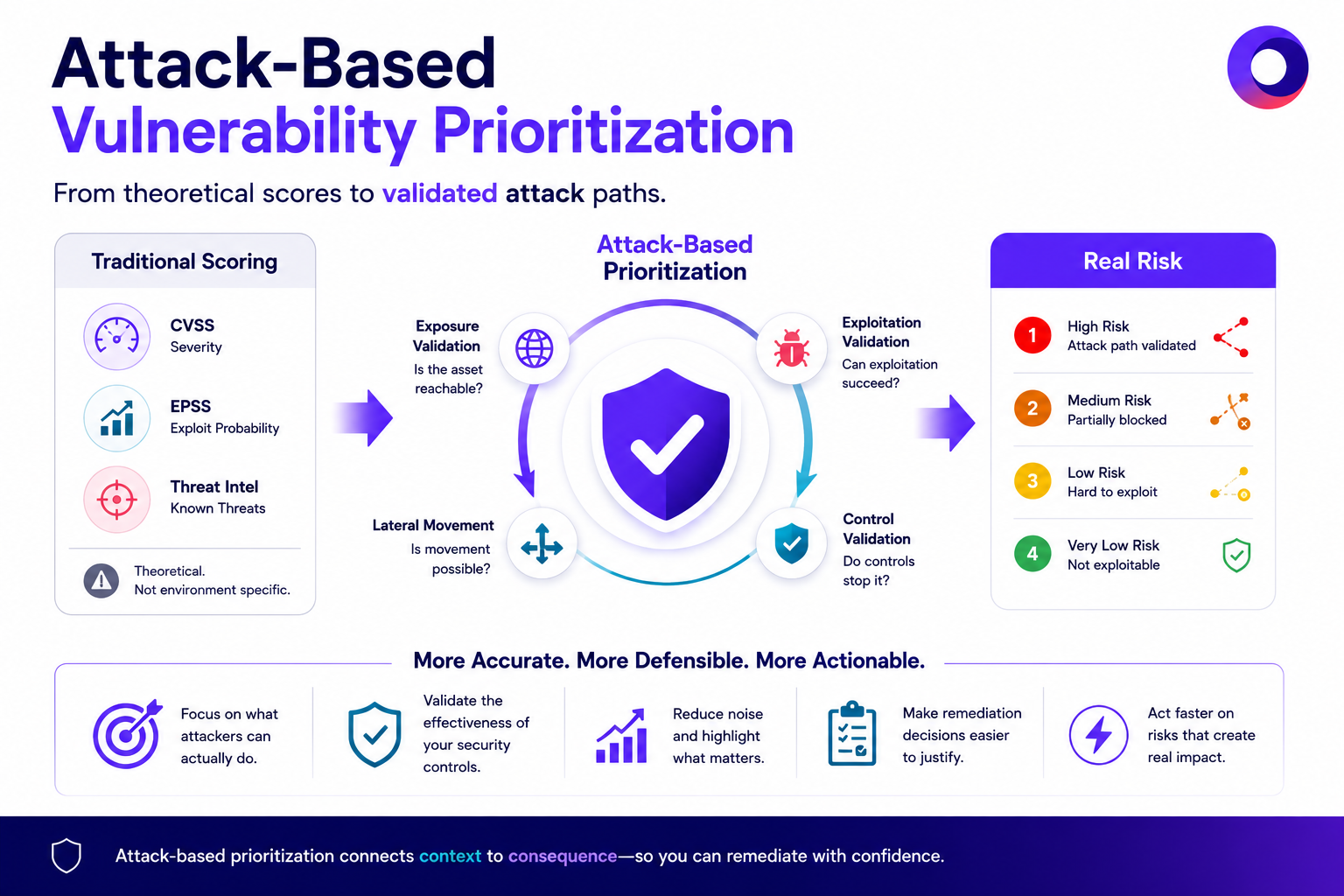
Attack-based vulnerability prioritization ranks vulnerabilities based on validated attackability and impact. It uses simulated attacks, exposure validation and control testing to show which vulnerabilities create real risk in a specific environment.
This approach is more accurate than theoretical scoring because it reflects the conditions attackers face. It considers whether the asset is reachable, whether exploitation can succeed, whether lateral movement is possible and whether security controls stop the activity.
Attack-based prioritization does not replace CVSS, EPSS or threat intelligence. It connects them to real-world evidence. That makes remediation decisions easier to defend and easier to act on.
Benefits of effective vulnerability prioritization
Effective vulnerability prioritization helps teams reduce backlog, focus resources and improve remediation speed.
It creates operational focus because teams stop treating every high or critical vulnerability as equal. It improves mean time to remediate (MTTR) because teams can route tickets faster, assign owners and reduce debate. It also reduces breach likelihood by closing the paths attackers are most likely to use.
Strong prioritization also improves business alignment. Security teams can explain remediation in terms of business impact, not only technical severity.
Cymulate customer results show the value of validated prioritization. The Cymulate CTEM data sheet reports a 52% reduction in critical exposures and 60% more efficient prioritization. These results show why validation matters.
Common mistakes to avoid
Common mistakes include treating all “critical” vulnerabilities equally, ignoring asset context, prioritizing only for compliance, skipping exploitability validation and treating prioritization as a one-time exercise. Critical severity should trigger review, but it should not automatically determine remediation order. Risk changes as assets, controls and attacker behavior change.
How Cymulate helps prioritize vulnerabilities
Cymulate helps security teams move from a long list of vulnerabilities to validated, risk-based action so organizations can know where to focus their efforts to ensure continued threat resilience.
The Cymulate CTEM platform helps prove exploitability, prioritize based on impact and adapt security controls to mitigate exposure. It ingests and aggregates exposure and asset data, validates exploitability through attack simulation and ranks exposures based on threat intelligence, business criticality and control effectiveness. It is supplemented with auto-remediation to security controls for prevention and detection.
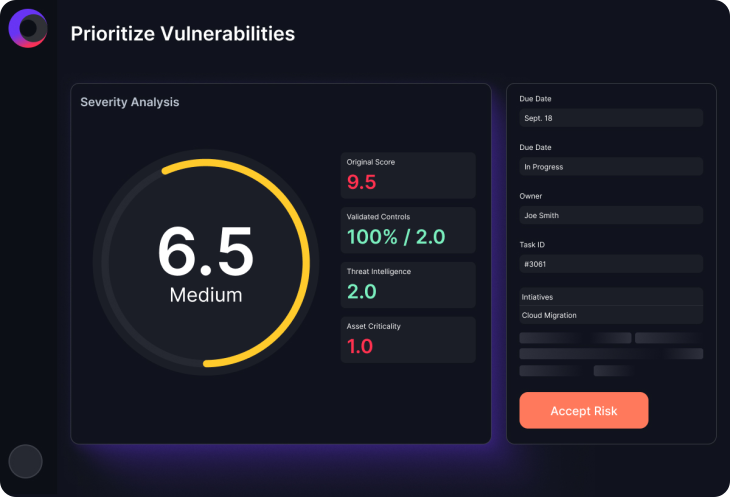
With Cymulate Exposure Validation, teams can test whether vulnerabilities are truly exploitable in their environment. This gives vulnerability management, security operation center (SOC), red team and security engineering teams shared evidence for remediation decisions.
Cymulate Detection Studio also supports the control effectiveness side of prioritization. When teams understand where detection coverage works and where it needs improvement, they can decide whether to patch, tune controls or apply mitigation.
With Cymulate, organizations are equipped with an effective approach and solution to prioritize vulnerabilities in today’s complex environment. Start with CVSS and EPSS, but move toward real risk. Add business impact and threat intelligence. Then, validate what attackers can actually do in your specific environment.

Featured Resources
View More Resources
Evolving Vulnerability Management to Continuous Threat Exposure Management
Shift from reactive vulnerability management to continuous, threat-validated exposure management for real risk resilience.
Cymulate for Vulnerability Management Teams
Move beyond vulnerability scanning with validated exposure, risk-based prioritization, and faster mitigation.

How a Retail Organization Became 12x Faster at Assessing Security Controls with Cymulate
A global retail organization transformed security validation, achieving 12x faster assessments with Cymulate.