
Frequently Asked Questions

Ransomware Detection & Techniques

What makes ransomware so difficult to detect?

Modern ransomware is engineered to evade conventional security tools using polymorphic code, living-off-the-land tactics, delayed activation, lateral movement, and double/triple extortion. These techniques allow attackers to remain undetected for extended periods, making early detection challenging. (Source: https://cymulate.com/blog/ransomware-detection-techniques)

What are the common signs of a ransomware attack?

Key indicators include unusual file activity (renaming, unauthorized encryption), suspicious user behavior (privilege escalation, lateral movement), system anomalies (performance degradation, crashes), outbound communication to malicious domains, and aggressive file encryption processes. (Source: https://cymulate.com/blog/ransomware-detection-techniques)

What types of ransomware attacks are most prevalent?

Primary classes include encrypting ransomware (crypto-ransomware), doxware/leakware, wiping ransomware, ransomware-as-a-service (RaaS), locker ransomware, MBR ransomware, and scareware. Each type employs unique tactics, from file encryption to system locking and data exfiltration. (Source: https://cymulate.com/blog/ransomware-detection-techniques)

How does Cymulate's platform help detect ransomware proactively?

Cymulate transforms detection from reactive to proactive by continuously validating detection capabilities across the entire ransomware kill chain. The platform simulates real-world ransomware payloads, infection paths, and evasion tactics in production-safe environments, enabling organizations to identify gaps before attackers exploit them. (Source: https://cymulate.com/blog/ransomware-detection-techniques)

What are the benefits of validated ransomware detection with Cymulate?

Validated detection reduces dwell time, improves incident response, maximizes security investments, and prioritizes patch management. By aligning detection with real-world attack behavior, Cymulate empowers teams to act smarter and faster. (Source: https://cymulate.com/blog/ransomware-detection-techniques)

How does Cymulate test email gateway resilience against ransomware?

Cymulate validates how well email filters catch malicious attachments and links before users interact with them. The platform identifies configuration flaws and provides actionable recommendations to strengthen email gateway defenses. (Source: https://cymulate.com/blog/ransomware-detection-techniques)

What is the role of endpoint security validation in ransomware detection?

Cymulate launches multi-stage ransomware scenarios to assess how EDR, antivirus, and XDR tools detect and respond to threats. This ensures endpoint security controls are effective against advanced ransomware tactics. (Source: https://cymulate.com/blog/ransomware-detection-techniques)

How does Cymulate emulate the full ransomware kill chain?

The platform tests resilience from initial infection to lateral movement, encryption, and exfiltration, providing a comprehensive assessment of an organization's defenses across all stages of a ransomware attack. (Source: https://cymulate.com/blog/ransomware-detection-techniques)

What are auto-generated Sigma rules in Cymulate?

Cymulate instantly provides detection rules for SOCs to close observed gaps and reduce dwell time, enabling faster and more effective incident response. (Source: https://cymulate.com/blog/ransomware-detection-techniques)

How quickly can Cymulate be deployed for ransomware detection?

Cymulate offers fast deployment with optional agents and a cloud-native setup, allowing organizations to start validating within hours. Pre-built scenarios make it easy to launch tests against ransomware strains and tactics. (Source: https://cymulate.com/blog/ransomware-detection-techniques)

How does Cymulate integrate with SIEM and EDR tools?

Cymulate findings can be correlated with SIEM and EDR tools such as Splunk, Microsoft Defender, and SentinelOne, accelerating detection and response workflows. (Source: https://cymulate.com/blog/ransomware-detection-techniques)

What is the advantage of continuous detection with Cymulate?

Cymulate enables continuous detection without disrupting daily operations or risking production systems, moving teams beyond alerts to actual detection validation and closing gaps in real-time. (Source: https://cymulate.com/blog/ransomware-detection-techniques)

How does Cymulate help organizations build ransomware resilience?

Cymulate offers exposure validation and threat resilience, enabling organizations to detect, test, and build resilience across all ransomware vectors. This proactive approach helps teams stay ahead of attacks rather than responding after damage occurs. (Source: https://cymulate.com/blog/ransomware-detection-techniques)

What practical steps can organizations take to become ransomware resilient?

Organizations can follow Cymulate's guidance, including validating detection capabilities, prioritizing patch management, and continuously testing defenses. For more details, see the blog post '7 Essential Steps to Becoming Ransomware Resilient.' (Source: https://cymulate.com/blog/essential-steps-to-becoming-ransomware-resilient/)

How does Cymulate address lateral movement attacks?

Cymulate's Attack Path Discovery solution automates testing for lateral movement, helping organizations identify and mitigate risks associated with attackers moving across endpoints. (Source: https://cymulate.com/attack-path-discovery/)

Where can I find more resources on ransomware detection and resilience?

Cymulate offers a Resource Hub with insights, thought leadership, and product information. Visit our Resource Hub for whitepapers, blogs, and webinars. (Source: https://cymulate.com/resources/)

How does Cymulate's platform differ from traditional ransomware detection tools?

Unlike traditional tools that rely on signature-based detection and heuristics, Cymulate provides continuous, automated validation of detection capabilities across the ransomware kill chain, including proactive testing and actionable reporting. (Source: https://cymulate.com/blog/ransomware-detection-techniques)

What is the impact of ransomware on organizations?

Ransomware attacks can cripple organizations, exfiltrate sensitive data, and cost billions annually in recovery and downtime. The use of strong encryption and extortion tactics makes recovery difficult without access to the attacker's decryption key. (Source: https://cymulate.com/blog/ransomware-detection-techniques)

How does Cymulate help prioritize patch management for ransomware defense?

Cymulate's validated detection approach helps organizations focus remediation efforts on exploitable paths and vulnerable assets, ensuring patch management is prioritized based on real-world risk. (Source: https://cymulate.com/blog/ransomware-detection-techniques)

How does Cymulate's reporting help improve incident response?

Cymulate provides detailed insights into what was executed, blocked, deleted, or missed, mapped to MITRE ATT&CK, equipping SOC teams with precise, actionable data for faster triage and containment. (Source: https://cymulate.com/blog/ransomware-detection-techniques)

How does Cymulate support organizations in responding to evolving ransomware threats?

Cymulate continuously updates its threat library and testing scenarios, ensuring organizations stay ahead of emerging ransomware tactics and maintain effective defenses. (Source: https://cymulate.com/blog/ransomware-detection-techniques)

Features & Capabilities

What are the key capabilities of Cymulate's platform for ransomware detection?

Cymulate offers continuous threat validation, breach and attack simulation, exposure analytics, attack path discovery, automated mitigation, AI-powered optimization, and a library of over 100,000 attack actions aligned to MITRE ATT&CK, updated daily. (Source: https://cymulate.com/platform/)

Does Cymulate integrate with other security technologies?

Yes, Cymulate integrates with a wide range of security technologies, including Akamai Guardicore, AWS GuardDuty, BlackBerry Cylance OPTICS, Carbon Black EDR, Check Point CloudGuard, Cisco Secure Endpoint, CrowdStrike Falcon, Wiz, SentinelOne, and more. For a complete list, visit our Partnerships and Integrations page. (Source: https://cymulate.com/cymulate-technology-alliances-partners/)

How easy is Cymulate to use for ransomware detection?

Cymulate is praised for its ease of use, intuitive dashboard, and user-friendly interface. Customers report immediate value, actionable insights, and minimal setup required. (Source: https://cymulate.com/schedule-a-demo/)

What certifications and compliance standards does Cymulate meet?

Cymulate holds SOC2 Type II, ISO 27001:2013, ISO 27701, ISO 27017, and CSA STAR Level 1 certifications, ensuring robust security and compliance standards. (Source: https://cymulate.com/security-at-cymulate/)

What is Cymulate's pricing model?

Cymulate operates on a subscription-based pricing model tailored to each organization's requirements. Pricing depends on the chosen package, number of assets, and scenarios selected. For a detailed quote, schedule a demo at our demo page. (Source: manual)

Who can benefit from Cymulate's ransomware detection capabilities?

Cymulate is designed for CISOs, security leaders, SecOps teams, Red Teams, and vulnerability management teams in organizations of all sizes and industries, including finance, healthcare, retail, media, transportation, and manufacturing. (Source: https://cymulate.com/roles-ciso-cio/)

How does Cymulate compare to other ransomware detection solutions?

Cymulate offers a unified platform integrating breach and attack simulation, continuous automated red teaming, and exposure analytics. It provides continuous threat validation, AI-powered optimization, and complete kill chain coverage, differentiating it from competitors that focus on specific areas or point-in-time assessments. (Source: https://cymulate.com/cymulate-vs-competitors/)

What customer success stories demonstrate Cymulate's ransomware detection effectiveness?

Hertz Israel reduced cyber risk by 81% in four months using Cymulate. A civil engineering organization went beyond security control validation with Cymulate's automated offensive testing. For more case studies, visit our Case Studies page. (Source: https://cymulate.com/customers/)

How does Cymulate help organizations address fragmented security tools?

Cymulate integrates exposure data and automates validation, providing a unified view of the security posture and addressing gaps caused by disconnected tools. (Source: manual)

What pain points does Cymulate solve for ransomware detection?

Cymulate addresses fragmented security tools, resource constraints, unclear risk prioritization, cloud complexity, communication barriers, inadequate threat simulation, operational inefficiencies, and post-breach recovery challenges. (Source: manual)

How does Cymulate tailor solutions for different user personas?

Cymulate provides quantifiable metrics for CISOs, automates processes for SecOps teams, offers automated offensive testing for Red Teams, and enables efficient vulnerability prioritization for vulnerability management teams. (Source: https://cymulate.com/roles-ciso-cio/)

How does Cymulate ensure data security and privacy?

Cymulate uses encryption for data in transit (TLS 1.2+) and at rest (AES-256), secure AWS-hosted data centers, a tested disaster recovery plan, secure development lifecycle, vulnerability scanning, third-party penetration tests, and GDPR compliance. (Source: https://cymulate.com/security-at-cymulate/)

How can I stay updated with Cymulate's latest research and news?

Visit Cymulate's blog for the latest threats and research, and the newsroom for media mentions and press releases. (Source: https://cymulate.com/blog/)

Where can I find events and webinars hosted by Cymulate?

Information about live events and webinars is available on Cymulate's Events & Webinars page. (Source: https://cymulate.com/events/)

How does Cymulate help remediate email gateway flaws?

Cymulate assessments can identify flaws in email gateway configurations, such as allowing emails through if only one antivirus detects ransomware. Cymulate provides guidance to reconfigure gateways, reducing risk scores and preventing ransomware penetration. (Source: Customer Story - Caught, But Not Contained_ The Email Gateway Flaw.pdf)

New: 2026 Gartner® Market Guide for Adversarial Exposure Validation
Learn More
Cymulate named a Customers' Choice in 2025 Gartner® Peer Insights™
Learn More
New Research: Azure Arc Privilege Escalation & Identity Takeover
Learn More
An Inside Look at the Technology Behind Cymulate
Learn More

Ransomware Detection Techniques: A Smarter Approach to Staying Ahead of Attacks 

By: Jake O’Donnell

Last Updated: September 7, 2025

cymulate blog article

Ransomware attacks continue to rise in both volume and sophistication, crippling organizations, exfiltrating sensitive data and costing billions annually in recovery and downtime.  

Early detection isn’t just important - it’s essential

Attackers deploy advanced tactics to remain undetected for as long as possible, from polymorphic code and evasion techniques to time-delayed execution and lateral movement. Relying solely on traditional antivirus and endpoint protection to detect ransomware is no longer enough.  

Security teams need smarter, faster and more proactive ransomware detection techniques to stay ahead. 

What Makes Ransomware So Hard to Detect? 

Modern ransomware strains are engineered to avoid conventional security tools. Here's why detecting ransomware is increasingly complex: 

  • Polymorphic Malware: Code changes on each execution, evading signature-based detection. 
  • Living-off-the-land Tactics: Attackers abuse legitimate tools like PowerShell or PsExec to avoid triggering alerts. 
  • Delayed Activation: Ransomware often lies dormant before executing, making early detection difficult. 
  • Lateral Movement: Attackers silently move across endpoints to escalate privileges and maximize damage. 
  • Double/Triple Extortion: Beyond encryption, attackers threaten to leak data or re-target unless ransoms are paid. 

These stealthy characteristics make detecting ransomware during the early stages a critical but challenging task. 

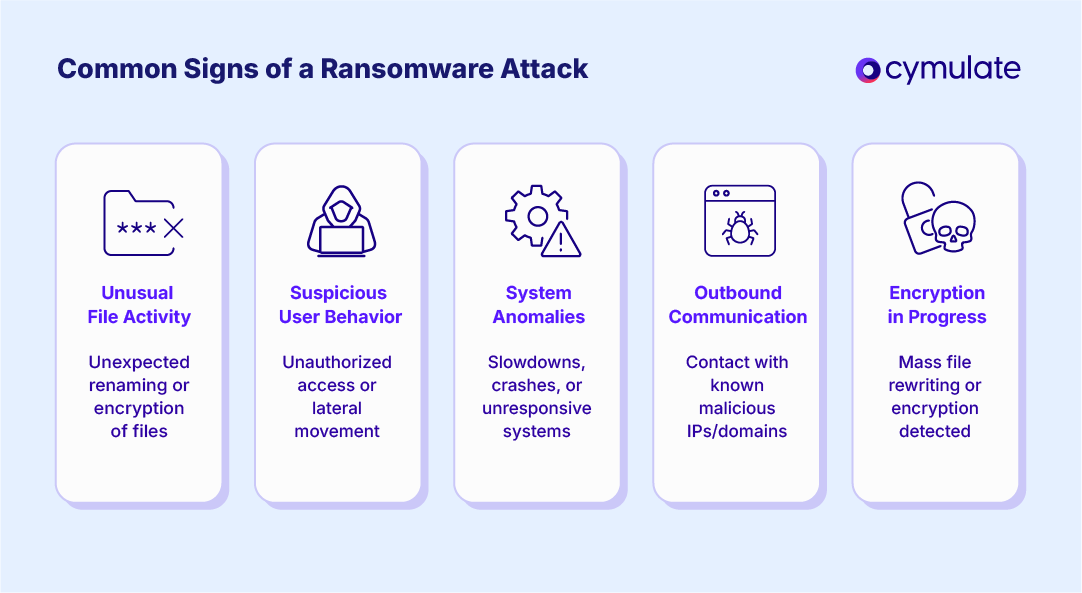
Common Signs of a Ransomware Attack 
common signs of a ransomware attack

While ransomware can be stealthy, there are often detectable symptoms if you know what to look for. Key signs of ransomware include: 

  • Unusual File Activity: Unexpected file renaming, modifications, or unauthorized encryption behavior. 
  • Suspicious User Behavior: Privilege escalation or lateral movement by compromised accounts. 
  • System Anomalies: Sudden performance degradation, frequent crashes, or system unresponsiveness. 
  • Outbound Communication: Connections to known malicious domains or IPs. 
  • Encryption in Progress: The presence of processes aggressively reading and rewriting files in bulk. 

Timely identification of these indicators is vital for swift incident response and mitigation. If not properly identified, you can quickly see how effective ransomware can be. Here’s how: 

  • Ransomware employs strong, unbreakable encryption algorithms, making it infeasible for victims to decrypt affected files without access to the attacker's private decryption key. 
  • It can encrypt a wide variety of file types, including documents, images, videos, and audio files, thereby maximizing the impact across personal and enterprise systems. 
  • Ransomware renames or scrambles file names during encryption, hindering the victim's ability to determine which files have been targeted. 
  • After encryption is complete, it presents a ransom note containing payment instructions. Payments are typically demanded in cryptocurrency, such as Bitcoin or Monero, to anonymize the attacker and bypass conventional financial oversight. 
  • Many ransomware variants are equipped with a "dead man's switch" or time-based triggers: if the ransom is not paid within a specified timeframe, the malware either deletes the encrypted data permanently or leaks stolen data publicly, damaging the brand, exposing sensitive information, or harming individual reputations. 
  • To ensure persistence and minimize detection, ransomware uses advanced evasion techniques, including code obfuscation, runtime packing, process hollowing and the disabling of endpoint protection tools, allowing it to bypass traditional antivirus and endpoint detection systems. 

Ransomware Typology: Different Attack Types 

As ransomware techniques have evolved, so too has the typology of attacks. Contemporary ransomware operations now span multiple categories, often overlapping or combining tactics for greater effectiveness. Below is a breakdown of the primary classes of ransomware observed in the wild: 

1. Encrypting Ransomware 

Also known as crypto-ransomware, this is the most prevalent type of ransomware in use today. It leverages strong cryptographic algorithms (often AES for symmetric encryption in conjunction with RSA for asymmetric key exchange) to encrypt critical files and render them inaccessible.  

Victims are typically presented with a ransom note demanding payment (commonly in cryptocurrency) in exchange for the decryption key. The sophistication of key management and encryption implementation has increased over time, making manual recovery or brute-force decryption impractical in most cases. 

2. Doxware / Leakware 

A variant of traditional encrypting ransomware, doxware extends the attack surface by exfiltrating sensitive data prior to - or in lieu of - encryption. The threat actor then issues a secondary extortion demand, threatening to publicly release or sell the stolen data if the ransom is not paid.  

This double extortion model has become increasingly common, with some campaigns incorporating direct outreach to customers, employees, or business partners of the victim organization to increase pressure. 

3. Wiping Ransomware 

Unlike encrypting ransomware, wiping variants do not offer data recovery as a viable outcome. These strains overwrite or corrupt the victim’s data irreversibly. In some cases, attackers may still demand a ransom under false pretenses, though no decryption or restoration mechanism exists.  

This tactic blurs the line between ransomware and data destruction malware (e.g., wipers like NotPetya) and is often politically or ideologically motivated, rather than purely financially driven. 

4. Ransomware-as-a-Service (RaaS) 

RaaS platforms commoditize ransomware by offering ready-to-deploy ransomware kits, command-and-control infrastructure, and payment handling services to affiliates in exchange for a cut of the ransom profits.  

These platforms operate similarly to legitimate SaaS models and drastically lower the barrier to entry for less technically skilled threat actors. RaaS has accelerated the proliferation of ransomware attacks, enabling organized cybercrime groups to scale operations through affiliate networks. 

5. Locker Ransomware 

Locker ransomware targets system functionality rather than file contents. These variants restrict user access to the infected operating system, often locking the screen and disabling input devices. Unlike encrypting ransomware, files themselves are typically left untouched.  

However, access to applications and data is obstructed, and the attacker demands a ransom to restore system functionality. While less damaging than file encryption, locker ransomware can still cause significant operational disruption. 

6. MBR Ransomware 

A subcategory of locker ransomware, MBR (Master Boot Record) ransomware compromises the bootloader by overwriting the MBR with malicious code. Upon system startup, instead of the OS loading, the victim is presented with a ransom demand screen. Because this type of ransomware operates at the boot level, it effectively disables the entire system from loading, presenting unique recovery challenges that often require advanced forensic or boot-level remediation techniques. 

7. Scareware 

Scareware typically masquerades as legitimate security software or system alerts, falsely claiming that the victim's system is infected or compromised. These messages are engineered to induce panic, prompting the user to pay for fake remediation services or "cleaning tools."  

While scareware lacks the destructive payloads of true ransomware, it remains an effective social engineering tactic, especially among non-technical users. 

Conventional Ransomware Detection Techniques 

Most organizations still rely on traditional tools and methods to detect ransomware: 

  • Signature-Based Antivirus and EDR: Detects known malware using predefined patterns but fails against zero-day or polymorphic variants. 
  • Heuristics and Behavioral Analysis: Identifies abnormal activity, though prone to false positives and limited by predefined baselines. 
  • Email Gateway Filtering: Scans attachments and URLs for known threats, often missing obfuscated payloads. 
  • SIEM and Log Analysis: Correlates logs and events to detect anomalies, but effectiveness depends on coverage and rule tuning. 

These methods are valuable but reactive. They detect what's already happening, often after the initial compromise

The Cymulate Approach to Proactive Detection 

Cymulate transforms ransomware detection from reactive to proactive through its exposure validation and threat resilience platform. Unlike traditional tools, Cymulate continuously validates detection capabilities across the entire ransomware kill chain before real attackers strike. 

Key Capabilities of the Cymulate Platform 

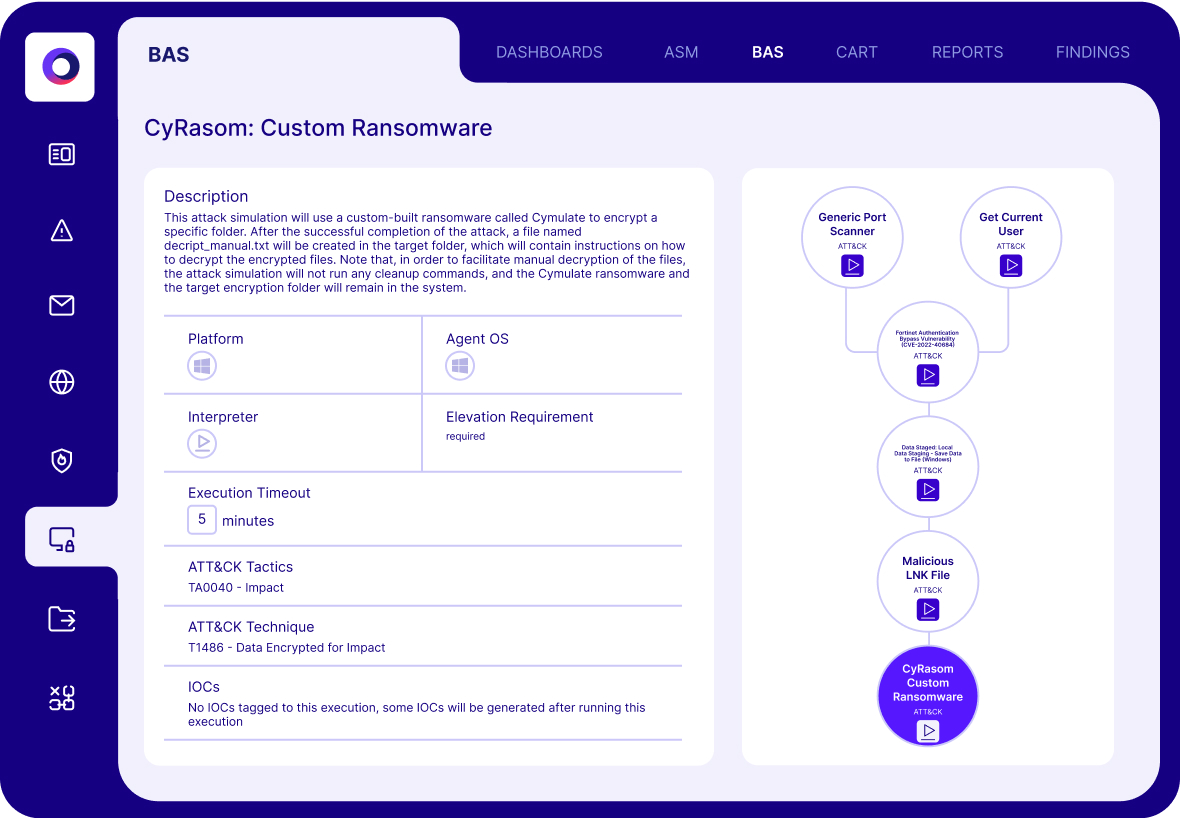
  • Breach and Attack Simulation (BAS): Simulates real-world ransomware payloads, infection paths, and evasion tactics in production-safe environments. 
  • Email Gateway Testing: Validates how well email filters catch malicious attachments and links, before users click. 
  • Endpoint Security Vector: Launches multi-stage ransomware scenarios that assess how your EDR, antivirus, and XDR tools detect and respond. 
  • Full Kill Chain Emulation: Tests resilience from initial infection to lateral movement and encryption to exfiltration. 
  • Auto-Generated Sigma Rules: Instantly provides detection rules for SOCs to close observed gaps and reduce dwell time. 
Real-World Application: Continuous Detection Without Disruption 

The Cymulate platform is designed for continuous detection without interrupting daily operations or putting production systems at risk. 

How It Works: 

  • Fast Deployment: Agents are optional, and cloud-native setup means you can start validating within hours. 
  • Click-to-Launch Testing: Pre-built scenarios make it easy to test against ransomware strains and tactics. 
  • Actionable Reporting: Detailed insights into what was executed, blocked, deleted or missed - mapped to MITRE ATT&CK
  • SIEM/EDR Integration: Findings can be correlated with tools like Splunk, Microsoft Defender, SentinelOne and more to accelerate detection and response workflows. 

This capability moves teams beyond alerts to actual detection validation, closing gaps in real-time. 

Benefits of Validated Ransomware Detection 

Validation turns assumptions into facts, ensuring your ransomware defenses actually work when it matters. The detection-first approach from Cymulate provides tangible benefits: 

  • Reduce Dwell Time: Identify ransomware activity earlier in the kill chain, minimizing damage. 
  • Improve Incident Response: Equip SOC teams with precise, actionable data for faster triage and containment. 
  • Maximize Security Investments: Understand where your current stack works - and where it needs tuning. 
  • Prioritize Patch Management: Focus remediation efforts on exploitable paths and vulnerable assets. 

By aligning detection with real-world attack behavior, Cymulate empowers security teams to act smarter, not just faster. 

From Detection to Resilience: The Smarter Strategy 

Detection alone is not enough. The new standard is validated detection - automated, continuous, and threat-informed. Ransomware is evolving every day, and so should your defenses. 

Cymulate offers a smarter, scalable, and comprehensive strategy to detect, test and build resilience across all ransomware vectors. With exposure validation and threat resilience, organizations can stay ahead of ransomware attacks, not just respond after the damage is done. 

Explore how Cymulate helps your team become ransomware resilient

Cymulate Exposure Validation makes advanced security testing fast and easy. When it comes to building custom attack chains, it's all right in front of you in one place.
Mike Humbert, Cybersecurity Engineer
DARLING INGREDIENTS INC.
Learn More
Book a Demo