

Red Team Exercise Guide: How to Automate and Integrate with Blue Teams
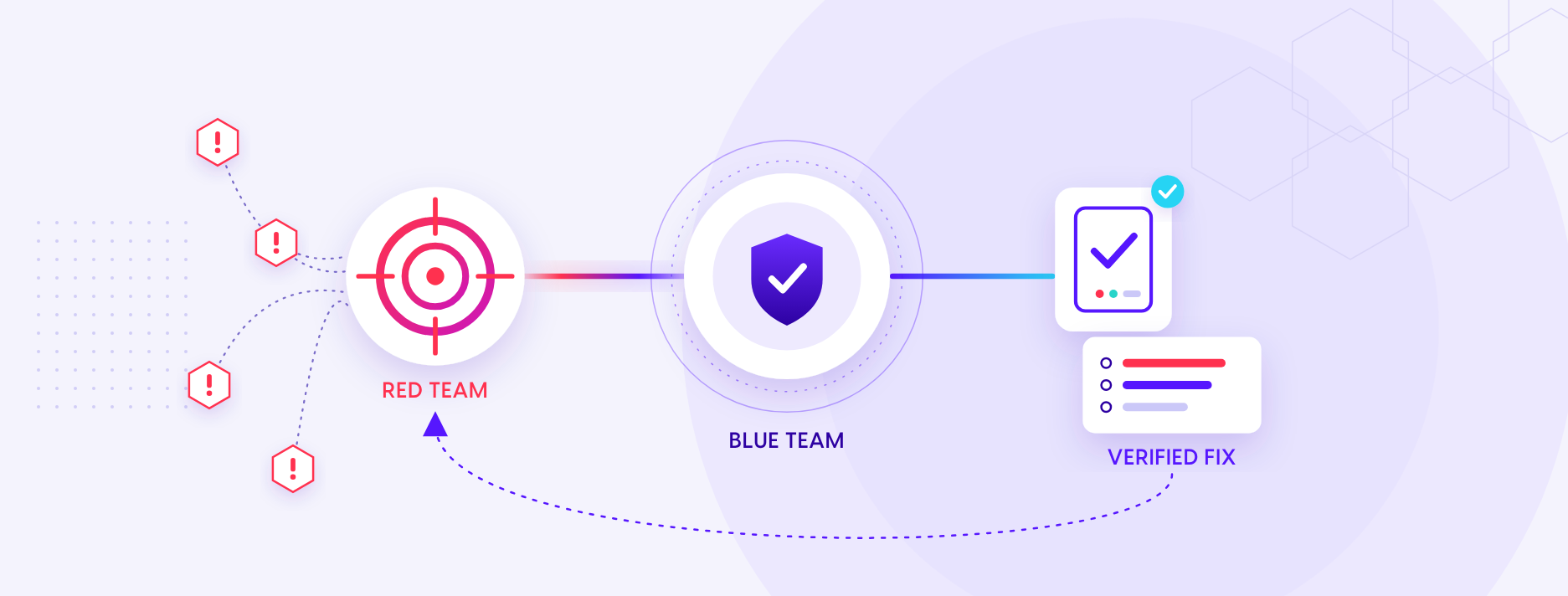
A red team exercise is an authorized, simulated attack in which ethical hackers emulate a real adversary to test how well an organization prevents, detects and responds to a threat. It chains multiple red team scenarios into one end-to-end campaign against a defined business objective, evaluating people, processes and technology along the way.
The value comes from what defenders learn and improve. The goal is evidence that your security controls interrupt the attack paths that matter most, not a long list of findings. Traditional exercises take months to plan and weeks to run, so most organizations test only a few times a year while attackers and environments change constantly. That creates a risk-to-fix gap: reports arrive weeks after testing, and defenses may change before fixes land. At Cymulate, we close that gap with agentic cyber defense engineering, and this guide shows where it fits in each phase.
What is a red team exercise?
A red team exercise tests whether an adversary could achieve an agreed objective within approved boundaries. NIST SP 800-53 Rev. 5 describes red teaming as a “simulated adversarial attempt to compromise organizational missions or business processes.”
A red team scenario is one attack storyline: one adversary, one objective and a connected chain of techniques, such as a spearphishing email that leads to a persistent foothold. An exercise links several scenarios, moving from that foothold through credential access and lateral movement to a crown-jewel system and data exfiltration. At each stage, it measures whether controls block the technique, whether the security operations center (SOC) detects it and how fast the team responds.
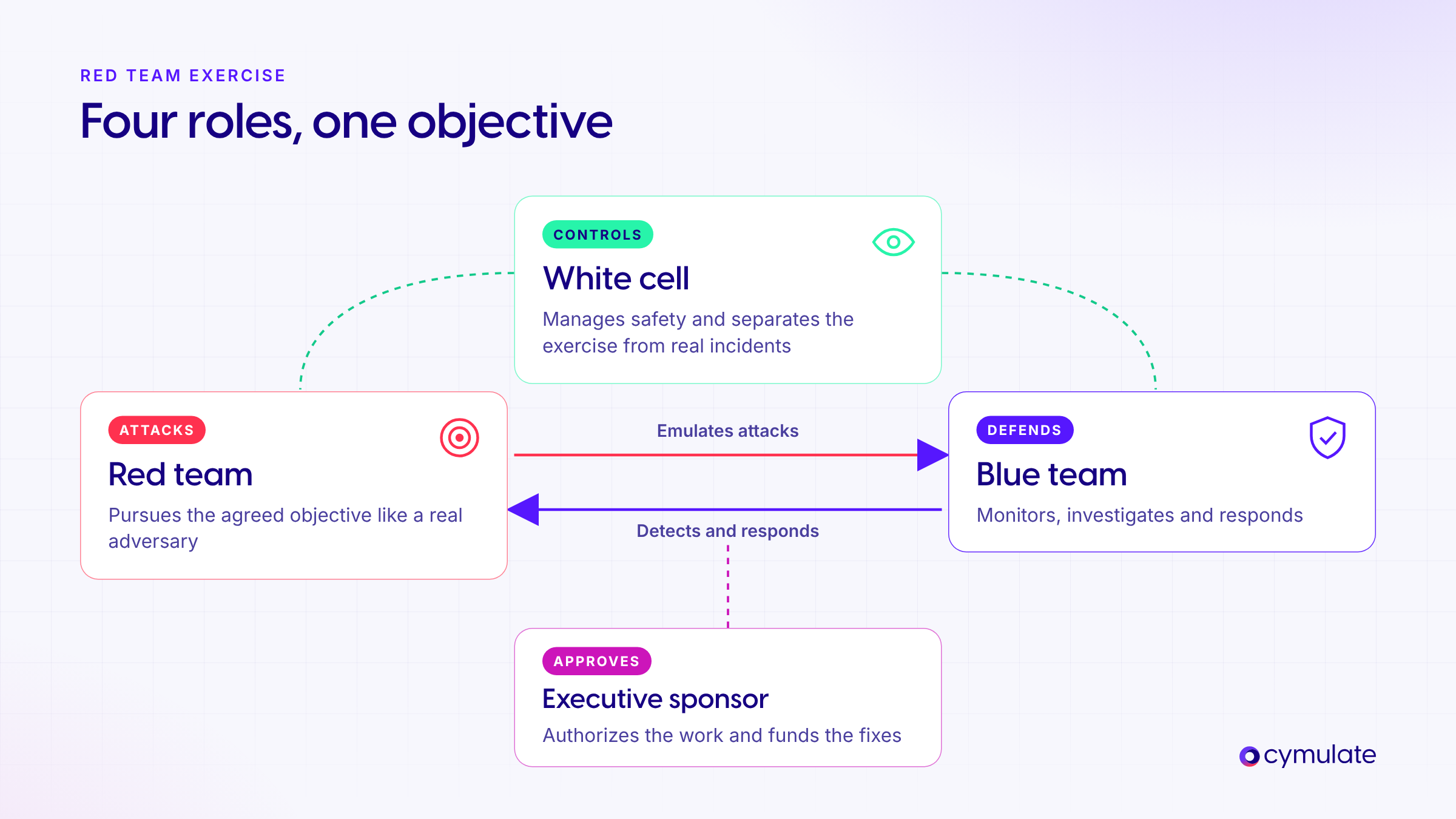
Four roles make an exercise work. The red team conducts offensive testing. The blue team monitors, investigates and responds. A white cell may be involved, which is responsible for managing safety and separation of exercise activity from real incidents. An executive sponsor approves the work and funds the fixes.
Red team exercise vs. penetration test
A penetration test finds as many technical vulnerabilities as possible in defined targets, openly and in one to two weeks. A red team exercise pursues a business objective covertly over weeks or months and tests how defenders prevent, detect and respond. For more, see red teaming vs. penetration testing.
| Feature | Penetration test | Red team exercise |
| Primary goal | Find and document as many technical vulnerabilities as possible. | Achieve a specific objective (e.g., reach the “crown jewels” or dump a database). |
| Scope | Defined technical targets (e.g., a specific web app, network or cloud environment). | Broad, open-ended attack paths across technology, physical security and humans. |
| Stealth | “Loud” and transparent; internal IT and security teams usually know it is happening. | Stealthy and covert; designed to evade the blue team (SOC). |
| Methods | Active exploitation of known vulnerabilities, misconfigurations and code flaws. | APT emulation, social engineering and evasion tactics. |
| Duration | Short-term (typically 1 to 2 weeks). | Long-term (several weeks to a few months). |
| Primary deliverable | A prioritized list of technical vulnerabilities with remediation steps. | An attack narrative, detection gaps and a test of incident response readiness. |
| Compliance use | Required by PCI DSS; commonly used as evidence for SOC 2 and HIPAA. | Built for operational defense testing; mandated as threat-led testing for some financial entities (e.g., DORA TLPT, TIBER-EU, CBEST). |
Types of red team exercises
Choose the format based on three factors:
- Operational needs: the question you need answered, such as how far an attacker could move after a merger or cloud migration.
- Industry and regulations: financial regimes such as DORA threat-led penetration testing (TLPT), TIBER-EU and CBEST dictate scope, providers and cadence, as an example.
- Resources: full-scope exercises need skilled operators and budget, so many teams combine external specialists with automation.
Adoption follows these factors. In a vendor-run survey of 512 organizations, 89% of enterprises with 10,000 or more employees and 64% of mid-market firms reported annual red team assessments, led by financial services as an example for a highly regulated industry. Formats can be combined; cadences below are planning suggestions.
| Type | Starting point | Best for | Typical cadence |
| Full-scope, objective-based exercise | External, with no insider knowledge | End-to-end readiness across technology, people and physical security | Annual or semiannual |
| Assumed breach exercise | Authorized internal foothold | Post-compromise detection, lateral movement and blast radius | Quarterly or after major changes |
| Threat-led adversary emulation | Intelligence on a named threat group | Threat-specific coverage; regulatory TLPT | When intelligence changes; at least every three years under DORA |
| Targeted red team exercise | A specific surface, such as cloud identity, social engineering or AI applications | Validating a new technology or migration | After major changes or launches |
| Continuous automated red teaming (CART) | Configured assets, agents and integrations | Repeatable control validation at scale | Continuous: scheduled and change-triggered |
The eight phases of a red team exercise
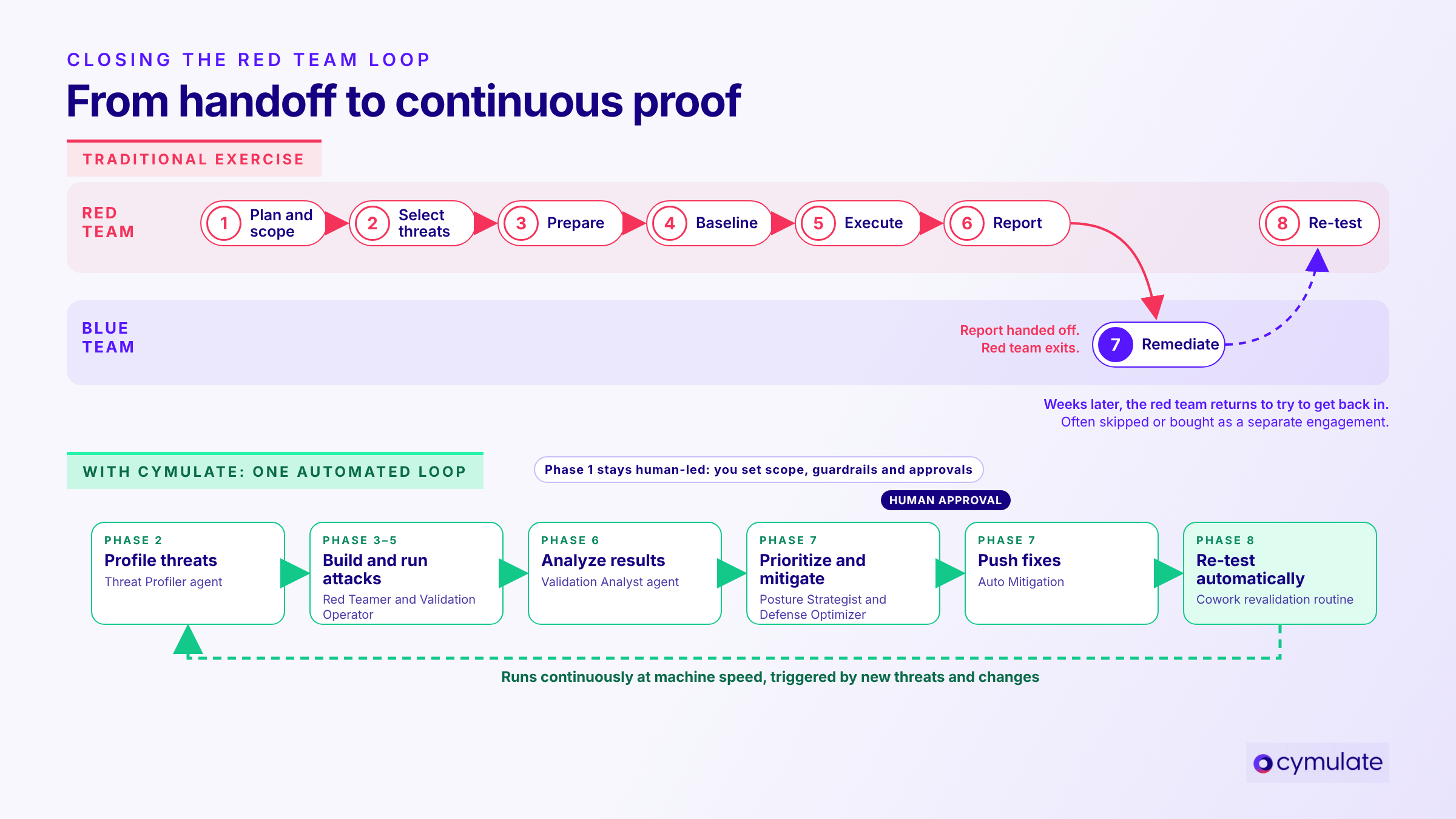
These phases of a red team a exercise connects planning to verified fixes. In practice, many engagements stop after phase 6: the red team delivers its report, and re-testing becomes a separate, optional engagement. Even the TIBER-EU closure phase asks only for a remediation plan that includes planning for follow-up testing. Fixes stall without that remediation and re-verification loop: Cobalt’s State of Pentesting Report 2025 found that firms remediate just 48% of pentest findings.
How Cymulate automates the eight phases
Cymulate automates red teaming through agentic cyber defense engineering. Cymulate Vero AI agents profile threats, run production-safe attack scenarios, validate prevention and detection, prioritize gaps, implement mitigation and re-validate. Cymulate Cowork turns those steps into scheduled routines, so phases 2 through 8 run continuously while your team controls objectives, scope and approvals.
1. Planning and scoping
Define objectives, systems in scope, participants and success criteria. Agree on rules of engagement, owners and time for remediation before testing begins.
With Cymulate: Planning stays human-led. Cowork routines capture the agreed scope, schedule, guardrails and approval points so every run follows the same rules.
2. Threat intelligence and scenario selection
Select adversaries and tactics, techniques and procedures (TTPs) relevant to your industry and exposures, then map them to the MITRE ATT&CK framework. See how to choose which red team scenarios to run.
With Cymulate: The Threat Profiler agent identifies threats relevant to your environment, and the Red Teamer agent converts them into attack scenarios. Teams draw on more than 100,000 attack actions, updated daily, or build custom attack chains in Cymulate Threat Studio.
3. Environment preparation
Verify logging, security information and event management (SIEM) coverage and endpoint detection and response (EDR) readiness. Establish private white-cell communications and confirm emergency contacts.
With Cymulate: More than 80 security control integrations confirm telemetry is flowing. After initial deployment, this phase isn’t repeated for every exercise.
4. Baseline assessment
Record control settings, detection coverage and known telemetry gaps in a dated baseline, so later comparisons show what improved.
With Cymulate: The Validation Operator agent runs a baseline in Cymulate Exposure Validation, mapping prevention and detection results to a MITRE ATT&CK heatmap as well as ingests all vulnerabilities and existing detection rules.
5. Execution
Red-teamers use specialized tools to conduct authorized reconnaissance, initial access, privilege escalation, lateral movement and actions on objectives. Testers timestamp actions and preserve evidence.
With Cymulate: Exposure Validation runs safe automated attacks against integrated security tools across the entire MITRE ATT&CK lifecycle. Continuous automated red teaming repeats them on a schedule, freeing human red teamers for creative chaining, social engineering and physical testing.
6. Reporting
Build an attack narrative showing what controls prevented, what defenders detected and what they missed, with business impact and evidence-based recommendations.
With Cymulate: Cymulate platform has numerous out of the box reporting dashboards and the ability to create custom dashboard in minutes. Cymulate Cowork expands these capabilities with agentic AI, allowing for automated routines and additional customization.
7. Remediation and tracking
Assign each finding an owner, priority and due date. Track control changes and detection-rule tuning as exercise deliverables.
With Cymulate: Cymulate CTEM prioritizes gaps by exploitability and business impact. The Cymulate Platform auto generates vendor-specific mitigations, Sigma and YARA rules and indicators of compromise (IoCs). Cymulate Auto Mitigation pushes supported updates to connected controls, with approval points for production changes.
8. Validation and re-testing
Repeat relevant techniques after fixes and confirm the expected prevention, alert or response. Remove test artifacts and feed results into the next exercise.
With Cymulate: A Cowork prove the fix routine automatically re-runs the original attack scenario when a mitigation closes, confirms the fix and records the evidence.
Red team rules of engagement: a checklist
Red team rules of engagement (RoE) are the written agreement that defines what a red team may test, how and when, who approves it and what happens if something goes wrong. They protect production systems, keep the exercise legal and help the SOC tell a test from a real incident.
- Authorization: Obtain written executive authorization and legal review, including third-party permissions.
- Scope: List in-scope assets, excluded systems, testing windows and rate limits.
- Permitted techniques: Specify allowed techniques and actions that need separate approval, including destructive testing.
- Deconfliction: Route deconfliction through the white cell so the SOC can identify a real incident.
- Emergency stop: Define stop triggers, such as service degradation, and who can pause testing.
- Data protection: Encrypt credentials and evidence, restrict access and agree on retention and deletion.
- Cleanup: Use synthetic data where possible and document cleanup responsibilities before execution.
With Cymulate, these rules become platform settings enforced on every run: assessments target only selected assets and test points, run on approved schedules, use techniques chosen from an ATT&CK-mapped library and route high-risk actions through approval points with full audit trails.
How to measure a red team exercise
Define clock starts, endpoints and denominators before testing. Count a detection as valid only when the alert reaches the intended queue.
| Metric | How to calculate |
| Time to objective | Objective achieved timestamp minus exercise start |
| Mean time to detect (MTTD) | Time from action start to first valid detection ÷ detected test cases |
| Mean time to contain | Time from first valid detection to confirmed containment ÷ contained test cases |
| Mean time to remediate (MTTR) | Time from finding logged to successful re-test ÷ verified closed findings |
| Prevention rate | Blocked actions ÷ valid attempted actions × 100 |
| Detection coverage by ATT&CK technique | Techniques meeting detection criteria ÷ techniques tested × 100 |
| Findings remediated and re-tested | Findings fixed and re-tested ÷ actionable findings × 100 |
The Cymulate platform automatically calculates these cybersecurity metrics with visual dashboards and monitors for configuration drift.
How often should you run red team exercises?
Full-scope exercises often run annually or semiannually. Adjust that rhythm for business risk, budget, regulatory obligations and major environment changes. The Threat Exposure Validation Impact Report 2025 found that organizations running exposure validation at least monthly reported a 20% reduction in breaches.
That annual rhythm assumed attackers needed weeks to weaponize a weakness. In April 2026, Anthropic withheld Claude Mythos Preview from public release, citing its ability to find software vulnerabilities, and the UK AI Security Institute reported it could autonomously complete a 32-step simulated network attack. When attackers move at machine speed, a once-a-year test leaves months of untested exposure. Pair periodic human-led exercises with continuous automated red teaming that re-tests after every new threat or change, so defenders move at machine speed too.
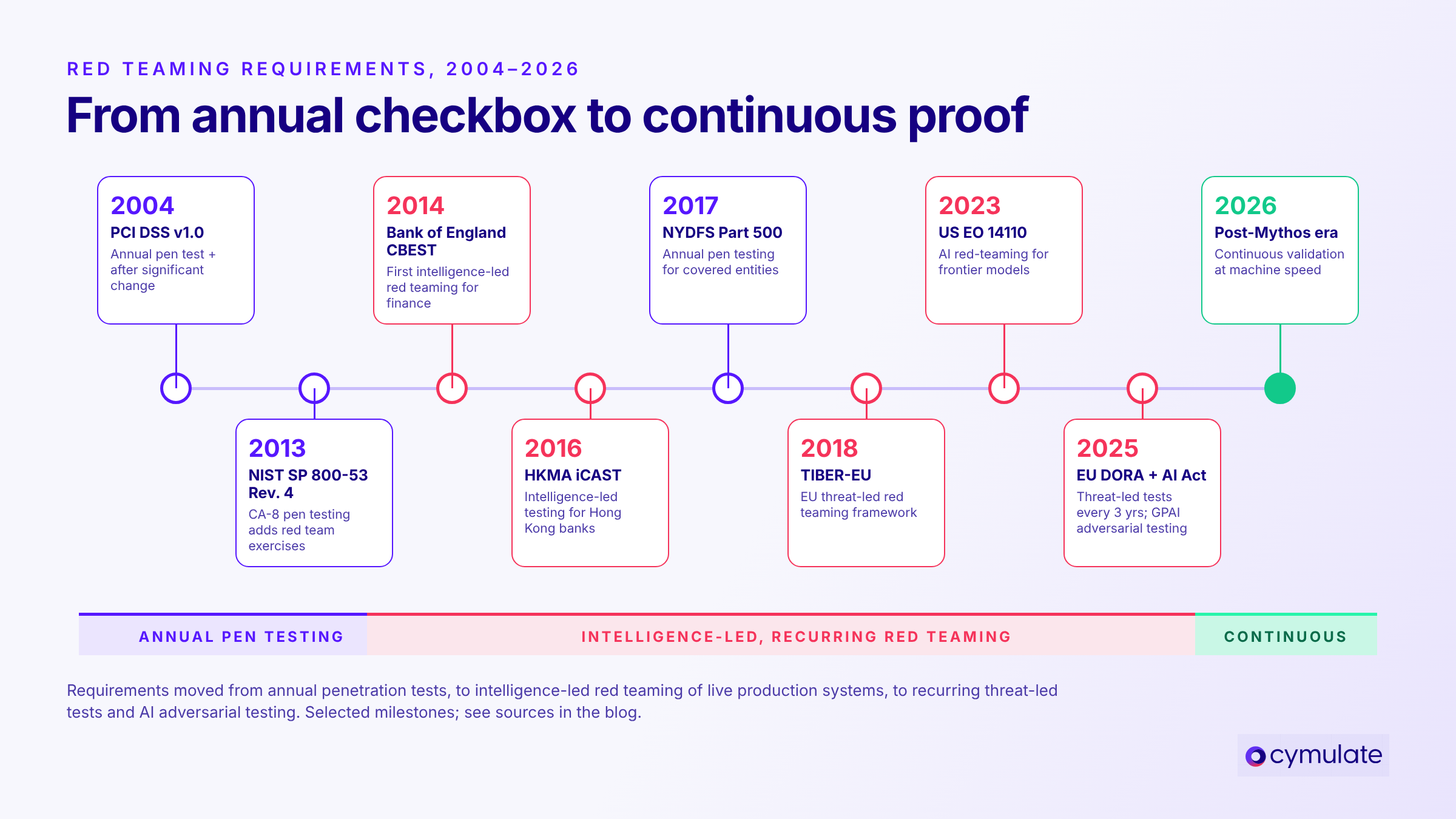
Regulators are moving the same way. Requirements have shifted from annual penetration tests under PCI DSS (2004), to intelligence-led red teaming of live systems under CBEST (2014) and TIBER-EU (2018), to recurring threat-led tests under DORA and AI adversarial testing under the EU AI Act (2025).
Red team exercise best practices
- Tie objectives to business risk and critical services.
- Base threat selection on current intelligence and relevant exposures.
- Hold a purple team debrief to compare attacker evidence with defender actions.
- Map every attack action to ATT&CK, recording results and telemetry.
- Reserve time and ownership for remediation and re-testing.
- Automate repeatable checks within approved boundaries.
Teams without a dedicated red team can follow the example of a bank that increased in-house security testing without a red team.
Key takeaways
- A red team exercise chains scenarios into a campaign that tests prevention, detection and response against a business objective.
- Most engagements stop at the report. Treat remediation and re-testing as exercise phases.
- Define metrics before testing and report misses separately.
- Defend at machine speed. Pair human-led exercises with continuous automated red teaming through agentic cyber defense engineering.
Cymulate enables continuous red teaming at machine speed
Agentic cyber defense engineering is a closed-loop, AI-assisted approach to continuously proving and improving security defenses. Cymulate applies it to red teaming through three connected steps: Prove. Prioritize. Adapt.
Prove. Cymulate Exposure Validation runs automated red teaming from the industry’s largest attack scenario library, with new simulations within 24 hours of major CISA advisories. Cymulate Threat Studio lets red teams build and save custom multi-stage attacks based on their operational needs.
Prioritize. Cymulate CTEM proves exploitability and prioritizes vulnerabilities by business impact, with results mapped to MITRE ATT&CK. With Cymulate Platform, all prevention and detection coverage is mapped to MITRE ATT&CK and prioritized by risk.
Adapt. The Cymulate Platform delivers vendor-specific mitigations, detection rules and IoCs, and Cymulate Auto Mitigation pushes supported updates to more than 80 integrated controls. Re-testing verifies each fix and closes the risk-to-fix gap.
Cymulate Cowork, powered by Vero AI, runs these steps as governed routines, with audit trails and human approval for high-risk actions. Customers report a 52% reduction in critical exposures, a 3X increase in threat detection and 40X faster threat validation, and Hertz Israel reduced its cyber risk by 81% within four months.
Ready to make your red team exercises continuous?
To explore the full operating model, download the Agentic Cyber Defense Engineering e-book. To see Cowork run exposure validation and mitigation, schedule a demo.
Frequently asked questions
A red team scenario is a single attack storyline: one adversary, one objective and one chain of techniques. A red team exercise links several scenarios into an end-to-end campaign that shows whether an attacker can get from initial access to business impact.
Most human-led red team exercises take several weeks to a few months, depending on scope and organization size, plus time for remediation and re-testing. Automated red teaming can run the repeatable phases in hours.
Many security teams run a full-scope exercise annually or semiannually, and entities designated under DORA must run threat-led tests at least every three years. Because AI now accelerates attacks, pair periodic exercises with continuous automated red teaming.
Red team rules of engagement are the written agreement covering scope, excluded systems, testing windows, permitted techniques, approvals, deconfliction, emergency stop triggers and data handling. They keep the exercise safe and legal.
Many repeatable activities can be automated, including threat profiling, technique execution, reporting, mitigation and re-testing. Human testers still lead objectives, social engineering and physical testing. Cymulate agents run the automated steps continuously within defined guardrails, with human approval for consequential changes.

Featured Resources
View More Resources
2026 Gartner® Market Guide for Adversarial Exposure Validation
The guide covers AEV use cases, key features, and market trends to improve threat exposure visibility and defenses.

Cymulate Cowork
Use AI agents and automated routines to validate exposures and streamline cyber defense engineering.

Agentic Cyber Defense Engineering
This e-book explores the six stages of agentic cyber defense engineering and how they work together to strengthen cyber defenses.