

Frequently Asked Questions

Exposure Management Platform Features

What are the top five must-have features in a modern exposure management platform?

The top five must-have features are: 1) Unified, multisource discovery across all environments; 2) Native validation and proof of exploitation; 3) Contextual risk prioritization; 4) Integration and workflow support; and 5) Continuous validation and improvement. These features ensure comprehensive visibility, actionable risk prioritization, and operational resilience. Source

Why is unified, multisource discovery important for exposure management?

Unified, multisource discovery aggregates exposure data from on-premises, cloud, identity, endpoints, networks, and applications, eliminating silos and blind spots. This enables security teams to detect exposures that span multiple environments and provides a consolidated view for faster investigation and remediation. Source

How does native validation and proof of exploitation improve security?

Native validation simulates attacker behavior to determine what is truly exploitable, providing automated proof of exploitation and eliminating false positives. This helps teams focus on exposures with real impact potential, rather than theoretical vulnerabilities. Source

What is contextual risk prioritization and why does it matter?

Contextual risk prioritization combines exploitability, asset criticality, threat intelligence, environmental factors, and blast radius to produce a true risk score. This ensures teams address the most urgent and impactful exposures, improving resource allocation and security outcomes. Source

How does integration and workflow support enhance exposure management?

Integration and workflow support allow exposure data to flow into SIEM, SOAR, ticketing, IT operations, and DevSecOps tools. This enables automated remediation, alert enrichment, and closed-loop validation, making exposure management an operational pillar rather than just a dashboard. Source

Why is continuous validation and improvement critical for exposure management?

Continuous validation ensures that fixes resolve root causes, new exposures don't reintroduce old risks, and detections remain effective as environments evolve. It supports ongoing posture scoring, benchmarking, and measurable improvements, aligning with the CTEM model. Source

How does Cymulate unify exposure discovery, validation, and prioritization?

Cymulate unifies exposure discovery, validation, and prioritization in a single platform, providing a continuously refreshed inventory mapped to attack paths and exploitability. This enables organizations to operationalize continuous resilience. Source

What differentiates true exposure management from traditional vulnerability scanning?

True exposure management goes beyond asset discovery and vulnerability lists by validating exploitability, prioritizing risk in context, and enabling remediation workflows. Traditional scanning tools lack these capabilities and only address parts of the problem. Source

How does Cymulate help reduce investigation time for security teams?

Cymulate consolidates exposure data from multiple sources into a single view, enabling teams to cross-correlate signals, detect attack paths, and reduce investigation time. Source

What types of integrations does Cymulate offer for exposure management?

Cymulate offers native connectors and integrations with vulnerability management solutions, endpoint/XDR platforms, cloud security tools, identity providers, network scanners, application security tools, and asset inventory platforms. Source

How does Cymulate validate security controls?

Cymulate provides continuous security control validation by simulating real-world attack techniques and confirming whether defensive controls are effective, enabling organizations to tune and improve their security posture. Source

What measurable outcomes have organizations achieved with continuous validation?

According to the Cymulate Threat Exposure Validation Report 2025, organizations using continuous validation saw a 47% improvement in mean time to detection, a 40% increase in threat resilience, and a 37% improvement in continuous validation and tuning of security controls. Source

How does Cymulate support closed-loop validation after remediation?

Cymulate's integrations and workflow automation enable teams to retest exposures after remediation, ensuring that fixes are effective and that no new risks are introduced. Source

What is the role of contextual risk scoring in exposure management?

Contextual risk scoring correlates exploitability, asset value, attack paths, and threat intelligence to provide validated risk scores, helping teams focus on exposures that matter most to the business. Source

How does Cymulate help align SecOps, IT operations, and leadership?

Cymulate provides visibility into which risks directly affect critical business assets and where controls are failing, enabling better alignment and communication between SecOps, IT operations, and leadership. Source

What is the CTEM model and how does Cymulate support it?

The Continuous Threat Exposure Management (CTEM) model is a framework for proactive, ongoing exposure management. Cymulate supports CTEM by automating the cycle of detection, validation, prioritization, and improvement. Source

How does Cymulate help organizations move from reactive to proactive resilience?

Cymulate enables continuous validation and improvement, allowing organizations to detect, validate, and remediate exposures in real time, rather than relying on periodic assessments. Source

What resources are available for learning more about exposure management?

Cymulate provides e-books, guides, and whitepapers such as "A Practical Guide to Exposure Management" and the "Cymulate Exposure Management: Product Whitepaper" for deeper technical insights. Source

How does Cymulate support collaboration across red, blue, and purple teams?

Cymulate's open APIs, flexible orchestration, and native integrations unify red, blue, and purple team activities across the exposure lifecycle, breaking down silos and improving collaboration. Source

What is the value of proof-based exposure management?

Proof-based exposure management provides validated evidence of exploitability, enabling organizations to prioritize and remediate exposures with confidence, rather than relying on assumptions. Source

Features & Capabilities

What features does Cymulate offer for exposure management?

Cymulate offers continuous threat validation, unified platform capabilities (BAS, CART, Exposure Analytics), attack path discovery, automated mitigation, AI-powered optimization, complete kill chain coverage, ease of use, and an extensive threat library with over 100,000 attack actions updated daily. Source

Does Cymulate support integration with other security tools?

Yes, Cymulate integrates with a wide range of security technologies, including Akamai Guardicore, AWS GuardDuty, BlackBerry Cylance OPTICS, Carbon Black EDR, Check Point CloudGuard, Cisco Secure Endpoint, CrowdStrike Falcon, Wiz, SentinelOne, and more. Source

What technical documentation is available for Cymulate?

Cymulate provides guides, whitepapers, solution briefs, and data sheets covering topics like CTEM, detection engineering, exposure validation, attack path discovery, and automated mitigation. Source

How does Cymulate automate remediation?

Cymulate integrates with security controls to push updates for immediate threat prevention and provides automated remediation capabilities, reducing manual effort and improving response times. Source

How easy is Cymulate to implement and use?

Cymulate is designed for agentless, quick deployment with minimal resources required. Customers can start running simulations almost immediately, and the platform is praised for its intuitive, user-friendly interface. Source

What feedback have customers given about Cymulate's ease of use?

Customers consistently praise Cymulate for its ease of use, intuitive dashboard, and accessible support. Testimonials highlight its user-friendly portal, immediate value, and actionable insights. Source

Pricing & Plans

What is Cymulate's pricing model?

Cymulate uses a subscription-based pricing model tailored to each organization's requirements, including chosen package, number of assets, and scenarios. For a detailed quote, schedule a demo with the Cymulate team. Source

Security & Compliance

What security and compliance certifications does Cymulate hold?

Cymulate holds SOC2 Type II, ISO 27001:2013, ISO 27701, ISO 27017, and CSA STAR Level 1 certifications, demonstrating adherence to industry-leading security and privacy standards. Source

How does Cymulate ensure data security and privacy?

Cymulate uses encryption for data in transit (TLS 1.2+) and at rest (AES-256), secure AWS-hosted data centers, a tested disaster recovery plan, and a dedicated privacy and security team, including a DPO and CISO. Source

Is Cymulate GDPR compliant?

Yes, Cymulate incorporates data protection by design and maintains GDPR compliance, supported by a dedicated privacy and security team. Source

Use Cases & Benefits

Who can benefit from using Cymulate?

Cymulate is designed for CISOs, security leaders, SecOps teams, red teams, and vulnerability management teams in organizations of all sizes and industries, including finance, healthcare, retail, media, transportation, and manufacturing. Source

What business impact can customers expect from Cymulate?

Customers can achieve up to a 52% reduction in critical exposures, a 60% increase in team efficiency, an 81% reduction in cyber risk within four months, and save up to 60 hours per month in testing new threats. Source

Are there case studies demonstrating Cymulate's effectiveness?

Yes, case studies include Hertz Israel reducing cyber risk by 81% in four months, a sustainable energy company scaling pen testing, and Nemours Children's Health improving detection in hybrid and cloud environments. Source

What pain points does Cymulate address for security teams?

Cymulate addresses fragmented tools, resource constraints, unclear risk prioritization, cloud complexity, communication barriers, inadequate threat simulation, operational inefficiencies, and post-breach recovery challenges. Source

How does Cymulate tailor solutions for different security roles?

Cymulate provides quantifiable metrics for CISOs, automates processes for SecOps, offers automated offensive testing for red teams, and enables efficient vulnerability prioritization for vulnerability management teams. Source

Competition & Comparison

How does Cymulate compare to AttackIQ?

Cymulate surpasses AttackIQ in innovation, threat coverage, and ease of use, offering an industry-leading threat scenario library and AI-powered capabilities. Source

How does Cymulate differ from Mandiant Security Validation?

Mandiant Security Validation is an original BAS platform but has seen little innovation recently. Cymulate continually innovates with AI and automation, expanding into exposure management as a grid leader. Source

What makes Cymulate different from Pentera?

Pentera focuses on attack path validation but lacks the depth Cymulate provides for fully assessing and strengthening defenses. Cymulate optimizes defense, scales offensive testing, and increases exposure awareness. Source

How does Cymulate compare to Picus Security?

Picus Security offers an on-premise BAS option but lacks the comprehensive exposure validation platform Cymulate provides, which covers the full kill-chain and includes cloud control validation. Source

What advantages does Cymulate have over SafeBreach?

Cymulate outpaces SafeBreach with unmatched innovation, precision, and automation, offering the industry’s largest attack library, a full CTEM solution, and comprehensive exposure validation. Source

How does Cymulate compare to Scythe?

Scythe is suitable for advanced red teams building custom attack campaigns, but Cymulate provides a more comprehensive exposure validation platform with actionable remediation and automated mitigation. Source

Cymulate named a Customers' Choice in 2025 Gartner® Peer Insights™
Learn More
New Case Study: Credit Union Boosts Threat Prevention & Detection with Cymulate
Learn More
New Research: Cymulate Research Labs Discovers Token Validation Flaw
Learn More
An Inside Look at the Technology Behind Cymulate
Learn More

Top 5 Must-Have Features in an Exposure Management Platform 

By: Jake O’Donnell

December 9, 2025

Security teams are under growing pressure to reduce risk faster and prove resilience continuously. Attack surfaces expand with every new cloud workload, SaaS connection and identity entitlement. Traditional vulnerability management, point-in-time assessments and siloed security tooling cannot keep pace with dynamic threats, nor modern business operations. 

Gartner predicts that “by 2028, organizations enriching SOC data with exposure information will enhance threat evaluation and accelerate incident response, reducing the frequency and impact of cyberattacks by 50%.”  

There’s a clear reality taking shape: if your organization can unify and validate exposure data, you’ll withstand more of what comes your way.  

Done correctly, exposure management gives security teams the ability to understand not just where they are vulnerable but what is exploitable, what matters most to the business and what to fix first. 

Selecting the right exposure management platform now directly impacts security performance. Yet with dozens of vendors claiming “exposure management” it’s important to look beyond buzzwords. Here, you’ll find five features that define a true exposure management platform, why each one matters and how security teams can use them to advance toward a continuous threat exposure management (CTEM) platform

In this blog, you’ll discover: 

  • How modern exposure management platforms must unify discovery, validation and prioritization, not just generate lists of vulnerabilities 
  • Why validation and proof of exploitation are the defining capabilities that separate true exposure management from traditional scanning 
  • How contextual risk scoring and integrated workflows accelerate remediation and enable continuous SecOps improvement 
  • How Cymulate delivers must-have exposure management features in one unified CTEM platform to operationalize continuous resilience 

Exposure Management Features That Actually Matter

Exposure management has become a crowded category of technology. Vendors with scanning tools, asset discovery products, cloud posture solutions and even traditional vulnerability management providers have all adopted language around exposure management. But terminology doesn’t equate to capability by itself. 

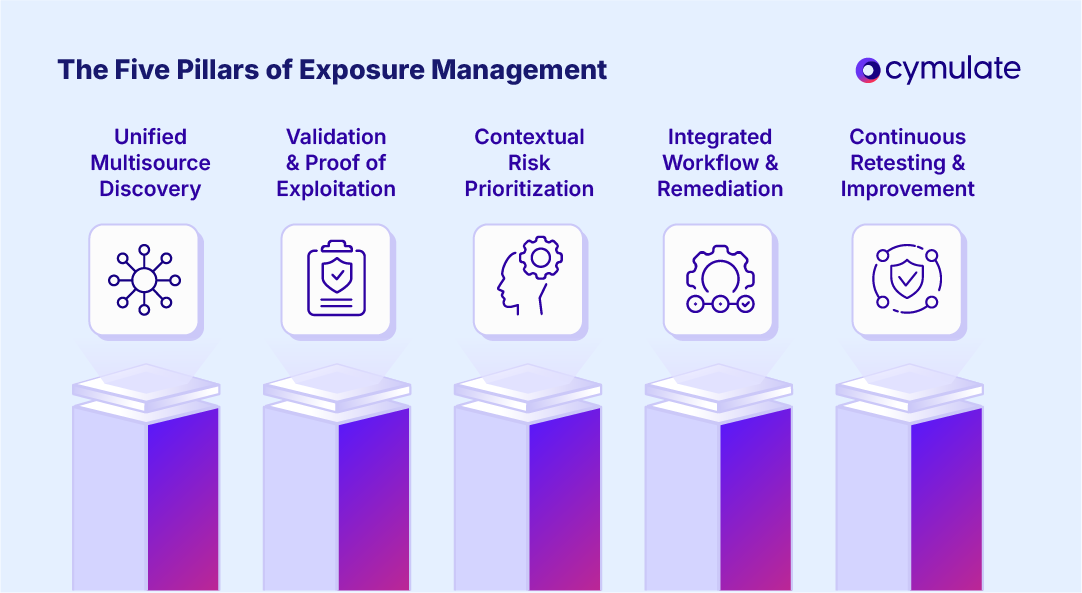
Real, unified exposure management requires more than discovering assets or inventorying vulnerabilities. A security program only matures and is effective when an exposure management solution: 

  • Aggregates data from multiple sources 
  • Validates which exposures are actively exploitable 
  • Prioritizes risk based on business context 
  • Enables remediation workflows across defensive teams 
  • Continuously retests benchmarks and resilience 

This level of validation, correlation and operationalization goes well beyond what traditional scanning or posture management tools offer. These five features separate true exposure management platforms from repurposed point solutions. 
the five pillars of exposure management

#1. Unified, multisource discovery 

The foundation of exposure management is complete visibility and that requires aggregating exposure data from every environment a business relies on, not just IT-managed assets. 

A mature exposure management platform must unify discovery across the following places: on-premises infrastructure, cloud environments (IaaS, PaaS and SaaS), identity and access systems, endpoints and workloads, network infrastructure and applications (as well as APIs).  

This approach requires native connectors and integrations with existing security tooling, including: vulnerability management solutions, endpoint/XDR platforms, cloud security tools, identity providers (IdP, IGA, PAM), network scanners, application security tools and CMDB/asset inventory platforms. 

When unified, these data sources provide a multidimensional map of exposure. This spans vulnerabilities, misconfigurations, excessive permissions, exploitable paths and unmonitored attack surface areas.  

Why this matters 

Silos create blind spots. If vulnerability data sits in one system, identity risks in another and cloud exposures in yet another, it’s impossible for security teams to cross-correlate signals to identify attack paths or root causes. Cross-environment visibility enables teams to: 

  • Detect exposures that span cloud-to-identity-to-endpoint chains 
  • Validate real attack paths, not isolated control failures 
  • Reduce investigation time by consolidating data into a single view 

The Cymulate Exposure Management Platform unifies these data sources into a single, continuously-refreshed exposure inventory, mapped directly to attack paths and exploitability.  

#2. Native validation and proof of exploitation 

Discovery alone is not exposure management. The critical differentiator? Validation, or, the ability to simulate attacker behavior and determine what can truly be exploited. 

Modern environments generate more risk signals than any team can manually interpret. Without validation, teams end up chasing “possible vulnerabilities” instead of focusing on weaknesses with actual impact potential. 

A mature exposure management platform should deliver: 

  • Native attack-path validation using real-world TTPs 
  • Automated proof of exploitation showing whether an attacker could reach critical assets 
  • Continuous security control validation to confirm defensive effectiveness 
  • Impact modeling to quantify potential blast radius 
  • False positive elimination by validating only what is operationally exploitable 

The value in validation is providing proof instead of assumptions. The Cymulate Threat Exposure Validation Report 2025 found that of surveyed organizations using continuous validation: 

  • 47% saw improved mean time to detection 
  • 40% saw increased threat resilience against the latest immediate threats 
  • 37% saw continuous validation and tuning of security controls 
Threat Exposure Validation Impact Report 2025
Further reading
Threat Exposure Validation Impact Report 2025

See why 1,000 security leaders call threat exposure validation essential in 2025, driven by AI, automation and optimized threat defense

Read More

Why this matters 

Validation creates a direct path between exposures and defensive controls. It enables teams to answer questions such as: 

  • Does a critical CVE actually lead to a compromise in my environment? 
  • Can attackers pivot from my cloud environment into internal systems? 
  • Which identity permissions enable lateral movement? 
  • Do my SIEM, EDR and network detections trigger when they should? 

Validation elevates exposure management from information gathering to operational security improvement. 

Cymulate delivers automated and safe exploit simulations that validate end-to-end attack paths, turning theoretical risks into measurable, actionable priorities. 

#3. Contextual risk prioritization 

Once exposures are discovered and validated, the next challenge is prioritization. Traditional risk scoring (based on CVSS or static severity ratings) fails to capture real-world exploitability or business impact. 

Your exposure management platform much elevate exposures in context, combining factors such as: 

  • Exploitability (validated through active testing) 
  • Asset criticality (business function, sensitivity, operational dependency) 
  • Threat intelligence (known exploits in the wild, adversary targeting patterns) 
  • Environmental factors (network position, privilege levels, compensating controls) 
  • Blast radius (potential lateral movement or privilege escalation pathways) 

When these elements are correlated, practitioners receive a true risk score, not a theoretical one. 

Why this matters 

Contextual prioritization prevents teams from spending endless hours or days patching low-impact exposures while possibly missing high-impact ones. This enables: 

  • Prioritization of exposures that are exploitable right now 
  • Visibility into which risks directly affect critical business assets 
  • Understanding of where controls are failing across detection and prevention 
  • Better alignment between SecOps, IT operations and leadership 

Cymulate correlates exploitability data, attack paths, asset value and current threat intelligence to produce contextual, validated risk scoring that aligns with CTEM best practices. 

#4. Integration and workflow support 

Exposure management cannot be a standalone practice. Once exposures are identified and prioritized, teams must be enabled to quickly take action.  This requires end-to-end operationalization across existing SOC and SecOps workflows. 

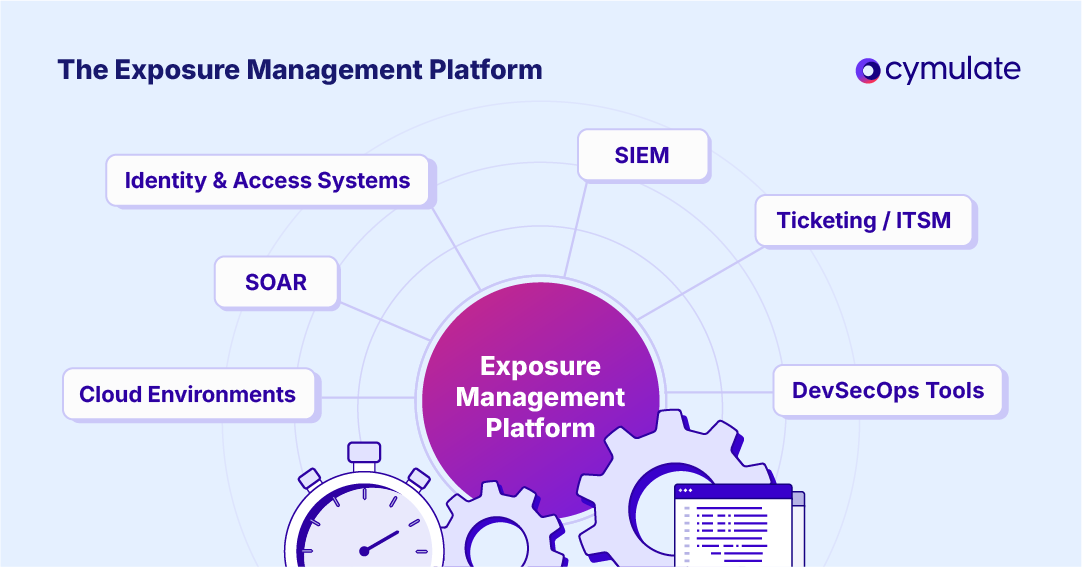
A mature exposure management platform must integrate with: 

  • SIEM for telemetry enrichment and detection validation 
  • SOAR for automated response and remediation workflows 
  • Ticketing systems such as Jira and ServiceNow 
  • IT operations tools 
  • Threat intelligence platforms 
  • DevSecOps pipelines 
  • Identity and cloud remediations systems 

These integrations allow exposures to flow directly into the systems your teams already use to collaborate, triage and resolve issues. 

Why this matters 

Without workflow integration, exposure management becomes solely a dashboard. Sure, that can be useful in theory, but it’s disconnected from operations. With seamless integrations, your team can: 

  • Automate remediation tasks 
  • Enrich alerts with exposure insights 
  • Break down silos between red, blue and purple teams 
  • Establish closed-loop validation after remediation 
  • Reduce MTTR by streamlining communication 

Integrated workflows take exposure management from an analytical function into a continuous operation pillar of your cybersecurity strategy. 

Cymulate is built with open APIs, flexible orchestration and native integrations designed to unify red, blue and purple team activities across the exposure lifecycle. 

#5. Continuous validation and improvement 

Exposure management is not a quarterly project, nor is it an annual audit. Threat actors operate continuously. The same must apply to defenders. 

A real exposure management platform must support continuous validation, meaning: 

  • Automated attack-path testing 
  • Frequent re-testing after remediation 
  • Scheduled simulations aligned with emerging threats 
  • Continuous security control insights 
  • Ongoing posture scoring and benchmarking 
  • Historical trend analysis to measure resilience improvements 

The continuous loop aligns directly with the CTEM model. It’s a framework that moves organizations from reactive to proactive resilience. 

Why this matters 

Continuous validation ensures that: 

  • Fixes actually resolve root causes 
  • New exposures don’t reintroduce old risks 
  • Detections remain effective as environments evolve 
  • Teams can demonstrate measurable improvements to executives and auditors 

Cymulate automates this cycle, enabling teams to detect, validate, prioritize and improve continuously, not just during scheduled assessments. 

Choose a platform that proves, not promises 

Modern cyber risk reduction requires unified visibility, validated exploitability, contextual prioritization, workflow automation and continuous improvement. Tools that only scan, only discover or only report are not exposure management platforms. They’re just point solutions that address parts of a problem, not the entire thing. 
must haves of an exposure management platform

Organizations evaluating exposure management solutions should invest in platforms that deliver proof-based, unified, continuous exposure management aligned with CTEM maturity.  

Cymulate offers unified exposure discovery, validation and prioritization in one platform. It's now your time to prove the threat and improve resilience continuously with Cymulate. 

Want to see Cymulate in action? Sign up for a demo today

Cymulate Exposure Validation makes advanced security testing fast and easy. When it comes to building custom attack chains, it's all right in front of you in one place.
Mike Humbert, Cybersecurity Engineer
DARLING INGREDIENTS INC.
Learn More
Book a Demo