

Frequently Asked Questions

Product Information & BAS Fundamentals

What is Breach and Attack Simulation (BAS)?

Breach and Attack Simulation (BAS) is a technology that mimics real-world cyberattack techniques to test whether your security controls can detect and stop threats. BAS platforms, like Cymulate, automate these simulations to uncover vulnerabilities and validate the effectiveness of your defenses without disrupting production environments.

How does BAS work in practice?

BAS platforms perform actions that closely resemble those of real threat actors, such as placing files that look like malware, sending phishing emails, or attempting to bypass firewalls. These tests are automated, repeatable, and designed not to interfere with business operations, providing continuous validation of your security posture.

What types of attack simulations does Cymulate offer?

Cymulate offers simulations across multiple vectors, including Email Gateway Simulation (phishing), Endpoint Simulation (malware detection), Behavioral Detection Simulation, and Web Application Firewall Simulation. These scenarios test your defenses against a wide range of threats and tactics.

How does BAS differ from penetration testing?

Penetration testing is performed by human experts who manually attempt to exploit vulnerabilities, often focusing on a specific scope and point in time. BAS, on the other hand, is automated, repeatable, and can run continuously to test a broader range of attack techniques without disrupting operations.

How is BAS different from red teaming?

Red teaming involves human-led, multi-vector attack simulations and social engineering to test both technical and human defenses. BAS automates these simulations, covers more attack techniques, and provides continuous, up-to-date testing using the latest threat intelligence.

How does BAS compare to vulnerability scanning?

Vulnerability scanners identify known vulnerabilities based on databases and generate reports for remediation. BAS goes further by simulating real attacks to validate whether those vulnerabilities are actually exploitable and if your controls can detect and stop them.

What are the main benefits of automated BAS?

Automated BAS enables continuous, comprehensive testing of your defenses, identifies gaps, provides actionable remediation insights, and allows you to test against the latest threats without impacting production. It helps answer, "How well do our controls and policies detect and stop attackers?"

How does Cymulate make BAS simple for organizations?

Cymulate's Exposure Validation Platform offers overview dashboards, assessment templates, best practice assessments, a workbench for custom scenarios, daily threat feeds, integrations with leading security tools, and AI-powered attack planning. These features make advanced security testing fast, easy, and repeatable.

What is the role of MITRE ATT&CK in Cymulate's BAS?

Cymulate maps its attack simulations and reports to the MITRE ATT&CK framework, providing heatmaps and insights into strengths and weaknesses across the full range of tactics and techniques used by real-world attackers.

Can BAS be run without disrupting business operations?

Yes, BAS platforms like Cymulate are designed to run quietly in the background, without interfering with production systems or end-users. Simulations are safe and controlled, ensuring business continuity.

What are some examples of attack vectors tested by Cymulate?

Cymulate tests vectors such as email gateways (phishing), endpoints (malware detection), behavioral detection, and web application firewalls. Each vector is targeted with realistic attack scenarios to validate your defenses.

How does Cymulate help with remediation after identifying weaknesses?

Cymulate provides actionable remediation guidance, detection rules, and automated control updates to help you quickly close security gaps identified during simulations.

Can Cymulate be used across different environments?

Yes, Cymulate supports attack simulation and threat testing across on-premises, cloud, and hybrid environments, and is compatible with Windows, Mac, and Linux operating systems.

How often can BAS tests be run with Cymulate?

Cymulate allows you to run tests at any interval—hourly, daily, weekly, or on-demand—enabling continuous validation and rapid response to new threats.

What is the primary goal of using BAS?

The main goal is to confirm that your security controls are working as intended, identify any weaknesses, and provide insights to remediate issues before attackers can exploit them.

How does Cymulate support custom attack scenarios?

Cymulate provides an attack scenario workbench and a rich library of the latest attack scenarios and malicious behaviors, allowing you to create custom assessments tailored to your organization's unique threats.

What kind of reporting does Cymulate provide?

Cymulate offers overview dashboards, risk scores, trends, prevention/detection ratios, and heatmaps mapped to MITRE ATT&CK, giving you actionable insights and clear visibility into your security posture.

How does Cymulate keep its attack scenarios up to date?

Cymulate's threat research team loads new emergent threats into the platform daily, ensuring that your simulations reflect the latest attacker tactics, techniques, and procedures.

What is Cymulate's approach to automation in BAS?

Cymulate automates attack simulations, control updates, and remediation guidance, making it easy to run repeatable, consistent tests and quickly address any identified gaps.

Features & Capabilities

What are the key features of Cymulate's platform?

Cymulate's platform features continuous threat validation, unified BAS and red teaming, exposure analytics, attack path discovery, automated mitigation, AI-powered optimization, and a library of over 100,000 attack actions updated daily. It also provides actionable insights, dashboards, and integration with leading security tools. Learn more.

Does Cymulate support integration with other security tools?

Yes, Cymulate integrates with a wide range of security technologies, including Akamai Guardicore, AWS GuardDuty, BlackBerry Cylance OPTICS, Carbon Black EDR, Check Point CloudGuard, Cisco Secure Endpoint, CrowdStrike Falcon, Wiz, SentinelOne, and more. For a full list, visit our Partnerships and Integrations page.

How does Cymulate use AI in its platform?

Cymulate uses AI-powered attack planning to convert threat intelligence and plain language prompts into custom threat assessments and complex attack chains, optimizing remediation and detection efforts.

What metrics and outcomes can Cymulate deliver?

Cymulate customers have reported up to a 52% reduction in critical exposures, a 60% increase in team efficiency, and an 81% reduction in cyber risk within four months. These metrics are based on real customer case studies. See case studies.

How does Cymulate help with exposure prioritization?

Cymulate validates exploitability and ranks exposures based on prevention and detection capabilities, business context, and threat intelligence, helping organizations focus on the most critical vulnerabilities. Learn more.

Use Cases & Benefits

Who can benefit from using Cymulate?

Cymulate is designed for CISOs, security leaders, SecOps teams, red teams, and vulnerability management teams in organizations of all sizes and industries, including finance, healthcare, retail, media, transportation, and manufacturing. Learn more.

What business impact can Cymulate deliver?

Cymulate helps organizations achieve improved security posture, operational efficiency, faster threat validation, cost savings, enhanced threat resilience, and better decision-making with actionable insights and quantifiable metrics. Learn more.

What pain points does Cymulate address?

Cymulate addresses fragmented security tools, resource constraints, unclear risk prioritization, cloud complexity, communication barriers, inadequate threat simulation, operational inefficiencies in vulnerability management, and post-breach recovery challenges. See case studies.

Are there case studies showing Cymulate's effectiveness?

Yes. For example, Hertz Israel reduced cyber risk by 81% in four months, and a sustainable energy company scaled penetration testing cost-effectively with Cymulate. Read more case studies.

How does Cymulate tailor solutions for different roles?

Cymulate provides quantifiable metrics for CISOs, automates processes for SecOps, offers automated offensive testing for red teams, and enables efficient vulnerability prioritization for vulnerability management teams. Learn more.

Implementation & Ease of Use

How easy is it to implement Cymulate?

Cymulate is designed for quick, agentless deployment with no need for additional hardware or complex configurations. Customers can start running simulations almost immediately, and the platform integrates seamlessly into existing workflows. Schedule a demo.

What do customers say about Cymulate's ease of use?

Customers consistently praise Cymulate for its intuitive interface, user-friendly dashboard, and ease of implementation. For example, Raphael Ferreira, Cybersecurity Manager, said, "Cymulate is easy to implement and use—all you need to do is click a few buttons, and you receive a lot of practical insights into how you can improve your security posture." Read more testimonials.

What support resources are available for Cymulate users?

Cymulate offers email and chat support, a knowledge base with technical articles and videos, webinars, e-books, and an AI chatbot for quick answers and best practices. Visit the Resource Hub.

Security, Compliance & Trust

What security and compliance certifications does Cymulate hold?

Cymulate is SOC2 Type II certified, complies with ISO 27001:2013, ISO 27701, ISO 27017, and holds CSA STAR Level 1 certification. These attest to its robust security, privacy, and cloud compliance practices. Learn more.

How does Cymulate ensure data security?

Cymulate uses encryption for data in transit (TLS 1.2+) and at rest (AES-256), hosts data in secure AWS data centers, and follows a strict Secure Development Lifecycle (SDLC) with regular vulnerability scanning and third-party penetration testing.

Is Cymulate GDPR compliant?

Yes, Cymulate incorporates data protection by design, has a dedicated privacy and security team, and includes a Data Protection Officer (DPO) and Chief Information Security Officer (CISO) to ensure GDPR compliance.

What product security features does Cymulate offer?

Cymulate includes mandatory 2-Factor Authentication (2FA), Role-Based Access Controls (RBAC), IP address restrictions, and TLS encryption for its Help Center, ensuring strong access and data protection controls.

Pricing & Plans

What is Cymulate's pricing model?

Cymulate uses a subscription-based pricing model tailored to each organization's needs. Pricing depends on the chosen package, number of assets, and scenarios required. For a personalized quote, schedule a demo.

Competition & Comparison

How does Cymulate compare to other BAS platforms?

Cymulate stands out with its unified platform combining BAS, continuous automated red teaming, and exposure analytics. It offers continuous validation, AI-powered optimization, full kill chain coverage, ease of use, and the most advanced attack simulation library with daily updates. See comparison.

What makes Cymulate unique for different user segments?

Cymulate tailors its platform for CISOs (metrics and insights), SecOps (automation and efficiency), red teams (automated offensive testing), and vulnerability management teams (efficient validation and prioritization). This ensures measurable improvements for each persona. Learn more.

Resources & Learning

Where can I find Cymulate's blog and latest research?

You can read about the latest threats, research, and product updates on Cymulate's blog.

Where can I find news, events, and webinars from Cymulate?

Stay up-to-date with Cymulate through the newsroom, events & webinars page, and blog.

Is there a central resource hub for Cymulate content?

Yes, the Resource Hub contains insights, thought leadership, and product information.

Does Cymulate provide educational content on lateral movement attacks?

Yes, Cymulate has a blog post titled 'Stopping Attackers in Their Tracks' that discusses lateral movement attacks and prevention strategies. Read the blog post.

Cymulate named a Customers' Choice in 2025 Gartner® Peer Insights™
Learn More
New Case Study: Credit Union Boosts Threat Prevention & Detection with Cymulate
Learn More
New Research: Cymulate Research Labs Discovers Token Validation Flaw
Learn More
An Inside Look at the Technology Behind Cymulate
Learn More

What is Breach and Attack Simulation (BAS)?

By: Cymulate

Last Updated: June 22, 2025

cymulate blog post

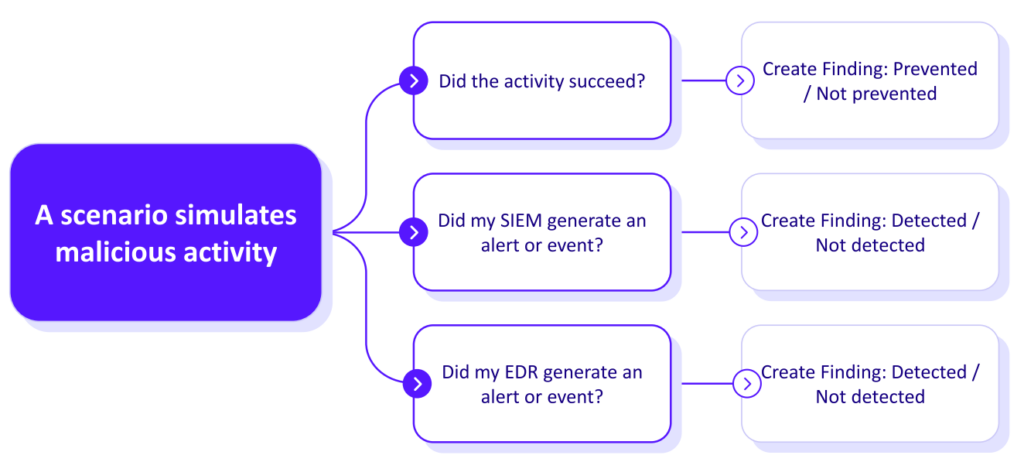
At its core, Breach and Attack Simulation (BAS) is exactly what it says on the tin - a platform that is designed to perform actions that closely mimic real threat actors breach attempts to determine if they are caught by your security measures.  

The simulation can be anything from placing files that are indistinguishable from malware (but not actually dangerous to systems) onto a machine to see if the anti-malware tool catches them; to attempting to send data traffic through a firewall or malicious email through an email filter. 

BAS Tools and Platforms 

BAS tools and platforms are designed to run repeatedly; even automated to make the process of keeping security tight and up-to-date, making it easier for security teams to handle. The tests are designed not to interfere with production operations, working quietly behind the scenes so that users don’t even notice them running unless the vector is something like Phishing Awareness which tests employee vigilance. 

Breach and Attack Simulation uses a set of complex attack scenarios that attempt to bypass these control systems to reach a specific goal. If that goal can be reached (such as traffic making it through a firewall or an email being delivered to an end recipient), then the BAS platform has helped to uncover a flaw in that control that needs to be remediated. 

Cymulate, for example, has multiple simulations designed to test a variety of vectors (potential attack paths that can be used to gain access to systems and resources). These simulations include:

  • Email Gateway Simulation: Sends phishing emails designed to bypass security controls, ensuring spam filters effectively block malicious messages.
  • Endpoint Simulation: Drops known malware files onto disks to test whether anti-malware tools detect and block them.
  • Behavioral Detection Simulation: Executes test files in a controlled environment to assess whether behavioral-based detection systems recognize and respond to suspicious activity.
  • Web Application Firewall (WAF) Simulation: Attempts to manipulate web servers into disclosing sensitive data or performing unauthorized actions, ensuring the web application firewall blocks such attempts before they reach the server.
How does BAS differ from other cybersecurity testing methods? 

Penetration testing 

Pen testing is conducted by human testers, also known as white-hackers, who attempt to evaluate the security of an organization’s infrastructure by safely exploiting potential vulnerabilities. Those security gaps may lie hidden in operating systems, services, or applications resulting from unpatched vulnerabilities, faulty configurations, or human error. 

The corporate network, application, devices, and/or people are attacked to check whether a cyber attacker would be able to penetrate the organization. The tests reveal how deep an attacker could penetrate and if the attack payload could be executed, i.e., data exfiltration, file or system encryption, infrastructure disablement, or destruction. 

Red teaming 

Red teams use techniques such as pen testing, spear-phishing, and other social engineering techniques, multi-vector attack testing, vulnerability scanning, and cyber reconnaissance to find and expose weaknesses in the security measures and in the human element. 
Red team exercises typically focus on just a few attack vectors - they don't test controls across the entire cyber kill chain. They typically use a limited number of attack techniques, unlike real-world malicious attackers who use more than 290 attack techniques, as listed in the MITRE ATT&CK™ framework. 

Red team tools often lack the latest cyber threat intelligence, which means that they can only challenge controls against known threats, or else red team testers must perform some research in advance to ensure they are incorporating the latest threat intelligence in their testing. New malware variants emerge daily, which means you still must ensure that your controls can identify the newest attacks’ Indicators of Compromise (IoCs), stealth techniques, and behaviors. 

Vulnerability scans 

Performed by proprietary or open-source applications, vulnerability scans check the environment for potential vulnerabilities. However, their search capabilities are limited to vulnerabilities already known to vendors and the industry and limited to weaknesses already exploited by cyber attackers.  

Vulnerability scanners typically scan networks and systems for thousands of security vulnerabilities of any variety, from software bugs and missing operating system patches to vulnerable services, insecure default configurations, and web application vulnerabilities. They then generate a report listing all the detected vulnerabilities, ideally affecting a risk score to each uncovered vulnerability.  

These scores are typically based on CVSS scores. A patching schedule based on these scores and on defined risk tolerance baselines is then passed on to the IT team to apply the required patches. 

The Benefits of Automated Breach and Attack Simulation

Automated BAS tools enable you to answer the question "How well do our controls and policies detect and stop attackers?" BAS tools model attacks, identify heat spots, and assess the risk of all security elements. 

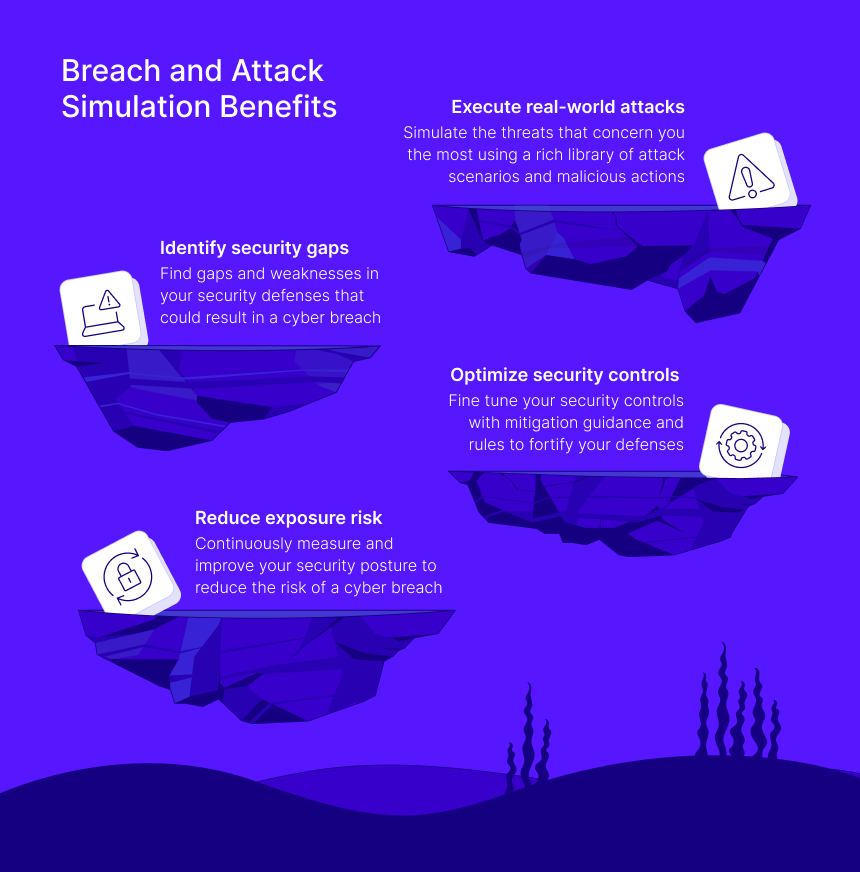
In addition, BAS enables continuous, comprehensive testing to challenge, measure, and optimize cyber defenses by: 

  1. Simulating attacks without jeopardizing production environments. 
  2. Simulating cyberattacks across the full kill chain against all threats, including the latest attacker TTPs. 
  3. Testing continuously with flexibility to target specific vectors, infrastructure, and internal teams for awareness against the latest threats. 
  4. Automating simulations for repeatability and consistency. 
  5. Conducting testing at any time interval—hourly, daily, weekly, or ad hoc. 
  6. Identifying gaps and evaluating controls against the MITRE ATT&CK framework. 
  7. Remediating exposure using actionable insights. 

With BAS, you can focus security control testing on techniques and potential attack paths that can be exploited by many different types of threat actors—without having to assemble teams of security experts. By utilizing technique-based frameworks such as MITRE ATT&CK, your organization can effectively test against and neutralize multiple types of attacks simultaneously for real security against real-world threats. 
Breach and Attack Simulation Benefits

Breach and Attack Simulation Made Simple with Cymulate 

The Cymulate Exposure Validation Platform applies breach and attack simulation to validate and optimize security controls with advanced testing and easy, repeatable automation in the industry’s most deployed solution for exposure validation that includes:  

  • Overview dashboards – Gain security posture insights and monitor for drift using risk scores, trends, prevention/detection ratios, top attack types and APT groups not prevented by your security controls.  
  • Assessment templates – Create your own assessment templates that validate your security posture and controls including dynamic smart templates that automatically include new attack scenarios at launch.  
  • Best practice assessments – Automated testing and validation of key security controls and threat scenarios using our best practice assessments and pre-built templates.   
  • Attack scenario workbench – Flexible workbench to create custom assessments for the threats that matter most to you, using a rich library of the latest attack scenarios and malicious behaviors.  
  • Daily threat feeds – Validate immediate threats using the latest emergent threats which are loaded into the Cymulate platform daily by our threat research team.  
  • Integrations and connectors – Integrate technologies from leading security vendors to optimize your investments in SIEM, SOAR, GRC, EDR, firewall and more via APIs to validate and improve detection and response capabilities.   
  • AI-powered attack planner – Privacy-focused artificial intelligence converts threat intel and plain language prompts into custom threat assessments and complex attack chains. 
  • Automated control updates – Integrate security controls and push new indicators of compromise (IOCs) to mitigate control gaps identified by the latest assessments.  
  • Mitigation guidance and detection rules – Remediation insights provide straightforward guidance to mitigate threats, fine tune controls and refine policies for better protection.   
  • Full MITRE ATT&CK coverage – Reports and findings are mapped to the MITRE ATT&CK® framework with heatmaps showing areas of strengths and weaknesses across the full range of MITRE tactics and techniques.   
  • Cross-platform solution – Extensive attack simulation and immediate threat testing across on-premises, cloud and hybrid environments for a wide variety of operating systems (Windows, Mac, Linux). 

Key Takeaways 

Breach and Attack Simulations test the effectiveness of security controls in your environment without impacting your end-users or requiring extensive cybersecurity knowledge.  

  • You can confirm that all of the security controls you put in place are working effectively and doing everything you expect them to be doing.  
  • You can quickly confirm that you are protected against the latest threats.  
  • You can test repeatedly - and whenever needed. 
  • If any weaknesses are discovered, you can use valuable insights to remediate the problem and close the gap quickly and completely. 

Cymulate Exposure Validation makes advanced security testing fast and easy. When it comes to building custom attack chains, it's all right in front of you in one place.
Mike Humbert, Cybersecurity Engineer
DARLING INGREDIENTS INC.
Learn More
Book a Demo