
Frequently Asked Questions

Healthcare Cybersecurity & Industry Challenges

Why is the healthcare industry a prime target for cyberattacks?

Healthcare organizations are targeted because they store highly sensitive personal data, including medical records, which are valuable on the dark web (averaging per record compared to for social security numbers and for credit cards). The critical nature of healthcare services also makes them susceptible to ransomware, as disruptions can impact patient care and business operations. [Source]

What is double extortion in healthcare ransomware attacks?

Double extortion occurs when attackers first demand a ransom to restore access to critical systems and then demand a second ransom for not releasing exfiltrated data. This tactic increases pressure on healthcare organizations to pay, as both operations and sensitive data are at risk. [Source]

How can healthcare organizations prepare for ransomware attacks?

Healthcare organizations should implement continuous security validation, robust backup and recovery processes, and proactive detection and response capabilities. Regularly testing defenses and recovery plans ensures resilience and minimizes operational disruption during an attack. [Source]

What are the consequences of not having robust business continuity plans in healthcare?

Without robust business continuity plans, healthcare organizations risk prolonged downtime, loss of access to electronic health records, and increased likelihood of paying ransoms. This can lead to repeated attacks and further data breaches. [Source]

How valuable are medical records compared to other personal data on the dark web?

Medical records sell for an average of each on the dark web, making them significantly more valuable than social security numbers () or credit card numbers (). This high value increases the incentive for attackers to target healthcare organizations. [Source]

What are the main cybersecurity threats facing healthcare organizations today?

The main threats include ransomware attacks, data exfiltration, disruption of critical services, and attacks on operational technologies (OT/IoT) that support life-saving medical devices. [Source]

How do recent attacks on organizations like Change Healthcare and Ascension highlight industry risks?

These attacks demonstrate the severe impact of disrupting both healthcare services and business operations, emphasizing the need for robust defenses, detection, and recovery strategies. [Source]

What is the importance of testing and validating cybersecurity defenses in healthcare?

Testing and validating defenses ensures that security controls are properly configured and effective against real-world threats. Regular validation helps identify gaps before attackers exploit them, improving overall resilience. [Source]

How can healthcare organizations use breach and attack simulation (BAS) technologies?

BAS technologies allow healthcare organizations to simulate a wide range of realistic attack scenarios, continuously testing and validating the effectiveness of their security measures. This proactive approach helps identify and remediate vulnerabilities before they are exploited. [Learn more]

What are the key steps for building cyber resilience in healthcare?

Key steps include continuous validation of defenses, proactive detection engineering, robust backup and recovery processes, and regular testing of both controls and recovery plans. Assigning clear roles and responsibilities for incident response is also essential. [Source]

Cymulate Platform & Features

How does Cymulate help healthcare organizations improve their cybersecurity posture?

Cymulate enables healthcare organizations to continuously validate their security controls, automate advanced offensive testing, and receive remediation guidance. This helps identify and close security gaps, ensuring defenses are effective against the latest threats. [Source]

What is continuous security validation and why is it important?

Continuous security validation involves regularly testing security controls with automated simulations to ensure they are effective against evolving threats. This approach helps organizations stay ahead of attackers and maintain a strong security posture. [Learn more]

How does Cymulate automate offensive security testing?

Cymulate automates offensive security testing by simulating the latest threat activity, running production-safe attack scenarios, and providing actionable remediation guidance. This allows organizations to test their defenses without disrupting operations. [Learn more]

What types of attack scenarios can Cymulate simulate?

Cymulate can simulate a wide range of attack scenarios, including ransomware, lateral movement, privilege escalation, and attacks targeting misconfigured firewalls or other security gaps. The platform includes a library of over 100,000 attack actions aligned to MITRE ATT&CK. [Learn more]

How does Cymulate support detection engineering in healthcare?

Cymulate enables security teams to proactively design, build, and test detection and response capabilities. The platform validates log visibility, threat analysis, alerting, and response workflows to ensure rapid detection and containment of threats. [Learn more]

What is the role of backup and recovery in healthcare cyber resilience?

Backup and recovery are critical for restoring operations after a ransomware attack. Healthcare organizations should maintain air-gapped, regularly tested backups in diverse formats and have clear, documented recovery procedures to minimize downtime. [Source]

How does Cymulate provide remediation guidance?

After each assessment, Cymulate delivers specific steps to update configurations and tune controls, helping organizations close security gaps and strengthen their defenses. [Source]

Which healthcare organizations use Cymulate?

Healthcare organizations such as Assuta Medical Center, Elara Caring, and Nemours Children’s Health System use Cymulate to continuously validate their cybersecurity controls and test their defensive posture. [Nemours Case Study]

Where can I find resources on healthcare cybersecurity and ransomware?

You can find whitepapers, blog posts, and case studies on healthcare cybersecurity and ransomware in Cymulate’s Resource Hub, including a dedicated blog post on staying protected from ransomware: Read the blog post.

Features & Capabilities

What are the key capabilities of the Cymulate platform?

Cymulate offers continuous threat validation, a unified platform for Breach and Attack Simulation (BAS), Continuous Automated Red Teaming (CART), and Exposure Analytics, attack path discovery, automated mitigation, AI-powered optimization, and an extensive threat library with over 100,000 attack actions. [Learn more]

How does Cymulate integrate with other security technologies?

Cymulate integrates with a wide range of security technologies, including Akamai Guardicore, AWS GuardDuty, BlackBerry Cylance OPTICS, Carbon Black EDR, Check Point CloudGuard, Cisco Secure Endpoint, CrowdStrike Falcon, Wiz, SentinelOne, and more. For a complete list, visit the Partnerships and Integrations page.

What security and compliance certifications does Cymulate hold?

Cymulate holds SOC2 Type II, ISO 27001:2013, ISO 27701, ISO 27017, and CSA STAR Level 1 certifications, demonstrating adherence to industry-leading security and privacy standards. [Learn more]

How easy is it to implement Cymulate in a healthcare environment?

Cymulate is designed for quick and easy implementation, operating in agentless mode without the need for additional hardware or complex configurations. Customers can start running simulations almost immediately after deployment. [Book a demo]

What feedback have healthcare customers given about Cymulate's ease of use?

Healthcare customers have praised Cymulate for its intuitive, user-friendly dashboard and ease of use. For example, a Senior Security Analyst noted the platform is "great and easy to use," and support is always accessible. [Read testimonials]

Does Cymulate support compliance with regulations like GDPR?

Yes, Cymulate incorporates data protection by design, is GDPR compliant, and has a dedicated privacy and security team, including a Data Protection Officer (DPO) and Chief Information Security Officer (CISO). [Learn more]

What educational resources does Cymulate provide for healthcare organizations?

Cymulate offers a Resource Hub with whitepapers, blog posts, webinars, and a glossary of cybersecurity terms. These resources help healthcare organizations stay informed about the latest threats and best practices. [Resource Hub]

How does Cymulate help with lateral movement attack prevention?

Cymulate provides attack path discovery and lateral movement simulations, helping organizations identify and remediate risks related to privilege escalation and internal movement by attackers. [Read the blog post]

What is Cymulate's pricing model?

Cymulate uses a subscription-based pricing model tailored to each organization's needs, based on the chosen package, number of assets, and scenarios. For a detailed quote, you can schedule a demo with the Cymulate team.

Use Cases, Benefits & Customer Success

What measurable outcomes have healthcare organizations achieved with Cymulate?

Healthcare organizations using Cymulate have reported outcomes such as an 81% reduction in cyber risk within four months (Hertz Israel), improved detection and response capabilities, and faster recovery after incidents. [Read the case study]

How does Cymulate address the unique needs of healthcare organizations?

Cymulate tailors its platform to address healthcare-specific challenges, such as protecting sensitive patient data, ensuring operational continuity, and meeting regulatory requirements. The platform provides continuous validation and actionable insights for healthcare environments. [Nemours Case Study]

Who can benefit from using Cymulate?

Cymulate is designed for CISOs, security leaders, SecOps teams, red teams, and vulnerability management teams in organizations of all sizes and industries, including healthcare, finance, retail, and more. [Learn more]

What problems does Cymulate solve for healthcare organizations?

Cymulate addresses fragmented security tools, resource constraints, unclear risk prioritization, cloud complexity, communication barriers, inadequate threat simulation, operational inefficiencies, and post-breach recovery challenges. [See case studies]

Are there case studies showing Cymulate's impact in healthcare?

Yes, case studies such as Nemours Children’s Health System and Hertz Israel demonstrate Cymulate’s impact in reducing cyber risk, improving detection and response, and supporting compliance. [Nemours Case Study] [Hertz Israel Case Study]

How does Cymulate compare to traditional penetration testing for healthcare?

Cymulate provides automated, continuous validation that is faster and more scalable than traditional manual penetration testing. It enables ongoing assessment and remediation, rather than point-in-time checks. [Learn more]

What support options are available for Cymulate customers?

Cymulate offers email and chat support, a knowledge base with technical articles and videos, webinars, e-books, and an AI chatbot for real-time assistance. [Contact support]

How does Cymulate help healthcare organizations meet compliance requirements?

Cymulate’s platform supports compliance with industry standards and regulations by providing continuous validation, detailed reporting, and alignment with frameworks like MITRE ATT&CK. The platform’s certifications (SOC2, ISO, CSA STAR) further support compliance efforts. [Learn more]

Where can I find the latest news, events, and research from Cymulate?

You can stay updated with Cymulate’s latest news, events, and research by visiting the blog, newsroom, and events page.

New: 2026 Gartner® Market Guide for Adversarial Exposure Validation
Learn More
Cymulate named a Customers' Choice in 2025 Gartner® Peer Insights™
Learn More
New Research: Azure Arc Privilege Escalation & Identity Takeover
Learn More
An Inside Look at the Technology Behind Cymulate
Learn More

In the Attacker’s Sights, Healthcare Must Ready their Defenses & Recovery Processes

By: Brian Moran, VP of Product Marketing

Last Updated: January 4, 2026

As threat actors continue to target the healthcare providers, cyber leaders in the industry face heightened urgency to harden their defenses ahead of the next attack while preparing their response and recovery capabilities for the potentially inevitable breach. 

Healthcare data has long been a valuable target because of its very personal nature that demands the highest level of sensitivity and the fact that it includes minors who have a more limited digital footprint. Recent research indicates that medical records sell for an average of $60 apiece on the dark web as compared to social security numbers at $15 and credit card numbers at $3. 

Beyond the value of the data, the very critical nature of healthcare services makes the industry a prime target for ransomware attacks. While the ultimate nightmare scenario would involve hospital operational technologies (OT and IoT), and other systems that regulate and manage medical devices for the delivery of life supporting services, the recent attacks against Change Healthcare and Ascension highlight the impact of disrupting both healthcare services and business operations.

Double Extortion 

By cutting off access to electronic health records, ordering systems, and claims/payment processing, these attacks demonstrate the damage of not having robust business continuity plans (or paying an immediate ransom). Of course, paying that ransom only entices the attacker to strike again. After restoring operations, the attackers will then demand another ransom for the data exfiltrated in the attack. 

With the healthcare industry in the attacker’s sights, security leaders can take practical steps to validate their defenses to prevent a breach, build detection and response capabilities to contain a breach, and implement strong backup and recovery processes that allow for a fast return to normal operations.

Test & Validate Defenses 

In the cybersecurity breach at Change Healthcare, attackers successfully infiltrated critical systems, caused significant damage, and exfiltrated data without timely detection. This demonstrates a crucial gap in the security-in-depth strategy. This incident highlights not just the need for robust security policies and solutions, but also the vital importance of regularly verifying their effectiveness.

For example, healthcare organizations could significantly benefit from implementing continuous security validation with breach and attack simulation (BAS) technologies. BAS systematically challenges existing defenses by simulating a wide range of realistic attack scenarios, allowing organizations to test and validate the effectiveness of their security measures continuously. 

Security control and threat validation help identify whether defensive measures are properly configured to mitigate threat campaigns across the cyber kill chain. In another incident involving a major hospital network, the attack led to a significant data breach despite having advanced malware protection. Attackers compromised their systems by targeting improperly configured firewalls.  

Proactive assessments with automated offensive security testing are imperative not just to ensure that security solutions are functioning as intended but also to guarantee they are effectively integrated without leaving any coverage gaps. Only through such rigorous, proactive testing can organizations truly validate their cybersecurity posture and safeguard against sophisticated cyber threats.
Assume Breach with Detection & Response 

While prevention is always better than detection, history shows us that breaches happen. Strong detection and response mitigates potential damage by detecting and disrupting the attack before the threat actor achieves their ultimate objective. While red teaming and detection engineering are typically limited to the most mature cyber programs, they are becoming a must-have in the healthcare industry. 

With a focused detection engineering practice, security teams proactively design and build their capabilities for visibility, analysis, and response to specific threats, known campaigns, and potential attacks against known weaknesses. In essence, healthcare cyber teams must start thinking like an attacker to build essential cyber resilience into their program. 

And like the preventive controls, detection and response capabilities must be tested to: 

  • Validate visibility to logs and proper collection of data 
  • Validate threat analysis and ability to trigger the appropriate alert for analysis 
  • Validate analysts and automated responses to triage, investigate, and contain the threat. 

Continuous security validation from BAS and automated red teaming can provide the production-safe automation to validate visibility, threat analysis, and response.

Back Up & Recovery 

In the event of a successful ransomware incident, cyber resilience must also include robust back up and recovery systems and processes to restore critical operations with minimal disruption. Critical elements of this strategy include maintaining regularly scheduled backups that are not connected to the network—often referred to as air-gapped—and using diverse formats such as cloud storage and physical drives to ensure redundancy. 

These backups should encompass all critical data, applications, and system configurations, organized in a way that prioritizes quick restoration of the most essential services first.  

Just like controls testing, regular testing of the backup integrity and the recovery process is crucial, ensuring that the system can be brought online swiftly and efficiently after an attack. Clear, step-by-step recovery procedures should be documented and accessible, with roles and responsibilities well-defined to avoid confusion during what is often a high-pressure situation.

Cymulate Can Help 

Healthcare organizations like Assuta Medical Center, Elara Caring, and Nemours know they must be prepared for the next attack, so they use Cymulate to continuously validate their cyber security controls and test their defensive posture.  

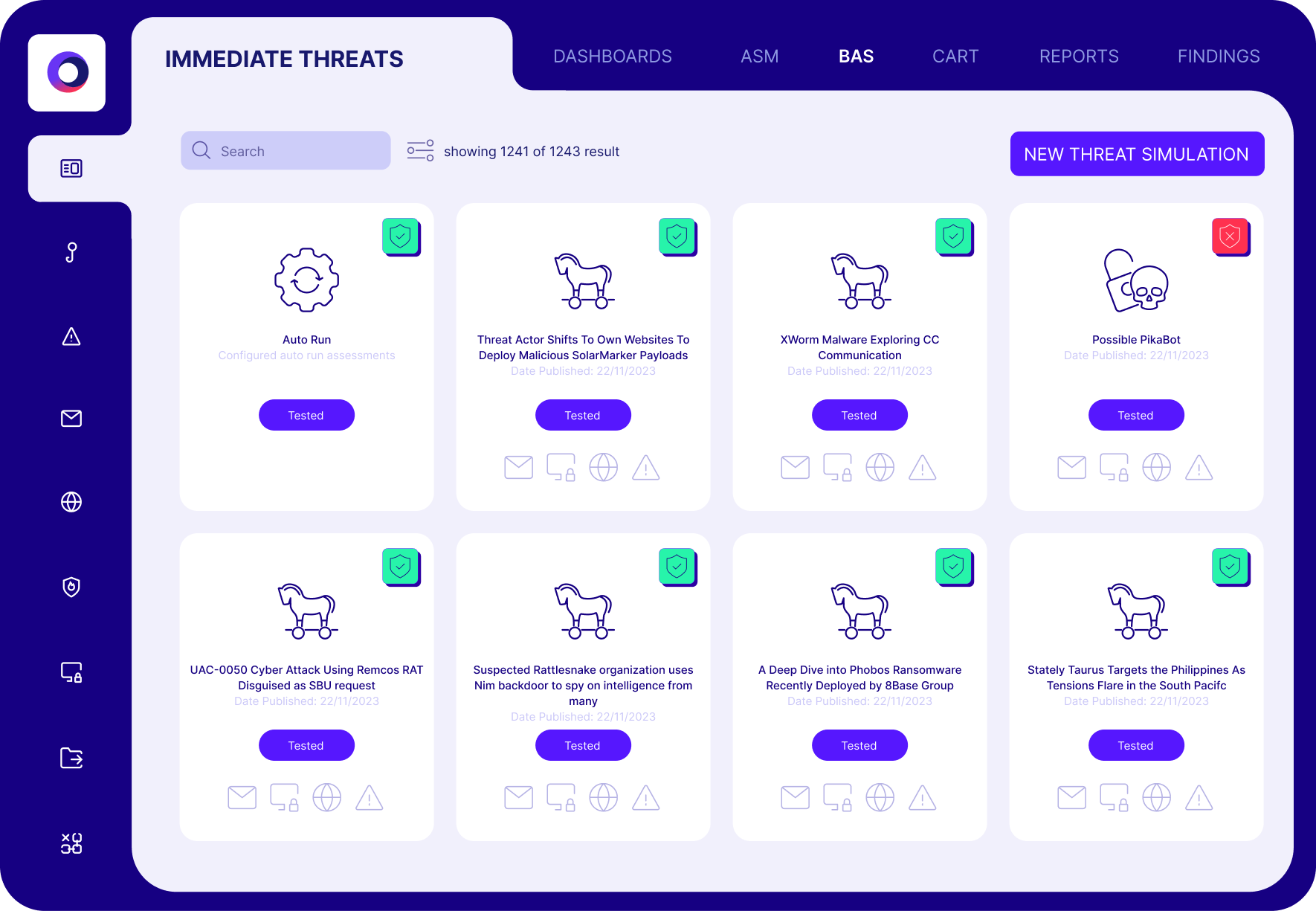
The Cymulate security and exposure validation platform automates advanced offensive testing with the latest threat activity facing the healthcare industry. Each assessment includes remediation guidance with specific steps to update configurations and tune controls. 

To learn more about how Cymulate helps healthcare organizations validate security and optimize defenses, check out this case study for Nemours Children’s Health System, a nonprofit children’s health organization that cares for 500,000 children every year. 

Cymulate Exposure Validation makes advanced security testing fast and easy. When it comes to building custom attack chains, it's all right in front of you in one place.
Mike Humbert, Cybersecurity Engineer
DARLING INGREDIENTS INC.
Learn More
Book a Demo