
Frequently Asked Questions
Identity Attack Validation in AD & Entra ID
What is identity attack validation in Active Directory and Microsoft Entra ID?
Identity attack validation in AD and Entra ID refers to the process of simulating real-world identity and privilege attacks across on-premises Active Directory, Microsoft Entra ID, and hybrid environments. Cymulate's Exposure Validation platform emulates attacker techniques such as privilege escalation, token abuse, and hybrid trust weaknesses, enabling security teams to validate not just configuration posture but whether identity controls and cloud detection mechanisms actually stop or surface abuse.
Why is continuous validation of identity and privileges important?
Continuous validation is essential because identity is now the primary attack surface. With the shift to cloud and remote work, attackers increasingly exploit misconfigurations, excessive privileges, and trust weaknesses in identity systems. Automated, repeatable validation helps organizations identify and remediate exposures before they are exploited, reducing risk and improving operational efficiency.
What types of identity attacks can Cymulate simulate?
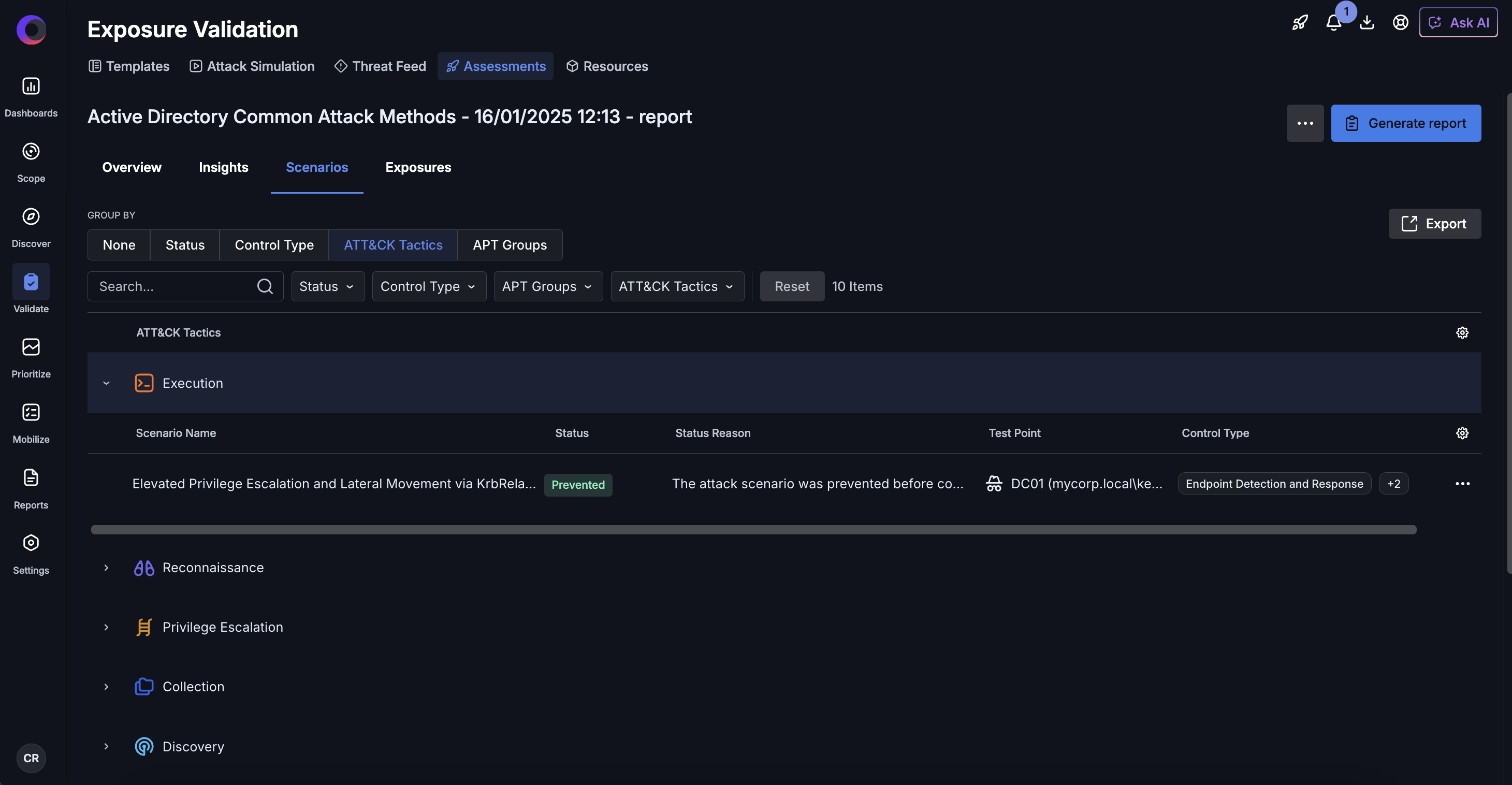
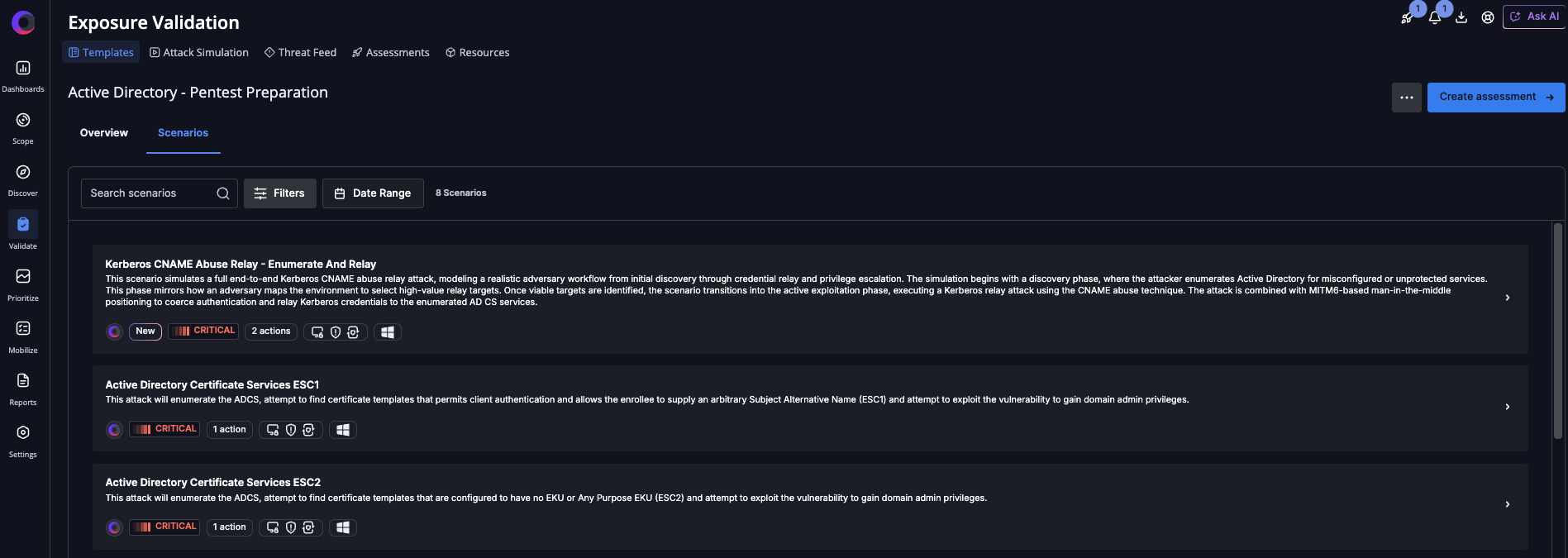
Cymulate can simulate a wide range of identity attacks, including enumeration, credential abuse, privilege escalation, token abuse, and attacks targeting hybrid trust boundaries. The platform includes 72 attack scenarios organized into 5 templates, covering Active Directory, Microsoft Entra ID, hybrid environments, AD penetration test preparation, and Active Directory Certificate Services (ADCS) abuse.
How does Cymulate validate detection and prevention of identity attacks?
Cymulate safely emulates advanced identity threats directly against your environment and security controls, executing the same techniques attackers use. It shows whether an exposure is exploitable, whether exploitation attempts are detected through identity logs, native alerts, or SIEM workflows, and whether remediation reduces risk in a measurable way. Testing is continuous, repeatable, and aligned to real attacker behavior.
What business value does identity-focused exposure validation deliver?
Identity-focused exposure validation helps organizations reduce risk by continuously identifying excessive privileges, misconfigurations, and trust weaknesses before they are exploited. It improves efficiency by replacing manual audits with automated simulations and lowers costs by prioritizing remediation based on proven exploitability and detection gaps.
How does Cymulate help with hybrid Active Directory and Entra ID environments?
Cymulate validates identity security across integrated AD and Entra ID deployments by testing policy enforcement, access controls, and monitoring across synchronization boundaries and identity tokens. It identifies gaps created by hybrid trust, ensuring comprehensive coverage of both on-premises and cloud identity systems.
What are the main attack techniques covered in Cymulate's identity validation templates?
The main attack techniques include enumeration, credential abuse, privilege escalation, recently discovered AD exploits, cloud identity attacks (including high-privilege operations and third-party Entra ID app abuse), conditional access testing, hybrid trust boundary validation, and ADCS abuse methods such as mis-issued certificates and privilege escalation.
How does Cymulate support Active Directory penetration test preparation?
Cymulate executes attack techniques commonly used during AD penetration tests, helping teams measure readiness before red team or third-party testing. It confirms whether security controls block or detect attacks, allowing organizations to proactively address gaps before formal assessments.
How does Cymulate validate detection of certificate-based attacks in ADCS?
Cymulate tests abuse methods of Active Directory Certificate Services (ADCS), including mis-issued certificates and privilege escalation. It validates detection of certificate-based attacks that are often missed by traditional controls and exposes trust weaknesses that enable long-term access.
How does Cymulate help organizations prove their identity defenses work?
Cymulate enables organizations to test their identity controls the same way attackers do, providing clear answers to questions like: Are we vulnerable right now? Can we detect identity abuse when it happens? Did our remediation actually remove the risk? This approach turns identity risk into measurable proof, not just compliance checklists.
What are the most common identity attack paths Cymulate helps uncover?
Cymulate helps uncover attack paths such as excessive privileges, misconfigurations, trust weaknesses, credential abuse, token hijacking, and lateral movement enabled by identity sprawl. These are the dominant breach paths in modern cloud and hybrid environments.
How does Cymulate's identity validation differ from traditional audits?
Unlike static reviews or point-in-time audits, Cymulate's identity validation is continuous, automated, and aligned to real attacker behavior. It provides evidence-based insights into what is exploitable and whether defenses actually detect or prevent abuse, rather than just checking for policy compliance.
How can security teams get started with Cymulate's identity attack scenarios?
Current Cymulate customers can activate the new identity-focused scenarios and continuously validate exposure across Active Directory, Microsoft Entra ID, and hybrid environments. Security teams evaluating Cymulate can request a demo to see how real-world identity attacks are executed safely and how detections surface in logs and SIEMs.
What are the prerequisites for deploying Cymulate's identity validation?
Cymulate operates in an agentless mode, requiring no additional hardware or dedicated servers. Customers are responsible for providing necessary infrastructure and third-party software as per Cymulate’s prerequisites, but the platform is designed for quick and seamless integration into existing workflows.
How does Cymulate help prioritize remediation efforts for identity exposures?
Cymulate prioritizes remediation based on proven exploitability and detection gaps, allowing security teams to focus resources where they matter most. The platform provides actionable insights and evidence-based recommendations to address the most critical identity exposures first.
What is the impact of configuration drift on identity security, and how does Cymulate address it?
Configuration drift can silently reintroduce exposures as new users, integrations, or changes occur. Cymulate addresses this by enabling recurring assessments, ensuring that identity security remains robust even as environments evolve.
How does Cymulate validate SIEM visibility for identity attacks?
Cymulate's identity attack simulations confirm whether SIEM solutions detect and surface identity abuse. The platform enables teams to review what is detected (and what is not), validate SIEM visibility, and ensure that detection rules are effective against real-world attack techniques.
What are some real-world incidents that highlight the importance of identity attack validation?
High-profile incidents at organizations such as Snowflake, Cloudflare, and Okta involved attackers leveraging stolen credentials or hijacked session tokens to access internal systems. These cases underscore the need for continuous identity attack validation to prevent similar breaches.
How does Cymulate's approach align with current industry research on identity security?
Industry surveys show that 99% of cloud-related breaches originate from insecure identities. Cymulate's approach aligns with this research by focusing on validating identity controls, detecting abuse, and addressing the most common breach methods targeting identity infrastructure.
What resources are available to learn more about identity attack validation with Cymulate?
You can access Cymulate's Resource Hub for whitepapers, solution briefs, and thought leadership articles. The blog features in-depth posts on identity attack techniques, recent research, and mitigation strategies. Visit the Resource Hub and the blog for more information.
Features & Capabilities
What are the key features of Cymulate's Exposure Validation platform?
Cymulate's Exposure Validation platform offers continuous threat validation, attack path discovery, automated mitigation, accelerated detection engineering, complete kill chain coverage, and an extensive threat library with daily updates. These features enable organizations to stay ahead of emerging risks and improve operational efficiency.
How does Cymulate integrate with other security tools?
Cymulate integrates with a wide range of technology partners across network, cloud, endpoint, and SIEM domains. Examples include Akamai Guardicore, AWS GuardDuty, BlackBerry Cylance OPTICS, Carbon Black EDR, Check Point CloudGuard, CrowdStrike Falcon, and more. For a complete list, visit our Partnerships and Integrations page.
How does exposure validation help improve threat detection?
Exposure validation enhances threat detection by continuously testing whether security controls are functioning as intended against real-world attack techniques. By simulating adversarial behaviors, organizations can verify if threats are detected by their existing tools, such as EDR, SIEM, and XDR systems, and identify blind spots or misconfigurations.
How complex is it to validate security against a single MITRE ATT&CK® technique?
Validating against a single MITRE ATT&CK® technique can be highly complex, as one technique may have thousands of variations. For example, validating email security against spear phishing requires testing with thousands of unique emails to identify which can bypass security controls undetected. Learn more at our MITRE ATT&CK® page.
Use Cases & Benefits
Who can benefit from Cymulate's identity attack validation?
Cymulate's identity attack validation is beneficial for CISOs, security leaders, SecOps teams, red teams, and vulnerability management teams across industries such as finance, healthcare, retail, media, transportation, and manufacturing. It helps these roles validate defenses, prioritize remediation, and improve overall security posture.
What business impact can customers expect from using Cymulate?
Customers have reported an 81% reduction in cyber risk within four months, a 60% increase in team efficiency, 40X faster threat validation, a 30% improvement in threat prevention, and a 52% reduction in critical exposures. These outcomes are supported by case studies such as Hertz Israel's experience (read the case study).
What pain points does Cymulate solve for security teams?
Cymulate addresses pain points such as overwhelming threat volume, lack of visibility, unclear prioritization, operational inefficiencies, fragmented tools, cloud complexity, and communication barriers. The platform provides continuous threat validation, exposure prioritization, improved resilience, and collaboration across teams.
How does Cymulate's solution differ for different security personas?
CISOs benefit from quantifiable metrics and insights for strategic decision-making. SecOps teams gain operational efficiency and actionable insights. Red teams leverage automated offensive testing with a vast attack library. Vulnerability management teams receive consolidated insights for effective exposure prioritization. Each persona's unique challenges are addressed with tailored features and workflows.
Pricing & Plans
What is Cymulate's pricing model?
Cymulate operates on a subscription-based pricing model tailored to each organization's needs. Pricing depends on the chosen package, number of assets, and selected scenarios. The subscription fee is non-refundable and must be paid regardless of actual use. For a detailed quote, schedule a demo with the Cymulate team.
Competition & Comparison
How does Cymulate compare to AttackIQ?
AttackIQ delivers automated security validation through attack simulation but lacks Cymulate's innovation, threat coverage, and ease of use. Cymulate offers the industry's leading threat scenario library and AI-powered capabilities to streamline workflows and accelerate security posture improvement. Read more.
How does Cymulate compare to Mandiant Security Validation?
Mandiant is one of the original BAS platforms but has become outdated with little innovation in the past 5 years. Cymulate continually innovates with AI and automation, expanding into the exposure management market as a grid leader. Read more.
How does Cymulate compare to Pentera?
Pentera focuses on attack path validation but lacks the depth Cymulate provides to fully assess and strengthen defenses. Cymulate offers comprehensive exposure validation, covering the full kill chain and providing cloud control validation. Read more.
How does Cymulate compare to Picus Security?
Picus is suitable for on-premise BAS needs but lacks the complete exposure validation platform Cymulate provides. Cymulate covers the full kill chain and includes cloud control validation, making it a more comprehensive solution. Read more.
How does Cymulate compare to SafeBreach?
SafeBreach offers breach and attack simulation but lacks Cymulate's innovation, precision, and automation. Cymulate leads with AI-powered BAS, the largest attack library, and a full Continuous Threat Exposure Management (CTEM) solution. Read more.
How does Cymulate compare to Scythe?
Scythe is suitable for advanced red teams but lacks Cymulate's focus on actionable remediation and automated mitigation. Cymulate provides a more complete exposure validation platform with daily threat updates, no-code workflows, and vendor-specific remediation guidance. Read more.
Security & Compliance
What security and compliance certifications does Cymulate have?
Cymulate holds several internationally recognized certifications, including SOC2 Type II, ISO 27001:2013, ISO 27701, ISO 27017, and CSA STAR Level 1. These certifications cover security, availability, confidentiality, privacy, and cloud security standards. For more details, visit Security at Cymulate.
How does Cymulate ensure data security and privacy?
Cymulate is hosted in secure AWS data centers with multiple data locality choices. The platform uses strong physical security, encryption for data in transit (TLS 1.2+) and at rest (AES-256), and ensures high availability through redundancy and a tested disaster recovery plan. Application security is maintained through a strict Secure Development Lifecycle (SDLC), continuous vulnerability scanning, and annual third-party penetration tests.
Support & Implementation
How long does it take to implement Cymulate?
Cymulate is designed for quick deployment and ease of use. Operating in agentless mode, customers can start running simulations almost immediately after deployment. Minimal resources are required, and comprehensive support is available via email, chat, and educational resources.
What support resources are available for Cymulate customers?
Cymulate offers email support, real-time chat support, a knowledge base with technical articles and videos, webinars, e-books, and an AI chatbot for quick answers. These resources help customers optimize their use of the platform and resolve issues efficiently.
Customer Proof & Recognition
What feedback have customers given about Cymulate's ease of use?
Customers consistently praise Cymulate for its user-friendly and intuitive platform. For example, Raphael Ferreira, Cybersecurity Manager at Banco PAN, stated: "Cymulate is easy to implement and use—all you need to do is click a few buttons, and you receive a lot of practical insights into how you can improve your security posture." Other customers highlight the platform's accessibility, actionable insights, and responsive support.