

Vulnerability Assessment Solutions: How to Run an AI-Driven Assessment in the Modern Enterprise
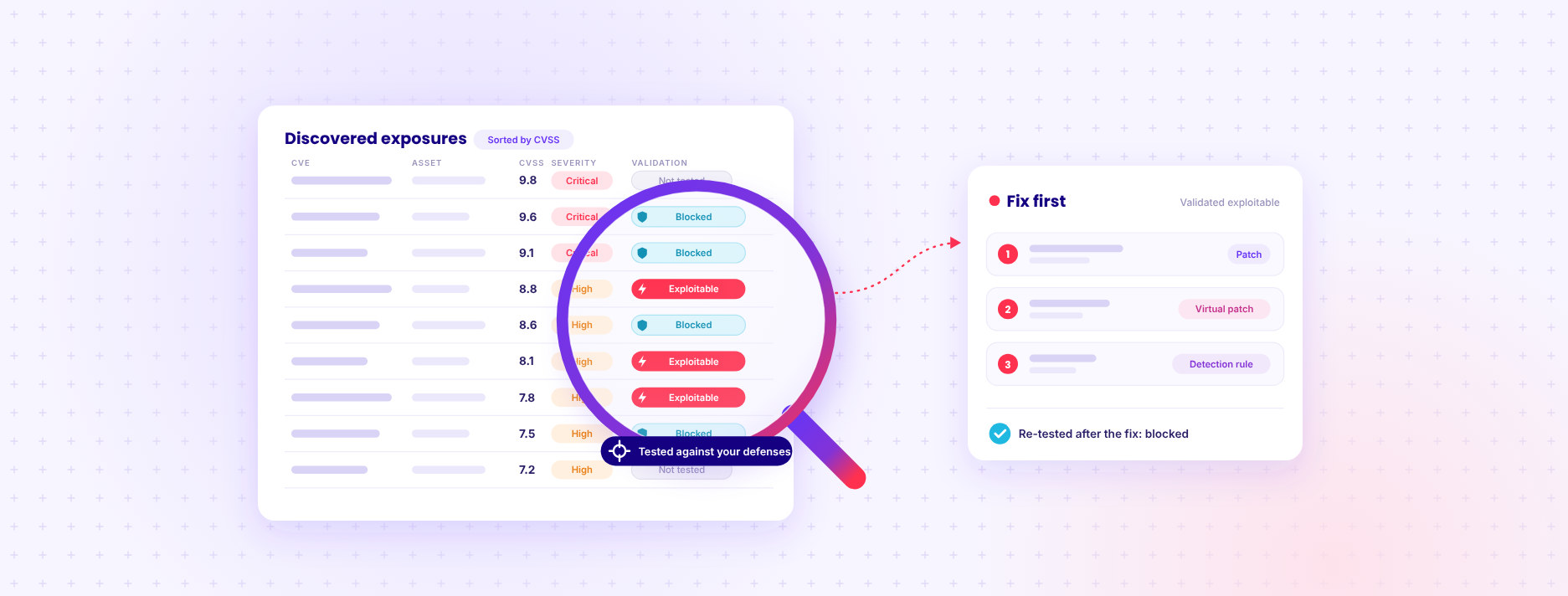
A vulnerability assessment solution helps organizations find security weaknesses, evaluate their significance and plan remediation. A modern solution also validates exploitability against existing defenses, so teams can tell a scanner finding apart from an exposure an attacker could use.
That distinction matters when scanners return thousands of common vulnerabilities and exposures (CVEs). Only a subset may be exploitable in your environment. Network access, software configuration and security controls all influence the outcome. Untested findings still need attention, and their evidence label should reflect that they haven't been tested yet. A confirmed attack path earns a stronger label.
An AI-driven assessment connects discovery with validation, mitigation and re-testing. Your team gets a clearer basis for deciding what to fix first and evidence that its actions reduced exposure.
Key takeaways
- Validate which identified exposures attackers can exploit against your existing defenses.
- Combine severity scores with threat intelligence, asset context and validation evidence.
- Use AI to speed up enrichment, test selection, mitigation planning and re-testing.
- Measure progress by validated risk reduction instead of scan volume or ticket counts.
- Re-test patches and compensating controls as threats and environments change.
What is vulnerability assessment?
Vulnerability assessment is the process of identifying security weaknesses, evaluating their risk and recommending corrective action. It gives security and IT teams an organized view of what needs attention across a defined environment.
The main types reflect the assets under review. Network assessments examine exposed services and network devices. Host assessments inspect operating systems, installed software and configurations. Application assessments cover websites, APIs and application behavior. Cloud assessments examine workloads, permissions and service configurations. Database assessments focus on database software, access and settings.
Vulnerability scanning supplies much of the discovery data. Assessment adds interpretation: whether findings apply, which business services they affect and what action makes sense.
Vulnerability assessment vs. penetration testing vs. exposure validation vs. CTEM
These approaches support different decisions. Vulnerability assessment vs. penetration testing is mainly a distinction between broad identification and deeper testing of how weaknesses can enable compromise. Exposure validation adds repeatable evidence about defenses. Continuous threat exposure management (CTEM) organizes the broader operating program.
| Approach | Purpose | Typical frequency | Output |
| Vulnerability assessment | Identify and evaluate weaknesses | Scheduled and after changes | Findings with remediation priorities |
| Penetration testing | Demonstrate compromise within an agreed scope | Periodic and after major changes | Tested attack paths and impact |
| Exposure validation | Test exploitability and control effectiveness | Recurring and event-triggered | Prevention, detection and exposure evidence |
| CTEM | Coordinate exposure discovery through action | Ongoing program | Business-aligned priorities and verified progress |
Frequency depends on risk and operational constraints. Continuous validation complements the depth and judgment of a penetration test.
Why traditional vulnerability assessment falls short
Traditional assessments struggle when the output grows faster than the team can investigate it. Three pressures make a severity-ranked spreadsheet an incomplete basis for remediation.
- Volume: Jerry Gamblin's 2025 CVE data review counted 48,185 published CVEs, excluding rejected records. Your organization will encounter only part of that total, but every relevant finding still needs an owner and a decision.
- Speed: In its State of Exploitation 2026 analysis, VulnCheck found that 28.96% of known exploited vulnerabilities (KEVs) in 2025 showed evidence of exploitation on or before the day their CVE was published. This figure describes the VulnCheck dataset rather than the Cybersecurity and Infrastructure Security Agency (CISA) catalog alone.
- Breach impact: The 2026 Verizon Data Breach Investigations Report identifies vulnerability exploitation as the leading initial access vector, found in 31% of breaches.
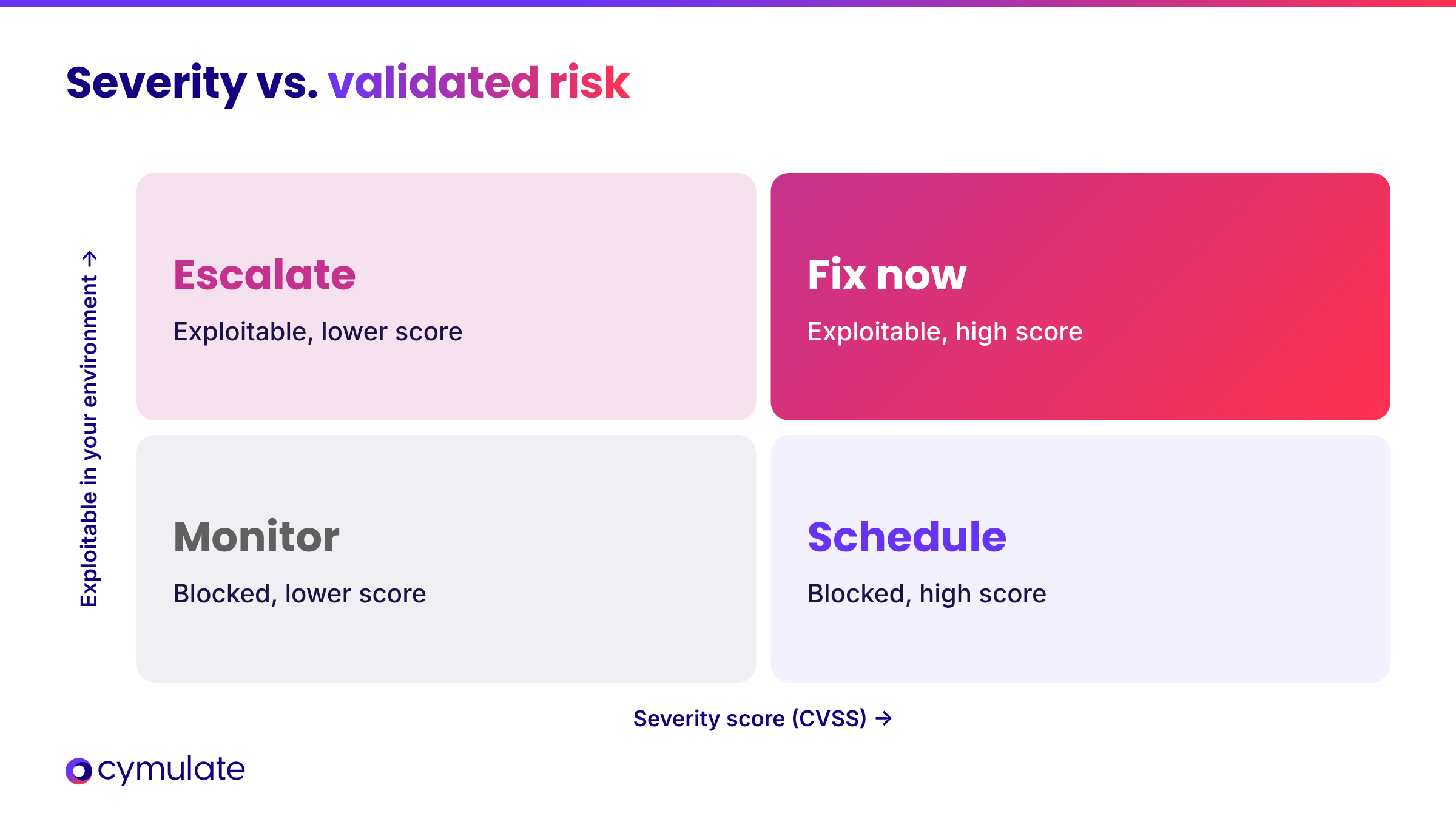
Severity describes a weakness. Actual impact also depends on whether an attacker can reach it, meet its prerequisites and get past your defenses. A critical finding behind effective controls may warrant a different response from a reachable flaw that supports access to a sensitive system.
That gap between a finding and a confident fix is the risk-to-fix gap. Closing it takes better evidence. When a test shows that a control blocks an attack, record the conditions and re-test after changes. When evidence is incomplete, keep the uncertainty visible in your priority decision.
What a modern vulnerability assessment solution must do
Use this checklist to evaluate how a solution moves a finding toward verified action:
- Integrate with existing scanners: Bring findings from network, endpoint, application and cloud tools into a consistent view. Preserve asset identifiers, scan timestamps and original evidence so analysts can trace each finding to its source. Group duplicates while keeping each affected system visible.
- Add risk context: Combine Common Vulnerability Scoring System (CVSS) severity, Exploit Prediction Scoring System (EPSS) likelihood and CISA KEV status with asset criticality, internet exposure and business dependencies. Keep these signals distinct and explain how they influence priority. A score should help an analyst understand the decision, with supporting evidence available for review.
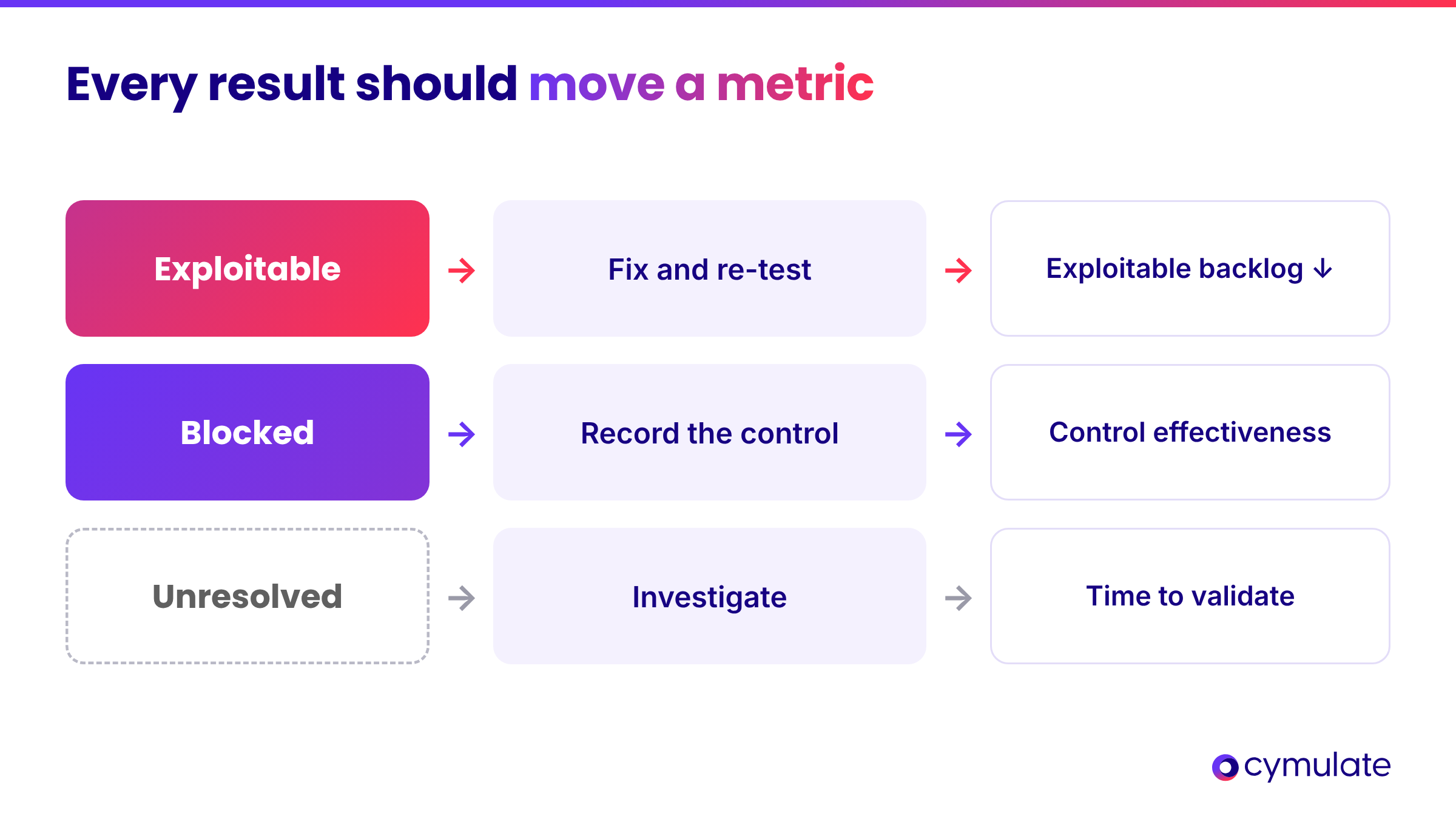
- Validate exploitability safely: Test whether relevant attack behavior can succeed against existing defenses within an approved scope. Document prerequisites, execution limits and test coverage. Results should separate confirmed exploitability, blocking under tested conditions and unresolved findings that need further investigation.
- Identify effective compensating controls: Show whether an existing web application firewall (WAF) rule, endpoint policy or network restriction interrupts the tested attack path. Identify the control responsible and retain the evidence. Report prevention and detection separately: an alert confirms visibility, and prevention confirms the attack stopped.
- Deliver mitigation guidance: Recommend a supported patch, configuration change or compensating control that addresses the exposure. Give the responsible team enough detail to assess dependencies, plan deployment and verify success. Where several findings share a root cause, group the recommended work to reduce duplicate effort.
- Re-test after remediation: Confirm that the change reached the affected assets and that the relevant attack behavior no longer succeeds. Check legitimate application activity as well, particularly after control updates. Keep temporarily mitigated findings visible with an owner, review date and permanent remediation plan.
- Run continuously with AI-driven automation: Use AI to correlate findings, refresh threat context, select relevant tests and coordinate approved re-validation workflows. Trigger reassessment when new vulnerabilities, deployments or control changes affect earlier conclusions. Retain an audit trail and require human approval for consequential production changes.
During a trial, follow one finding from ingestion through closure. Ask the provider to show why it received its priority, which evidence supports the proposed mitigation and how re-testing confirms the outcome. This makes it easier to judge whether the solution improves remediation decisions in your environment.
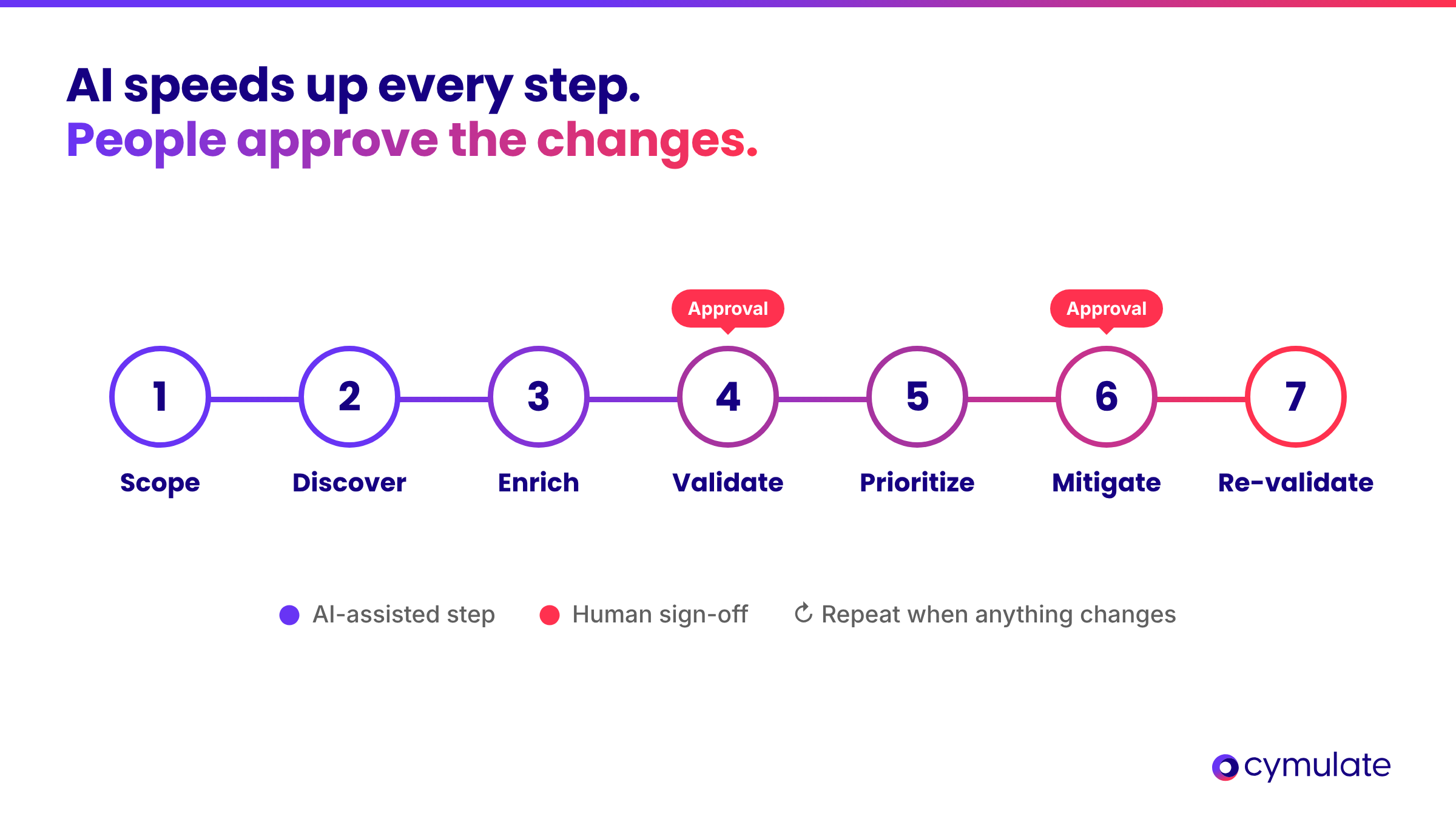
How to conduct a vulnerability assessment with AI: seven steps
Start with a manageable scope, such as one customer-facing service and its dependencies. Establish a repeatable workflow before expanding coverage across the enterprise.
1. Scope assets and add business context
Define the systems you will assess and the business outcomes they support. Include cloud accounts, on-premises systems, applications and relevant dependencies. Record service owners, sensitive data, internet exposure and acceptable testing windows in the asset inventory.
Agree on what a successful assessment means. For a customer portal, that might mean validating exposed application weaknesses and the controls protecting access to customer records. Document exclusions so a clean result reflects only the coverage you had.
AI can reconcile asset descriptions, suggest service groupings and flag missing ownership. An application owner should confirm business criticality rather than accept a model's inference from a hostname. The deliverable is an approved scope with owners, priorities and testing boundaries.
2. Discover assets and scan for vulnerabilities
Combine inventory records with discovery tools and cloud APIs to find assets that existing lists miss. Collect findings from network scanners, endpoint agents, application tests and cloud assessments as appropriate to the scope.
Use authenticated checks where supported to inspect installed software and settings. Verify that credentials worked and that scans completed. A scan with failed authentication can leave important gaps even when its report looks quiet.
AI can normalize names and group duplicate findings across tools. Keep the original evidence available so analysts can inspect a proposed match. A shared CVE on two different assets is still two affected instances, even if one coordinated change can resolve both.
Finish with a deduplicated finding set and a separate list of missing coverage, unreachable assets and failed checks.
3. Enrich findings with threat intelligence
Attach the CVE identifier, affected versions and vendor guidance to each applicable finding. Then add distinct signals and keep each one separate.
CVSS describes vulnerability severity. EPSS estimates the probability that a published CVE will see exploitation in the wild within the next 30 days. It measures likelihood across the wider threat environment, so pair it with context about your specific asset.
The CISA KEV catalog identifies vulnerabilities with confirmed exploitation. Combine it with vendor advisories and other credible exploitation reports. Treat a CVE that's absent from the catalog as unconfirmed, and keep evaluating it.
AI can extract relevant details from advisories and summarize changes. Retain source links and timestamps, then check disputed version matches. The output should explain the threat evidence and its relevance to the affected asset.
4. Validate exploitability
Use controlled testing to establish whether the exposure presents a usable opportunity under defined conditions. Match the test to the affected technology, access prerequisites and attack path. Coordinate execution with system owners and security operations.
Choose a safe method for each environment. National Institute of Standards and Technology (NIST) guidance on security testing emphasizes planning, assessment and mitigation. Sensitive systems may require a representative test environment or limited checks in place of direct exploitation in production.
Exposure validation and breach and attack simulation (BAS) can test relevant attack behavior against defenses. Record whether a test directly exercised the vulnerability or validated a related technique. A blocked simulation supports a specific control conclusion. Other exploit variants may still need their own tests.
AI can recommend relevant tests and correlate results with control telemetry. Analysts should verify what the evidence supports. Label outcomes as confirmed exploitable, blocked under tested conditions or unresolved. A failed test without an established cause belongs in the unresolved group.
5. Prioritize based on validated risk
Combine validation results with active exploitation, asset criticality, reachability and business consequences. Use severity as one input to risk-based vulnerability prioritization.
For example, a reachable weakness on a payment service that gets past existing defenses deserves urgent attention. A similar finding with confirmed blocking may allow a planned patch window, subject to policy and continued monitoring. An untested internet-facing KEV still requires urgent review. Take protective action while validation is in progress.
AI can group related findings, draft priority explanations and identify shared fixes. Require those explanations to reference evidence. Keep mandatory deadlines and analyst overrides visible.
The output is a remediation queue with accountable owners, action dates and reasons. This makes the priority clear to the team that must schedule the change.
6. Mitigate with patches or compensating controls
Apply the vendor's patch or supported configuration fix where practical. Check dependencies and deployment requirements with the service owner. When immediate patching is impractical, choose a compensating control that interrupts the relevant attack path.
Options may include restricting network access, disabling an affected feature or applying a WAF rule. Endpoint detection and response (EDR) may block relevant behavior where its capabilities and configuration support prevention.
Virtual patching uses an enforcement layer to prevent exploitation without changing the vulnerable application code. It reduces exposure while a software fix awaits deployment. The underlying vulnerability remains, so assign an owner and review date to the temporary protection.
AI can draft vendor-specific rules, change requests and rollback instructions. Review them for accuracy and application impact before deployment. A detection rule or indicator of compromise (IoC) improves visibility, and blocking exploitation may take a separate prevention control. Test the intended protective effect explicitly. Use security control validation to check that the deployed policy delivers the outcome your mitigation plan requires.
7. Re-validate and continuously repeat
Re-scan to confirm the patch or configuration change, then repeat the relevant validation test. Check that the attack behavior no longer succeeds and that legitimate service activity still works. Close the exposure once the evidence meets your closure criteria.
If a compensating control provides protection, retain the original finding with its mitigation status and patch plan. Schedule re-testing when policies, infrastructure or threat conditions change. A new route around a control can invalidate an earlier result.
AI can monitor those triggers, schedule approved tests and compare current evidence with previous results. Keep an audit trail of inputs, actions and approvals.
Continuous vulnerability assessment means recurring discovery and event-driven reassessment. Reserve intrusive tests for the systems and moments that call for them, and match the cadence to risk, coverage and operational tolerance.
Where AI fits in vulnerability assessment
AI vulnerability assessment works best when each capability has a defined job and a verifiable output. Data correlation connects scanner findings with assets and advisories. Test selection narrows a library to relevant scenarios. Mitigation drafting converts results into proposed changes. Recurring workflows keep evidence current.
Agentic AI in cybersecurity extends this into coordinated tasks. An agent might ingest a new advisory, identify affected assets, select approved tests and prepare remediation recommendations. Give it bounded permissions and require human approval for consequential security changes.
Keep source evidence attached to AI-generated conclusions. A model can confuse product versions, suggest an unsupported rule or overstate what a test proves. Validate outputs through deterministic checks, control telemetry and analyst review. Treat externally collected text as input data, never as instructions that can change the agent's scope.
Our 2025 Threat Exposure Validation Impact Report found that 89% of security teams have already begun implementing AI in their exposure validation processes. Organizations that run exposure validation processes at least once a month reported a 20% reduction in breaches.
Start automation with read-only enrichment and approved recurring tests. Expand it as the team verifies outputs and builds confidence in recovering from errors. Keep human approval clear at the point where a proposed action changes production security.
Metrics that prove your vulnerability assessment works
Activity counts show workload. Outcome metrics show whether attackers have fewer opportunities. Build vulnerability management metrics around validated outcomes and keep coverage visible alongside them.
| Vanity metrics | Proof metrics |
| Number of scans completed | Time to validate a new CVE |
| Total vulnerabilities identified | Validated exploitable backlog |
| Number of tickets created | Mean time to remediate KEVs |
| Number of rules deployed | Compensating control effectiveness |
- Time to validate a new CVE: Measure elapsed time from a defined trigger, such as identifying an applicable disclosure, to a reviewed validation result. Report unresolved cases separately so missing tests can't improve the average.
- Validated exploitable backlog: Count open asset-vulnerability instances with confirmed exploitability. Break the count down by business service and age. Show validation coverage beside it, since a backlog that shrinks because of fewer tests isn't progress.
- Mean time to remediate (MTTR) for KEVs: Measure time from confirmed applicability to verified remediation. Track temporary mitigation separately from permanent remediation. Include aging open findings so averages based on closed tickets keep stalled work visible.
- Compensating control effectiveness: Measure the share of relevant, valid tests in which the intended control prevented the tested behavior. State the test set and date. Give detection-only outcomes their own measure.
Together, these metrics help leaders see where exposure persists and whether remediation resources are producing verified improvements.
How Cymulate turns vulnerability assessment into agentic cyber defense engineering
Cymulate closes the risk-to-fix gap between what scanners find and what your defenses stop. We apply agentic cyber defense engineering to vulnerability assessment through three actions: Prove. Prioritize. Adapt.
- Prove: Cymulate CTEM integrates with your vulnerability scanners and asset management tools, then maps each CVE to attack simulations in the Cymulate Exposure Validation attack library to prove exploitability against your existing controls.
- Prioritize: Cymulate CTEM stack-ranks exposures by validated prevention and detection rates, threat intelligence, asset business impact, CVSS and CISA KEV status. Because of this customized prioritization, Cymulate customers see an average 52% reduction in critical exposures.
- Adapt: Cymulate CTEM creates exposure-specific threat updates and behavioral rules you apply directly to your security controls for immediate prevention and detection while patches are pending, so teams can test a new threat in under an hour and mitigate it the same day. Cymulate Exposure Validation re-tests to confirm the fix and keeps defenses current as threats change.
Cymulate Vero AI tailors validation and mitigation to your environment and exposure context. Vulnerability management and security operations teams get a shared basis for action: the finding, validation evidence, proposed response and measured result.

From vulnerability assessment to continuous exposure validation
Vulnerability assessment remains foundational. Its value grows when every important finding leads to a supported decision and a verified outcome.
The progression has five steps: find vulnerabilities, validate exploitability, prioritize actual risk, mitigate and re-test continuously. This connects assessment to a broader CTEM program that adapts as the business and its threats change.
Start with one service. Establish its exposure baseline, validate the highest-priority findings and confirm that remediation works. Expand the workflow with the evidence and operating lessons from that first cycle.

Featured Resources
View More Resources
Cymulate for Vulnerability Management Teams
Move beyond vulnerability scanning with validated exposure, risk-based prioritization, and faster mitigation.

Exposure Validation Demo
Demo of automated offensive simulations validating detection, prevention, and IOC coverage

Vulnerability Assessment vs Penetration Testing: Which Do You Need?
A breakdown of the differences between vulnerability assessments and penetration testing in goals and methods.