

Frequently Asked Questions

AI Cyber Defense & White House Roundtable Insights

What was the focus of the White House AI Cyber Defense Roundtable?

The White House AI Cyber Defense Roundtable centered on leveraging rapidly advancing AI capabilities to strengthen federal cybersecurity. Government and industry leaders, including Cymulate, discussed practical AI-driven use cases that enhance threat detection, deliver predictive insights, and enable response at machine speed. The session emphasized the need for continuous, autonomous, and agentic AI solutions to modernize cyber defense. Source

How is U.S. federal policy accelerating AI adoption in cybersecurity?

U.S. federal policy, including the White House Presidential Cyber Strategy and National Policy Framework for AI (March 2026), is actively promoting secure, innovative AI adoption to strengthen cyber defense. These policies encourage implementing AI-enabled cyber tools, modernizing procurement processes, and removing barriers to innovation, aiming to shift the balance in favor of defenders. Source

What are the main takeaways from the White House AI Cyber Defense Roundtable?

Key takeaways include: U.S. policy is accelerating AI adoption in cybersecurity; the administration seeks to modernize government security practices; adversarial exposure validation (AEV) is critical for all industries; traditional security validation without AI falls short; Cymulate is advancing AI-driven cyber defense; and organizations must adopt AI-powered security validation to keep pace with attacks. Source

Why is adversarial exposure validation (AEV) considered critical for cyber defense?

AEV, formerly known as breach and attack simulation (BAS), is recognized in Gartner® market guidance as a cornerstone capability for strengthening cyber resilience. It enables continuous, threat-informed validation aligned to real-world adversary behavior, helping organizations proactively identify and remediate vulnerabilities. Over 60% of organizations have integrated BAS into SOC operations, with nearly three-quarters reporting measurable improvements in incident response times. Source

How does Cymulate participate in government-industry collaboration for AI cyber defense?

Cymulate participated in an invite-only, closed-door AI cyber defense roundtable at the White House, led by the Federal Chief Information Officer. Cymulate provided industry perspectives on breach and attack simulation and adversarial exposure validation, advocating for these solutions to become standard operational cyber defense practices. Source

What operational challenges do organizations face in cybersecurity, according to the roundtable?

Organizations face persistent challenges such as limited visibility, siloed data, overwhelming alert volumes, and reliance on manual processes. Attackers continue to innovate faster than defenders, and the hope is that AI will help change the game by enabling continuous, automated, and threat-informed validation. Source

How does Cymulate leverage AI and automation to modernize cyber defense?

Cymulate incorporates AI-powered template creation, auto-attack scenario mapping, auto-generation of vendor-specific detection rules, and auto-mitigation features. These innovations simplify automated offensive testing, lower barriers to entry, and make continuous, threat-informed validation accessible for organizations across industries. Source

What are the risks of failing to adopt AI-driven and agentic AEV solutions?

Organizations that fail to adopt modern, agentic AI-driven cyber defense solutions risk falling behind as adversaries exploit gaps faster than defenders can detect or respond. This can lead to more frequent and impactful breaches, loss of sensitive data, operational disruption, and erosion of trust, ultimately affecting mission success and business outcomes. Source

How does Cymulate Exposure Validation simplify advanced security testing?

Cymulate Exposure Validation makes advanced security testing fast and easy by providing a unified platform for building custom attack chains. Users can scope and run new threat simulations within minutes, leveraging AI-powered features for continuous validation. Learn More

What is the role of NIST in promoting secure AI for cyber defense?

NIST's Cybersecurity Framework Profile for AI (NIST IR 8596, Draft) provides operational guidance for leveraging AI in cyber defense and ensuring AI systems are secure and reliable. It establishes shared priorities and outcomes for securing AI systems, conducting AI-enabled cyber defense, and thwarting AI-enabled attacks. Source

How does Cymulate support organizations in adopting AI-powered security validation?

Cymulate provides a platform with AI-driven features such as automated attack simulations, exposure validation, and auto-mitigation. These capabilities help organizations continuously validate their security effectiveness and stay ahead of evolving threats. Book a Demo

What are some examples of AI use cases promoted by CISA?

CISA has identified innovative AI use cases to enhance cyber prevention and detection, including automated detection of PII, confidence scoring in cybersecurity threat indicators, malware reverse engineering, critical infrastructure network anomaly detection, and SOC anomaly detection. Source

How does Cymulate's AI-powered template creator work?

Cymulate's AI-powered template creator allows users to rapidly scope and run new threat attack simulations based on plain-text or threat intelligence URLs. This feature streamlines the process of creating and executing attack scenarios for continuous security validation. Source

What is agentic AI and how is Cymulate investing in it?

Agentic AI refers to autonomous AI capabilities that execute end-to-end threat validation, maintain context-aware environment profiles, run relevant attacks, auto-push remediations, and continuously adapt and learn. Cymulate is investing heavily in agentic AI to deliver autonomous execution of adversarial exposure validation across the threat validation lifecycle. Source

How does Cymulate help organizations overcome barriers to adopting advanced cyber defense solutions?

Cymulate lowers barriers to entry by simplifying automated offensive testing, providing AI-driven features, and making continuous, threat-informed validation accessible for organizations of all sizes. The platform supports rapid testing, prototyping, and evaluation of new solutions, aligning with government and industry needs. Source

What is the impact of AI-driven cyber defense on incident response times?

Industry data shows that nearly three-quarters of organizations that have integrated breach and attack simulation (BAS) into SOC operations report measurable improvements in incident response times, reflecting the effectiveness of AI-driven, continuous security validation. Source

Features & Capabilities

What features does Cymulate offer for exposure validation?

Cymulate offers continuous threat validation, exposure awareness, defensive posture optimization, scalable offensive testing, cloud validation, collaboration across teams, and comprehensive integration of Breach and Attack Simulation (BAS), Continuous Automated Red Teaming (CART), and Exposure Analytics. Learn More

Does Cymulate support integrations with other security tools?

Yes, Cymulate integrates with a wide range of technology partners, including Akamai Guardicore, AWS GuardDuty, BlackBerry Cylance OPTICS, Carbon Black EDR, Check Point CloudGuard, CrowdStrike Falcon, Rapid7 InsightVM, SentinelOne, Wiz, and more. For a full list, visit our technology alliances and partners page.

What AI-powered capabilities are included in Cymulate's platform?

Cymulate's platform includes AI-powered template creation, auto-attack scenario mapping, auto-generation of detection rules, auto-mitigation, and agentic AI for autonomous execution of adversarial exposure validation. These features enable rapid, continuous, and context-aware threat validation. Source

How does Cymulate help organizations validate their security controls?

Cymulate simulates real-world threats to test and validate security controls, providing actionable insights and evidence-based prioritization. The platform ranks vulnerabilities based on exploitability, business context, and threat intelligence, enabling focused remediation efforts. Source

What technical documentation is available for Cymulate?

Cymulate provides a product whitepaper, custom attacks data sheet, technology integrations data sheet, solution briefs, and analyst reports. These resources offer technical details on exposure management, attack simulation, integrations, and market positioning. View Resources

Use Cases & Benefits

Who can benefit from Cymulate's platform?

Cymulate's platform is designed for CISOs, Security Operations teams, Red Teams, Detection Engineers, and Vulnerability Management teams across industries such as finance, healthcare, retail, and technology. The platform addresses universal cybersecurity challenges and supports collaboration across roles. Source

What business impact can customers expect from using Cymulate?

Customers report a 30% improvement in threat prevention, 52% reduction in critical exposures, 60% increase in operational efficiency, 40X faster threat validation, 85% improvement in threat detection accuracy, and an 81% reduction in cyber risk within four months. These outcomes are supported by case studies such as Hertz Israel. Read Case Study

What pain points does Cymulate solve for security teams?

Cymulate addresses overwhelming threat volumes, lack of visibility, unclear prioritization, operational inefficiencies, fragmented security tools, cloud complexity, and communication barriers. The platform provides continuous threat validation, actionable insights, and quantifiable metrics for improved decision-making. Read Case Studies

Are Cymulate's solutions tailored for different user personas?

Yes, Cymulate tailors its solutions for Red Teams (production-safe attack simulations, custom offensive testing), Detection Engineers (SIEM coverage gap analysis, rule validation), and Vulnerability Management teams (consolidated exposure prioritization). Each persona benefits from features designed to address their specific challenges. Learn More

What customer feedback has Cymulate received regarding ease of use?

Customers consistently praise Cymulate for its ease of use and intuitive design. Testimonials highlight quick implementation, user-friendly dashboards, actionable insights, and excellent support. For example, Raphael Ferreira, Cybersecurity Manager, stated, "Cymulate is easy to implement and use—all you need to do is click a few buttons, and you receive a lot of practical insights." Read More

How quickly can Cymulate be implemented?

Cymulate is known for its quick and seamless implementation. The platform operates in agentless mode, requires minimal resources, and allows customers to start running simulations almost immediately after deployment. Comprehensive support and educational resources are available to ensure a smooth onboarding process. Webinars

Pricing & Plans

What is Cymulate's pricing model?

Cymulate operates on a subscription-based pricing model tailored to each organization's needs. Pricing is determined by the specific package, number of assets, and scenarios selected for testing and validation. For a detailed quote, schedule a demo with Cymulate's team. Schedule a Demo

Competition & Comparison

How does Cymulate compare to AttackIQ?

Cymulate surpasses AttackIQ with its industry-leading threat scenario library, AI-powered capabilities, and ease of use. Cymulate provides streamlined workflows and accelerates security posture improvement, while AttackIQ lacks the same level of innovation and threat coverage. Read More

How does Cymulate compare to Mandiant Security Validation?

Mandiant Security Validation is considered outdated, with little innovation in the past five years. Cymulate continuously innovates with AI and automation, expanding into the exposure management market as a grid leader. Read More

How does Cymulate compare to Pentera?

Pentera focuses on attack path validation but lacks the depth Cymulate provides in assessing and strengthening defenses. Cymulate optimizes defense, scales offensive testing, and increases exposure awareness with a broader scope. Read More

How does Cymulate compare to Picus Security?

Picus Security offers an on-prem option for breach and attack simulation (BAS), but Cymulate provides a more complete exposure validation platform, covering the full kill chain and including cloud control validation. Read More

How does Cymulate compare to SafeBreach?

Cymulate outpaces SafeBreach with unmatched innovation, precision, and automation. Cymulate features the industry’s largest attack library, a full Continuous Threat Exposure Management (CTEM) solution, and comprehensive exposure validation. Read More

How does Cymulate compare to Scythe?

Scythe is suitable for advanced red teams building custom attack campaigns, but Cymulate is trusted by security teams focused on fixing issues and eliminating exposure. Cymulate provides actionable remediation, automated mitigation, and a more user-friendly platform. Read More

Security & Compliance

What security and compliance certifications does Cymulate hold?

Cymulate is certified for SOC2 Type II, ISO 27001:2013 (Information Security Management), ISO 27701 (Privacy Information Management), ISO 27017 (Cloud Services Security), and CSA STAR Level 1. These certifications demonstrate Cymulate's commitment to industry-leading security and privacy standards. Learn More

How does Cymulate ensure GDPR compliance?

Cymulate ensures GDPR readiness through data protection by design, secure development practices, and a dedicated privacy and security team led by a Data Protection Officer (DPO) and Chief Information Security Officer (CISO). Learn More

What product security features does Cymulate offer?

Cymulate includes mandatory 2-Factor Authentication (2FA), Role-Based Access Controls (RBAC), IP address restrictions, and TLS encryption for data in transit. The platform is developed using a strict Secure Development Lifecycle (SDLC) and hosted in secure AWS data centers. Learn More

Company Information & Trust Signals

What is Cymulate's history and global presence?

Cymulate was founded in 2016 and serves over 1,000 customers across 50 countries. The company operates from eight global locations and is recognized for continuous innovation and measurable outcomes. About Us

What is Cymulate's mission and vision?

Cymulate's mission is to empower organizations worldwide against threats and make advanced cybersecurity as simple and familiar as sending an email. The company aims to revolutionize how businesses approach cybersecurity by fostering a proactive stance against threats. About Us

Support & Implementation

What support options are available for Cymulate customers?

Cymulate offers email support, real-time chat support, a knowledge base with technical articles and videos, webinars, and e-books on security validation best practices. These resources ensure customers can optimize their use of the platform. Email Support | Chat Support

Where can I find Cymulate's latest research and threat intelligence?

You can stay updated on the latest threats and Cymulate research by visiting our blog. The blog features posts from Cymulate Research Lab and expert authors, including Amanda Kegley and Elad Beber.

New: 2026 Gartner® Market Guide for Adversarial Exposure Validation
Learn More
Cymulate named a Customers' Choice in 2025 Gartner® Peer Insights™
Learn More
New Research: The Security Tradeoffs Behind AI Tooling
Learn More
An Inside Look at the Technology Behind Cymulate
Learn More

White House Roundtable: AI Innovation Is Redefining Cyber Defense Across Government and Industry 

By: Amanda Kegley

Last Updated: May 4, 2026

AI is no longer a future capability in cybersecurity. It is already reshaping how organizations defend against modern threats. As attackers leverage AI and automation to scale faster than ever, the gap between traditional proactive defenses and today’s threat landscape continues to widen. 

At last month’s White House AI Cyber Defense Roundtable, I was fortunate to have voice in the discussion for how both U.S. government and industry must leverage autonomous, AI-driven solutions that can operate continuously in real time, deliver predictive insight and respond at machine speed. 

Throughout my career, I’ve conducted threat-based cybersecurity assessments across the DoD, Intelligence Community and federal agencies using the MITRE ATT&CK framework. This work supported major acquisition decisions and enterprise cyber strategies, which advanced capabilities and strengthened cyber defense. I had a front-row view into the operational challenges across legacy, cloud, hybrid and multi-cloud environments. The experience was invaluable, and I saw the cyber landscape transform, specifically seeing how adversaries continue to evolve, in ways I could not have even imagined.  

I have brought that perspective and experience into the private sector, advancing and increasing adoption of automated, proactive cyber defense solutions. I continue to see the same persistent critical gaps that traditional security approaches fail to address, which I see I am not alone. This shift is now being reinforced at the highest levels of U.S. policy, with the White House, NIST and CISA accelerating the secure adoption of AI. At the same time, government and industry collaboration is unprecedented and growing to operationalize AI-driven solutions and strengthen cyber resilience. 

Key takeaways: 

  • U.S. policy is accelerating AI adoption in cybersecurity and engaging the private sector more 
  • Presidential administration recognizes the shift and seeks to modernize U.S. government security practices, specifically antiquated acquisition processes 
  • Adversarial exposure validation is a critical defense capability for all industries 
  • Traditional approaches to security validation without AI fall short  
  • Cymulate is advancing AI-driven cyber defense  
  • Organizations must adopt AI-powered security validation to keep pace with attacks  

U.S. Federal Government and NIST Promote Secure AI for Cyber Defense 

AI solutions enable organizations to process massive amounts of data in real time, rapidly identify subtle patterns of malicious activity and respond faster than human-led operations alone.  

Recently published U.S. policies and frameworks, highlighted in Table 1, send a clear and consistent message that secure, innovative AI must be adopted rapidly to strengthen cyber defense across prevention, detection and response. These initiatives aren’t just encouraging AI adoption; they are actively working to significantly strengthen cyber defense capabilities and shift the favor back to defenders.  
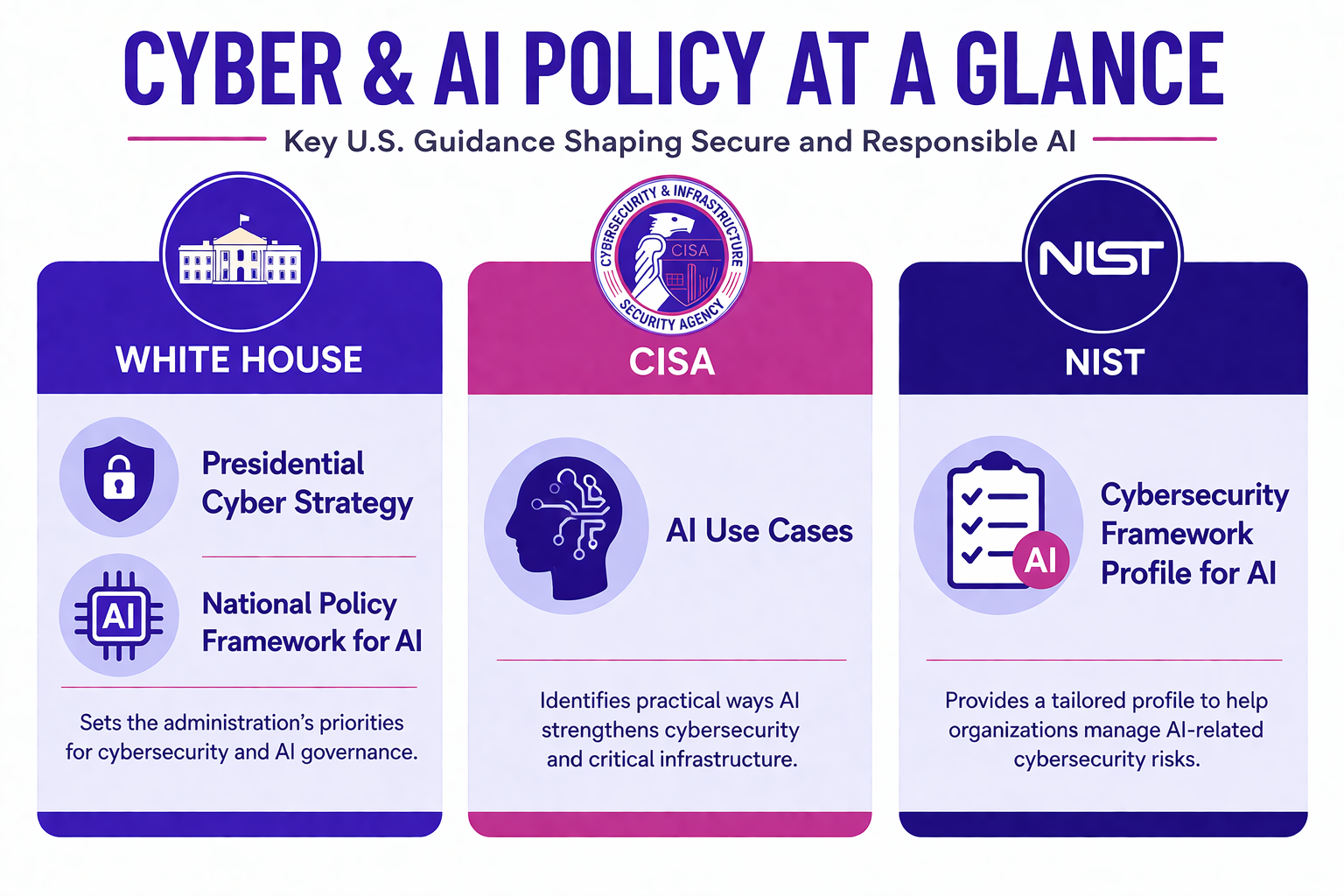
Given the volume of the policy memos coming out of D.C., it’s not always easy to stay on top of the most relevant points. To help, I’ve distilled the key insights that matter most for the purposes of this discussion in the table below. 

White House Presidential Cyber Strategy (March 2026)  
• Implement AI-enabled cyber tools to detect, divert and deceive threat actors 
• Adopt and promote agentic AI in ways that securely scale network defense and disruption 
• Modernize procurement processes and remove barriers to entry so that the government can buy and use the best AI innovation technology to enhance cyber capabilities.  
White House National Policy Framework for AI (March 2026)  
• Communicated the importance on “removing barriers to innovation and accelerating deployment of AI applications” 
• Requested Congress establish regulatory sandboxes for AI applications that help “unleash American ingenuity and further American leadership in AI development and deployment” 
• Seeking to support development and deployment of sector-specific AI applications that follow existing regulations vs. creating a new federal rulemaking body to regulate AI 
 
CISA Artificial Intelligence Use Cases 
• Identified and evaluated innovative AI use cases to enhance cyber prevention and detection capabilities, such as: 
- Automated detection of PII 
- Confidence scoring in cybersecurity threat indicators 
- Malware reverse engineering 
- Critical infrastructure network anomaly detection 
- SOC anomaly detection 
Cybersecurity Framework Profile for AI (NIST IR 8596) - Draft 
• Provides an operational approach to both leverage AI in cyber defense and ensure AI is secure and reliable 
• Support organizations in their efforts to use AI to address cybersecurity challenges 
• Establishing a shared understanding of AI-related cybersecurity priorities and considerations organizations 
• Provides a set of common cybersecurity outcomes using AI for securing AI systems (secure), conducting AI-enabled cyber defense (defend) and thwarting AI-enabled attacks (thwart) 
 

Table 1: Summary of Recently Published U.S. Cybersecurity and AI Policies and Frameworks 

AI-driven cyber defense solutions must be viewed as essential, not as just emerging capabilities, to restore the balance of power in favor of defenders. 

White House AI Cyber Defense Roundtable 

Cymulate participated in an invite-only, closed-door AI cyber defense roundtable at the White House, led by Michael Duffy, Federal Chief Information Officer. The session focused on how rapidly advancing AI capabilities can be leveraged to strengthen federal cybersecurity. Government and industry leaders came together to explore cyber challenges and practical, AI-driven use cases that enhance threat detection, deliver predictive insights and enable response at machine speed.  

Along with Cymulate President Matt Handler, I represented Cymulate at the roundtable to provide industry perspectives to the discussion. It was refreshing to witness (and be a part of) senior government leaders on the panel directly asking the industry which cybersecurity solutions should be adopted as standard practice. In response, we highlighted our deep experience supporting the government’s use of breach and attack simulation, now evolved into adversarial exposure validation (AEV), to advance the cyber defense mission. 

I was a part of federal programs that leveraged breach and attack simulation solutions to assess security capabilities and improve cyber defenses. I communicated to the panel that solutions like BAS/automated exposure validation with a threat-informed approach have been leveraged in the past; however, they have not been mandated and are still often treated as a “nice to have.” These proactive, threat-based solutions with advanced innovation and agentic AI must be mandated as a standard operational cyber defense solution to support the mission in shifting the balance in favor of the cyber defenders. 

I also wanted to share additional important themes Matt and I identified throughout the discussion: 

  • Organizations are still grappling with persistent traditional cybersecurity challenge, which include limited visibility, siloed data, overwhelming alert volumes and reliance on manual processes, while attackers continue to innovate faster than defenders – the hope is AI will change the game. 
  • Data remains a central obstacle, highlighting that while centralized data lakes are ideal in theory, they are often impractical, leading to a growing need for federated, secure and accessible data approaches that can operate across modern, legacy and hybrid multi-cloud environments. 
  • It is critical that AI models and systems are secure and reliable; there were discussions on how to best apply identity and access management zero trust principles into AI solutions to ensure trust, attribution and integrity of data and actions.  
  • Private industry continues to face barriers to entering the market, limiting the federal government from achieving its cyber defense goals. 
  • The federal government is actively looking for ways to rapidly test, prototype and evaluate new solutions and modernize the procurement process.    

This milestone event marks the first of many roundtables and collaborative engagements the government plans to hold with private industry to advance cyber defenses and achieve its broader cybersecurity strategy. 

AEV solutions are critical, but traditional ones are not enough 

Adversarial exposure validation (AEV), formerly known as breach and attack simulation (BAS), has evolved into a cornerstone capability in modern cybersecurity. What began as periodic, point-in-time testing has transformed into continuous, threat-informed validation aligned to real-world adversary behavior. Currently, over 60% of organizations have integrated BAS into their SOC operations, and nearly three-quarters report measurable improvements in incident response times. This rapid growth reflects a broader industry shift toward proactive, continuous security validation.  

Adversarial exposure validation (AEV), recognized in Gartner® market guidance, is emerging as a critical capability for strengthening cyber resilience 

However, despite this momentum, many aspects of these solutions still rely on human intervention, making it difficult to keep pace with increasingly advanced adversaries. As threats evolve at machine speed, traditional BAS and AEV approaches must advance and embrace agentic AI, advanced automation and autonomous capabilities to allow organizations to truly stay ahead. 

How Cymulate is modernizing with advanced innovation and agentic AI and the value 

Just like the federal government is recognizing the need to rapidly adopt AI and other advanced innovation to modernize cyber defenses, Cymulate also has recognized this and has invested heavily in incorporating innovation with AI and advanced automations into the platform.  

The following Cymulate innovations with AI and advanced automation have significantly simplified automated offensive testing, lowered barriers to entry and makes continuous, threat-informed validation more accessible for organizations across all industries: 

  • AI-powered template creator: Within minutes, rapidly scope and run new threat attack simulations based on plain-text or threat intelligence URLs 
  • Auto-attack scenario mapping of existing detections: Automatically ingest existing detection rules and correlate to attacks to quickly validate detections are working for the latest threats 
  • Auto-generation of vendor-specific detection rules for gaps to quickly implement and re-test 
  • Auto mitigation pushes threat updates and recommended behavior rules to integrated security controls 

As a sneak peek, Cymulate is investing heavily in the use of agentic AI to deliver autonomous execution of AEV across the end-to-end threat validation lifecycle – from maintaining context-aware organization environment and threat profiles, automatically running new attacks for the relevant threats, auto-pushing remediations for missed detections and prevention, continuously adapting and learning, and repeating this autonomous loop.  

The risks and impacts of failing to adopt AI-driven and agentic AEV solutions  

The consequences are clear if federal agencies and industry fail to adopt modern, agentic AI-driven cyber defense solutions. Adversaries will continue to outpace defenders, exploiting gaps faster than organizations can detect or respond. This imbalance will lead to more frequent and impactful breaches, loss of sensitive data, operational disruption and erosion of trust. Ultimately, mission success and business outcomes will be negatively impacted. Without evolving cyber defense capabilities (i.e., leveraging agentic AI and advanced innovation) to keep pace with the speed and sophistication of today’s threat landscape, organizations risk falling permanently behind in a fight that is only accelerating. 

Don’t wait to connect with us 

Reach out to us today to see how Cymulate is leveraging AI, automation and agentic innovation to modernize cyber defense. Learn how your organization can continuously validate security effectiveness and stay ahead of evolving threats. 

Request a Live Demo


Book a Demo