

Frequently Asked Questions

Phishing Awareness Training & Best Practices

What is the main goal of phishing awareness training for employees?

The main goal of phishing awareness training is to equip employees with the skills to recognize and respond appropriately to phishing attempts. This helps build a resilient human firewall, reducing the risk of successful phishing attacks by addressing the human element, which is often the most vulnerable target. (Source: Original Webpage)

What are the best practices for delivering effective phishing awareness training?

Best practices include engaging, practical sessions with interactive demonstrations, quizzes, roleplaying, real phishing examples, phishing labs, gamification, and reward programs. Training should be fun, interesting, and regularly refreshed to ensure retention and build appropriate behavior. (Source: Original Webpage)

How does the SLAM method help employees spot phishing emails?

The SLAM method teaches employees to systematically evaluate Sender, Links, Attachments, and Message in emails. This structured approach helps identify red flags and reinforces key skills for detecting phishing attempts. (Source: Original Webpage)

What topics should phishing awareness training cover?

Training should cover red flags (urgency, threats, odd links, spelling errors), safe reporting protocols, dangers of clicking links or opening attachments, secure password practices, social engineering, impersonation techniques, current phishing trends, and case studies. (Source: Original Webpage)

How often should phishing awareness training be conducted?

At a minimum, phishing awareness training should be conducted yearly, with initial onboarding and regular refresher courses to maintain employee vigilance. The frequency may vary based on organization size and risk level. (Source: Original Webpage)

Why is it important to keep phishing awareness training content updated?

Cybercriminals constantly evolve their tactics, so training content must be updated frequently to address new phishing techniques and trends, ensuring employees are prepared for the latest threats. (Source: Original Webpage)

What are some engaging methods to improve retention in phishing training?

Methods include quizzes, roleplaying, real-world examples, phishing labs, gamification, and reward programs. These approaches make training memorable and encourage appropriate behavior. (Source: Original Webpage)

How should organizations handle mistakes made during phishing simulations?

Organizations should encourage openness about mistakes and avoid penalizing employees. Instead, they should use mistakes as learning opportunities, providing additional coaching and support to improve awareness. (Source: Original Webpage)

What is the role of feedback in improving phishing awareness programs?

Direct feedback from surveys and focus groups helps identify blind spots in awareness programs, allowing organizations to tailor content and coaching to address specific gaps. (Source: Original Webpage)

How can organizations localize phishing awareness training for global teams?

Organizations should adapt training materials to resonate with different geographic regions and cultures, ensuring relevance and effectiveness across global teams. (Source: Original Webpage)

Phishing Simulation & Testing

What is the purpose of simulated phishing exercises?

Simulated phishing exercises safely mimic real-world attacks, allowing organizations to assess employee responses, identify high-risk individuals, and target additional training where needed. (Source: Original Webpage)

What features should phishing simulation technology include?

Phishing simulation technology should offer easy campaign launches, automated reporting, analytics on click rates, credential entry rates, response rates by department, and identification of repeat offenders. (Source: Original Webpage)

How can organizations use simulation results to improve training?

Organizations can analyze simulation results to identify susceptible departments or individuals, target awareness gaps, and provide customized coaching or additional controls as needed. (Source: Original Webpage)

How often should phishing simulations be conducted?

Phishing simulations should be ongoing, with new scenarios launched regularly. Starting with a baseline assessment and tracking improvement over time helps measure and enhance employee resilience. (Source: Original Webpage)

What metrics should be tracked during phishing simulations?

Key metrics include click rates on links and attachments, credential entry rates on fake login pages, response rates by department, and identification of repeat offenders. (Source: Original Webpage)

How can organizations address departments with high phishing simulation failure rates?

Organizations should provide supplemental training, targeted coaching, and possibly configure additional controls for departments with high failure rates in phishing simulations. (Source: Original Webpage)

What is the benefit of combining training with simulated phishing campaigns?

Combining training with simulated phishing campaigns reinforces learning, provides practical experience, and helps organizations measure and improve employee resilience against phishing attacks. (Source: Original Webpage)

How can organizations continuously improve their phishing defense?

Continuous improvement involves analyzing metrics, coaching employees, updating content, and seeking direct feedback to address awareness gaps and adapt to new phishing tactics. (Source: Original Webpage)

Why is an informed workforce considered the first line of defense against phishing?

An informed and alert workforce is the most effective first line of defense because technology alone cannot stop all phishing threats. Employee vigilance and proper response are crucial to organizational resilience. (Source: Original Webpage)

Cymulate Platform & Features

What is Cymulate and how does it help with phishing resilience?

Cymulate is a cybersecurity platform that empowers organizations to fortify their defenses through continuous assessment and validation of their security posture. It offers threat simulation, comprehensive security assessments, and tools to improve resilience against phishing and other cyber threats. (Source: Original Webpage)

What are the key capabilities of the Cymulate platform?

Cymulate provides continuous threat validation, unified Breach and Attack Simulation (BAS), Continuous Automated Red Teaming (CART), exposure analytics, attack path discovery, automated mitigation, AI-powered optimization, and an extensive threat library with over 100,000 attack actions updated daily. (Source: Knowledge Base)

How does Cymulate support continuous improvement in security awareness?

Cymulate enables organizations to continuously validate and improve their security posture by automating attack simulations, analyzing results, and providing actionable insights for targeted training and remediation. (Source: Knowledge Base)

What integrations does Cymulate offer for security validation?

Cymulate integrates with a wide range of security technologies, including Akamai Guardicore, AWS GuardDuty, BlackBerry Cylance OPTICS, Carbon Black EDR, Check Point CloudGuard, Cisco Secure Endpoint, CrowdStrike Falcon, Wiz, SentinelOne, and more. For a full list, visit our Partnerships and Integrations page. (Source: Knowledge Base)

How easy is it to implement Cymulate in an organization?

Cymulate is designed for quick and easy implementation, operating in agentless mode with no need for additional hardware or complex configurations. Customers can start running simulations almost immediately, with comprehensive support and educational resources available. (Source: Knowledge Base)

What feedback have customers given about Cymulate's ease of use?

Customers consistently praise Cymulate for its intuitive, user-friendly interface and ease of use. Testimonials highlight quick implementation, accessible support, and actionable insights that make the platform effective for users of all skill levels. (Source: Knowledge Base)

What security and compliance certifications does Cymulate hold?

Cymulate holds SOC2 Type II, ISO 27001:2013, ISO 27701, ISO 27017, and CSA STAR Level 1 certifications, demonstrating adherence to industry-leading security and compliance standards. (Source: Knowledge Base)

How does Cymulate ensure data security and privacy?

Cymulate ensures data security through encryption in transit (TLS 1.2+) and at rest (AES-256), secure AWS-hosted data centers, a tested disaster recovery plan, and compliance with GDPR. (Source: Knowledge Base)

What is Cymulate's pricing model?

Cymulate uses a subscription-based pricing model tailored to each organization's needs, considering the chosen package, number of assets, and scenarios. For a detailed quote, organizations can schedule a demo with Cymulate. (Source: Knowledge Base)

Who can benefit from using Cymulate?

Cymulate is designed for CISOs, security leaders, SecOps teams, red teams, vulnerability management teams, and organizations of all sizes across industries such as finance, healthcare, retail, media, transportation, and manufacturing. (Source: Knowledge Base)

What business impact can organizations expect from Cymulate?

Organizations using Cymulate can achieve up to a 52% reduction in critical exposures, a 60% increase in team efficiency, and an 81% reduction in cyber risk within four months, along with improved operational efficiency and cost savings. (Source: Knowledge Base)

How does Cymulate compare to other security validation platforms?

Cymulate stands out with its unified platform combining BAS, CART, and exposure analytics, continuous threat validation, AI-powered optimization, ease of use, and an extensive threat library. It is recognized for measurable outcomes and continuous innovation. (Source: Knowledge Base)

What are some real-world case studies demonstrating Cymulate's effectiveness?

Case studies include Hertz Israel reducing cyber risk by 81% in four months, a sustainable energy company scaling penetration testing, and Nemours Children's Health improving detection in hybrid environments. More case studies are available on the Cymulate Customers page. (Source: Knowledge Base)

Where can I find Cymulate's blog, newsroom, and resource hub?

You can find the latest insights, research, and company news on the Cymulate Blog, Newsroom, and Resource Hub. (Source: Knowledge Base)

What is Cymulate's overarching vision and mission?

Cymulate's vision is to transform cybersecurity practices by enabling organizations to proactively validate defenses, identify vulnerabilities, and optimize their security posture, fostering a collaborative environment for lasting improvements. (Source: Knowledge Base)

Cymulate named a Customers' Choice in 2025 Gartner® Peer Insights™
Learn More
New Case Study: Credit Union Boosts Threat Prevention & Detection with Cymulate
Learn More
New Research: Cymulate Research Labs Discovers Token Validation Flaw
Learn More
An Inside Look at the Technology Behind Cymulate
Learn More

Phishing Awareness Training: Building a Human Firewall Against Phishing Attacks

By: Cymulate

Last Updated: March 30, 2025

Phishing Attacks

As phishing attacks become increasingly sophisticated and evasive, technology solutions alone cannot thwart every threat. The human element remains the most vulnerable target. That is why comprehensive security awareness training, testing, and improvement programs are essential to equip employees with effective methods to recognize and respond properly to phishing attempts.

When implemented effectively, human phishing prevention initiatives can significantly boost organizational resilience against phishing.

Training Employees to Spot Phishing Attempts

The foundation of any phishing prevention program is security awareness training to help employees identify common phishing techniques and respond appropriately. Training should aim to be engaging, practical, and refreshed regularly. Avoid using harsh or deceptive tactics, such as the controversial GoDaddy campaign, which used a fake bonus email as a test. Such approaches can harm trust and undermine the program's effectiveness.

Phishing awareness training best practices

Engaging training sessions bring phishing to life through interactive demonstrations of actual tactics used by hackers. Adding the SLAM method—focusing on evaluating Sender, Links, Attachments, and Message—helps employees systematically assess emails for red flags, reinforcing key skills for spotting phishing attempts.
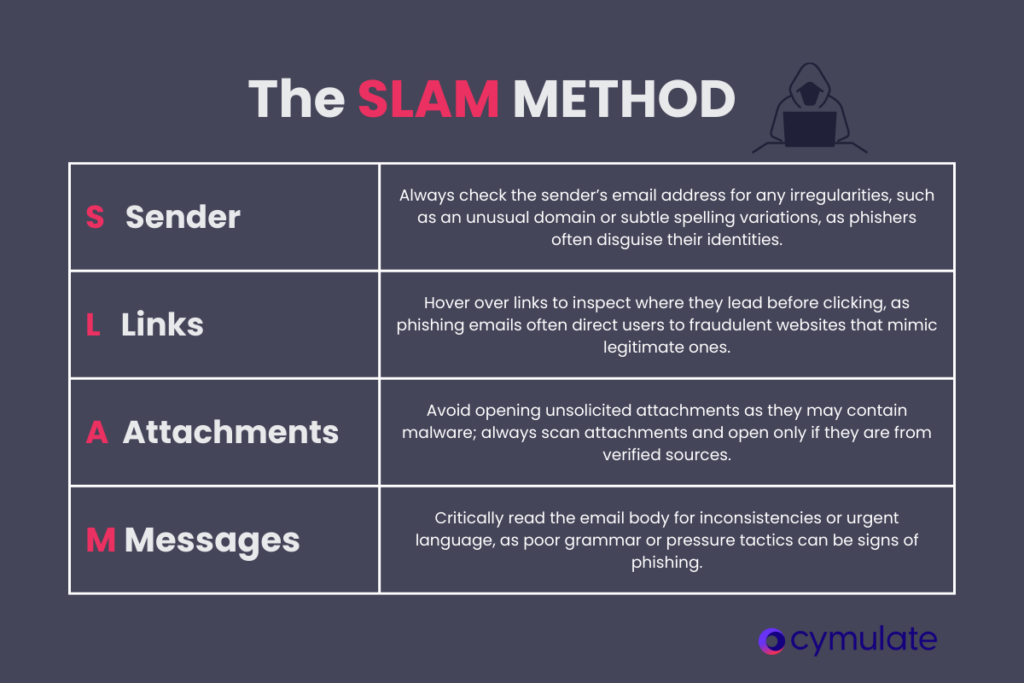
slam method phishing

Employees are more likely to retain the content if sessions incorporate:

  1. Quizzes and roleplaying scenarios to apply concepts
  2. Real examples of phishing emails, voicemails, texts, QR codes and malicious sites
  3. “Phishing labs” where employees identify fraudulent messages
  4. Gamification through phishing simulations and competitions
  5. Reward programs for reporting phishing and attending training

Making training fun, interesting, and rewarding helps to fix the material in trainees' memory and build appropriate behavior. Sessions should also provide easily digestible information that employees can apply daily, rather than overwhelming staff with complex technical concepts.

Along with engaging delivery, training content should cover:

  • Red flags like urgency, threats, odd links, and spelling errors
  • Safe protocols for reporting suspicious messages
  • The dangers of clicking links or opening attachments
  • Secure password practices
  • Social engineering and impersonation techniques
  • Current phishing trends and case studies

Cybercriminals rapidly adjust their techniques, so training must stay ahead of emerging trends. Periodic Phishing awareness training content should be updated frequently to address new phishing tactics and the new techniques included in controlled phishing simulations.

The ideal frequency for phishing awareness training varies based on organization size and risk levels but, at minimum, should occur yearly. Combining initial onboarding training with regular refresher courses maintains employees' ability to effectively filter out suspicious incoming messages.

Testing Employees with Simulated Phishing Exercises

Classroom-style awareness training provides a strong foundation. However, the next step of any phishing prevention program should be simulated phishing campaigns that put skills into practice.

These controlled test "phishing" emails allow organizations to safely mimic real-world attacks by sending messages with typical phishing lures. Employee interactions reveal who takes the bait so you can identify high-risk individuals in need of additional coaching.

Requirements for phishing simulation technology

Phishing simulation technology, whether dedicated platforms or capability included in more inclusive platforms, makes it easy to launch simulated campaigns and track detailed results. Features like automated reporting provide analytics on:

  • Click rates for links and attachments
  • Credential entry rates on fake login pages
  • Response rates by department
  • Repeat offenders or chronic report skippers

Based on the results, you can double down on training for susceptible departments or high-risk employees. Identifying trends in tactics that evade detection from controlled phishing awareness campaigns assists in identifying knowledge gaps.

For optimal impact, phishing simulations should be ongoing with new campaign scenarios regularly. Start with a baseline assessment, then track improvement over time as training and testing heighten human awareness and resilience.

Improving Defense Against Phishing

An effective phishing awareness training program requires continuously improving over time by learning from metrics, coaching employees, and enhancing content.

Analyze phishing report data will spot areas providing improvement opportunities such as:

  • Departments in need of supplemental training
  • Phishing tactics with a high success rate
  • Failure to report potential threats

With these insights, you can:

  • Target awareness gaps with customized content and coaching.
  • Identify repeat victims of simulated phishing and have one-on-one talks to understand their challenges
  • Require additional training
  • Configure additional controls
phishing awareness assesment

Continuous phishing awareness training content recommendations

The variety of phishing techniques will continue to grow, so training must always stay one step ahead. Maintaining an adaptive, ever-improving training curriculum is crucial for sharpening human phishing detection skills.

Best practices include:

  • Seek direct feedback through surveys and focus groups will provide further visibility into the awareness program blind spots. Opting to encourage openness about clicking or failing to report real phishing attempts has better results than penalizing employees with deficient records.
  • Keep training content fresh and relevant by promptly incorporating examples of new phishing methods observed internally or making the rounds externally.
  • Localize material to resonate across geographic regions and cultures throughout global organizations.

In the ongoing battle against increasingly convincing phishing scams, combining interactive and engaging training, ongoing testing through simulated campaigns, metrics-driven enhancement of content, and coaching for high-risk individuals are all necessary steps to increase resilience to phishing attempts.

An informed and alert workforce remains the most effective first line of defense. For an advanced, proactive approach to phishing prevention and resilience building, book a demo today and see how continuous security validation can empower your organization against emerging threats.

Cymulate Exposure Validation makes advanced security testing fast and easy. When it comes to building custom attack chains, it's all right in front of you in one place.
Mike Humbert, Cybersecurity Engineer
DARLING INGREDIENTS INC.
Learn More
Book a Demo