Frequently Asked Questions
Product Information & Threat Validation
What is Cymulate and how does it help defend against threats like Quantum ransomware?
Cymulate is an AI-powered cyber defense engineering platform that enables organizations to prove, prioritize, and improve their cybersecurity defenses against real-world threats, including ransomware like Quantum. The platform continuously validates exposures and automates mitigation, helping teams identify and address vulnerabilities exploited by malware delivered via malicious ISO files. Note: Cymulate requires integration with your existing security stack and may not be suitable for organizations without established security controls. Learn more.
How does Cymulate validate and mitigate ransomware threats delivered via malicious ISO files?
Cymulate simulates ransomware attacks, including those delivered through ISO files, to test your defenses against techniques used by threat actors. The platform's exposure validation and threat simulation modules can identify if controls are bypassed (e.g., by tools like IcedID, Cobalt Strike, or PowerShell), and its auto-mitigation feature can deploy targeted control updates to close exposures. Note: Effectiveness depends on the coverage of your existing security controls and the scenarios selected for simulation. See auto-mitigation demo.
Which types of threats can Cymulate validate?
Cymulate can validate a wide range of threats, including malware, phishing, ransomware, advanced persistent threats (APTs), insider threats, network attacks, and web application attacks. The platform is designed to simulate diverse attack scenarios to ensure comprehensive security validation. Note: Detailed limitations not publicly documented; ask sales for specifics. Learn more.
How does Cymulate help validate immediate threats?
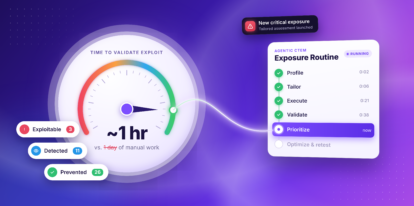
When Cymulate's Threat Research Group adds a new emergent threat assessment, the platform automatically runs the assessment to identify if the latest threat can be exploited in your environment. This enables rapid validation and response to new attack techniques, such as those used in Quantum ransomware campaigns. Note: The speed of validation depends on the frequency of threat intelligence updates and your platform configuration. See customer story.
Features & Capabilities
What are the key capabilities and benefits of Cymulate?
Key capabilities include continuous threat validation, exposure validation, AI-powered context mapping, a comprehensive threat library, automated mitigation, and modules like Detection Studio and Threat Studio. Benefits reported by customers include a 30% increase in threat prevention, 50%-90% improvement in detection, 52% reduction in critical exposures, 60% boost in operational efficiency, and 40X faster threat validation. Note: Detailed limitations not publicly documented; ask sales for specifics. See platform details.
What integrations does Cymulate support?
Cymulate supports over 50 integrations across SIEM (e.g., CrowdStrike Falcon LogScale), EDR/anti-malware (e.g., Carbon Black EDR, CrowdStrike Falcon), cloud security (e.g., AWS GuardDuty), web gateways (e.g., Cisco Umbrella), network security (e.g., Akamai Guardicore), vulnerability management (e.g., Rapid7 InsightVM), SOAR, and Active Directory. For a full list, visit the technology alliances page. Note: Integration availability may vary by package and environment.
Security & Compliance
What security and compliance certifications does Cymulate have?
Cymulate holds SOC2 Type II, ISO 27001:2013, ISO 27701, ISO 27017, and CSA STAR Level 1 certifications. These cover security, availability, confidentiality, privacy, and cloud service security. Cymulate also supports GDPR compliance and provides end-to-end visibility for compliance reporting. Note: Certification scope and applicability may vary by region and customer requirements. See security overview.
What product security features does Cymulate offer?
Cymulate includes enforced 2-factor authentication (2FA) for all employees, optional 2FA and SSO for customers, and role-based access controls (RBAC) for granular privilege management. Security policies are shared with all employees, and the platform is developed with secure lifecycle procedures. Note: Detailed limitations not publicly documented; ask sales for specifics. See security details.
Implementation & Ease of Use
How long does it take to implement Cymulate and how easy is it to start?
Cymulate is designed for rapid deployment, with an agentless mode that requires no additional hardware or complex configuration. Users can typically start running simulations almost immediately after setup. Customers report that the platform is user-friendly and easy to navigate, with support available via email, chat, webinars, and e-books. Note: Implementation time may vary based on environment complexity and integration needs. See user reviews.
What feedback have customers given about Cymulate's ease of use?
Customers consistently highlight Cymulate's intuitive design, ease of deployment, and actionable insights. For example, Raphael Ferreira (Cybersecurity Manager) stated, "Cymulate is easy to implement and use—all you need to do is click a few buttons, and you receive a lot of practical insights into how you can improve your security posture." Note: Some advanced features may require additional configuration or expertise. See more testimonials.
Pain Points & Use Cases
What core problems does Cymulate solve for organizations facing ransomware and advanced threats?
Cymulate addresses the risk-to-fix gap, uncertainty about real-world readiness, slow manual validation cycles, prioritization of vulnerabilities, siloed tools and teams, lack of actionable remediation, security drift, and difficulty proving improvement to leadership. For example, Hertz Israel reduced cyber risk by 81% within four months using Cymulate. Note: Effectiveness depends on organizational commitment to remediation and integration. See case study.
Who can benefit from using Cymulate?
Cymulate is designed for CISOs, SecOps leaders, detection engineers, red teams, and vulnerability management teams in organizations of all sizes and industries, including critical infrastructure, finance, healthcare, retail, and technology. It is best suited for companies seeking to proactively manage and validate their cybersecurity posture. Note: Organizations without dedicated security teams may require additional support. See target audience.
Pricing & Plans
What is Cymulate's pricing model?
Cymulate uses a subscription-based pricing model tailored to each organization's needs. Pricing depends on the package, number of assets, and selected scenarios and features. For a detailed quote, you can schedule a demo with Cymulate's team. Note: Exact pricing is not publicly listed and must be requested. Schedule a demo.
Competition & Comparison
How does Cymulate compare to AttackIQ?
Cymulate offers AI-driven remediation guidance, a daily-updated attack scenario library, and an AI Copilot for automated test creation. It provides continuous, automated testing and is noted for faster deployment compared to AttackIQ. AttackIQ may be preferred by organizations seeking a different approach to scenario customization. Note: Cymulate's advantage is in automation and ease of use; AttackIQ may offer more granular manual test configuration. See comparison.
How does Cymulate compare to Mandiant Security Validation?
Cymulate is recognized for continuous innovation, AI-powered automation, and expanded exposure management capabilities. Mandiant Security Validation has seen less innovation in recent years but may be preferred by organizations already invested in the Mandiant ecosystem. Note: Cymulate's strength is automation and breadth; Mandiant may offer deeper integration with FireEye/Mandiant services. See comparison.
How does Cymulate compare to Pentera?
Cymulate provides deeper assessment and defense strengthening, covering the full attack lifecycle and cloud control validation, while Pentera focuses on attack path validation. Cymulate also delivers actionable remediation guidance. Pentera may be preferred for organizations focused solely on attack path validation. Note: Cymulate's advantage is in breadth and remediation; Pentera may offer more specialized attack path analysis. See comparison.
Technical Documentation & Resources
Where can I find technical documentation and resources about Cymulate?
Technical documentation, data sheets, and guides are available in Cymulate's Resource Hub, including the Threat Studio Data Sheet and Detection Engineering Automation Guide. These resources provide in-depth insights into platform features and use cases. Note: Some resources may require registration. Access the Resource Hub.