

Purple Team Training: A Practical Guide to Exercises, Tools and Building a Continuous Program
Purple team training helps security teams turn attack simulations into better prevention, detection and response. Offensive specialists execute attacks against the latest threats and adversary behavior, defenders examine how their controls behave in terms of blocking and alerting and both teams investigate gaps and validate fixes together. This integrated, holistic security approach with an automated and agentic adversarial exposure validation platform closes the risk-to-fix gap between finding exposures and proving they are fixed.
For security leaders, the value is practical: evidence that your security controls are protecting you against the latest threats. Many organizations have separate teams for offensive and defensive, and too often, these teams operate in silos. The red team attacks, writes a report and hands it to the blue team weeks later, and by the time defenders act on it, the environment has changed. Purple teaming can replace that one-way handoff with a shared loop. Building purple teaming capability takes individual skills, collaborative testing and repeatable exercises. A continuous program connects all three.
What is purple teaming?
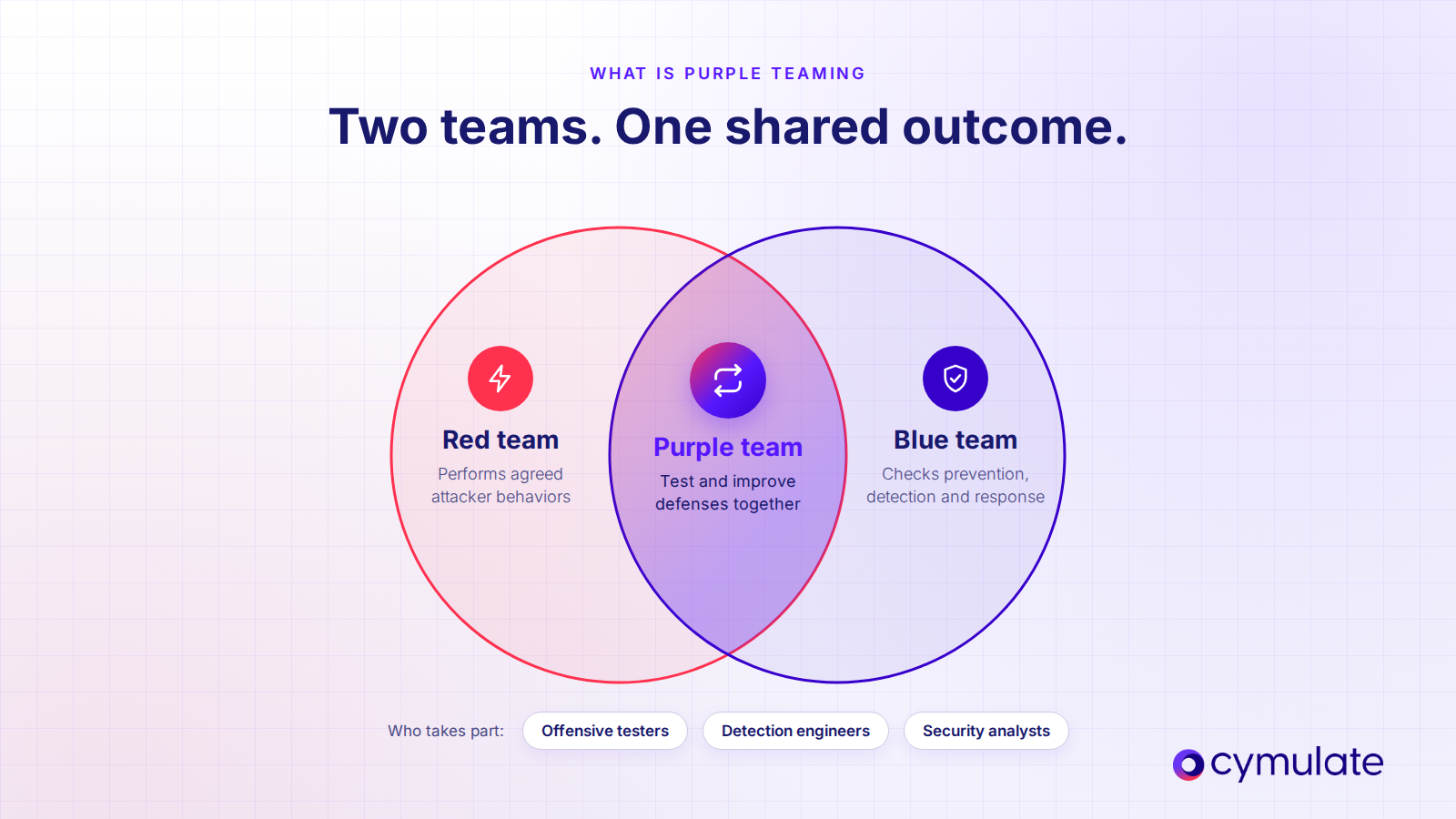
Purple teaming is a collaborative security approach in which red and blue teams test and improve defenses together. The red team performs agreed attacker behaviors while the blue team checks prevention, detection and response, and both teams share observations as the work happens. Learn more about purple teaming.
Purple teaming can be a team, a process or both. Some organizations staff a dedicated purple team. Others treat it as a working arrangement in which offensive testers, detection engineers and security analysts contribute their expertise toward a shared outcome. At its most mature, purple teaming is a program: a holistic cybersecurity approach that connects threat intelligence, attack simulation, exposure validation, detection engineering and remediation into one continuous cycle of improvement, rather than an occasional exercise.
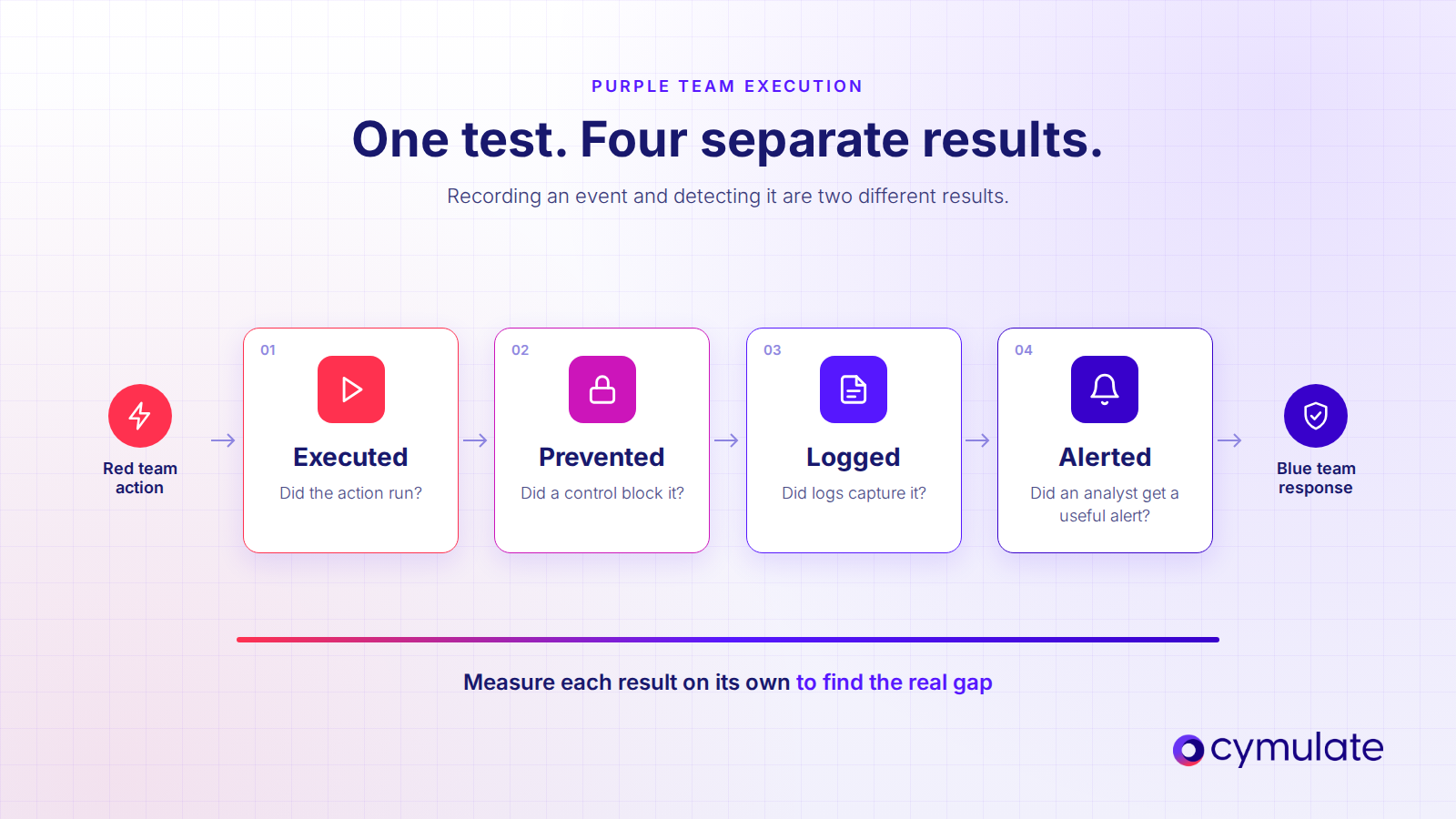
For example, an authorized attack simulation might generate suspicious activity on an endpoint. The teams check whether the control blocked it, whether logs captured it and whether an alert reached an analyst. These are separate results. Recording an event does not necessarily mean the team detected or investigated it.
This approach connects demonstrated attack behavior with evidence of defensive performance. For how purple teaming fits alongside red and blue teams, see red team vs. blue team vs. purple team, and for how red teams hand findings to defenders, see our red team exercise guide.
Purple team training: building the skills and the program
Purple team training develops the technical and communication skills needed to plan attack simulations, evaluate defenses and make measurable improvements. A useful learning program covers three connected areas.
Attack simulation and exposure validation teach practitioners to safely reproduce relevant attacker behavior and prove whether existing controls stop it, increasingly with automated platforms such as Cymulate that test and validate defenses continuously. Participants learn to select scenarios from threat intelligence, identify prerequisites and explain what each test should demonstrate. For examples mapped to MITRE ATT&CK®, see Red Team Scenarios: 10 Real-World Attacks to Test Your Defenses.
Detection engineering focuses on ensuring relevant telemetry is collected and forwarded to the SIEM, then turning observable behavior into useful alerts. Defenders learn to inspect logs, develop detection logic and test whether alerts provide enough context for investigation.
Collaboration connects the two. Participants practice explaining their actions, comparing expected and actual results and agreeing on the next change. A missed detection becomes a shared problem to solve.
Individual training paths
Structured courses can help practitioners build these skills. SANS SEC699 covers advanced purple teaming, attack simulation and detection engineering. MAD20 training and certifications develop skills in applying MITRE ATT&CK to areas such as threat intelligence, attack simulation and defensive recommendations.
Choose training around the participant’s responsibilities. An offensive tester may need more experience interpreting defensive telemetry. An analyst may benefit from understanding how attackers carry out the behaviors behind an alert.
Organizational training
Turn individual learning into regular work. Pair an offensive practitioner with a defender, select a small set of relevant behaviors and work through the results together.
Tabletop sessions help teams rehearse decisions and responsibilities. Technical exercises add evidence from actual controls and workflows. Begin in a suitable test environment, then extend approved validation into representative production environments.
Give the program an owner and reserve time for remediation. Each session should leave behind reusable test cases, documented findings and validated improvements.
Purple team frameworks and tools to know
Frameworks give purple team exercises structure, and tools make the work repeatable. Choose them around your objectives, regulatory obligations and existing environment.
- MITRE ATT&CK provides a shared vocabulary for attacker behavior. Teams use it to connect threat intelligence, test cases and defensive observations.
- MITRE D3FEND maps defensive countermeasures, helping blue teams connect each tested technique to the controls and detections that should stop it.
- Attack simulation plans organize behaviors into realistic scenarios. The Center for Threat-Informed Defense publishes plans that teams can adapt to their scope and objectives.
- Regulatory frameworks increasingly require collaboration between red and blue teams. The TIBER-EU framework, updated in February 2025 to align with the Digital Operational Resilience Act (DORA), includes purple teaming in its closure phase.
- Defensive tools deliver the security and supply the evidence. Security information and event management (SIEM) and endpoint detection and response (EDR) platforms help practitioners inspect activity and evaluate alerts. This also includes allows security teams to find tune their controls across endpoint, network, email and web gateways and web application firewalls.
- Adversarial exposure validation platforms keep the work continuous between live exercises. They automate attack simulation, measure prevention and detection, and re-test fixes on demand.
Manual exercises remain useful for exploring unexpected results and teaching investigative reasoning. Automation extends their reach, and agentic AI goes further: agents choose relevant tests, run them, propose fixes and re-test, within guardrails such as audit trails and human approval for high-risk actions. The Cymulate Threat Exposure Validation Impact Report 2025 found that respondents could test about 230 times more threats using automated validation than manual methods, and that organizations using AI took an average of 24 fewer hours to test defenses against newly identified threats. Gartner predicts that by 2029, 30% of organizations will link validation results directly to automated remediation (2026 Gartner Market Guide for Adversarial Exposure Validation).
How to run a purple team exercise: a step-by-step framework
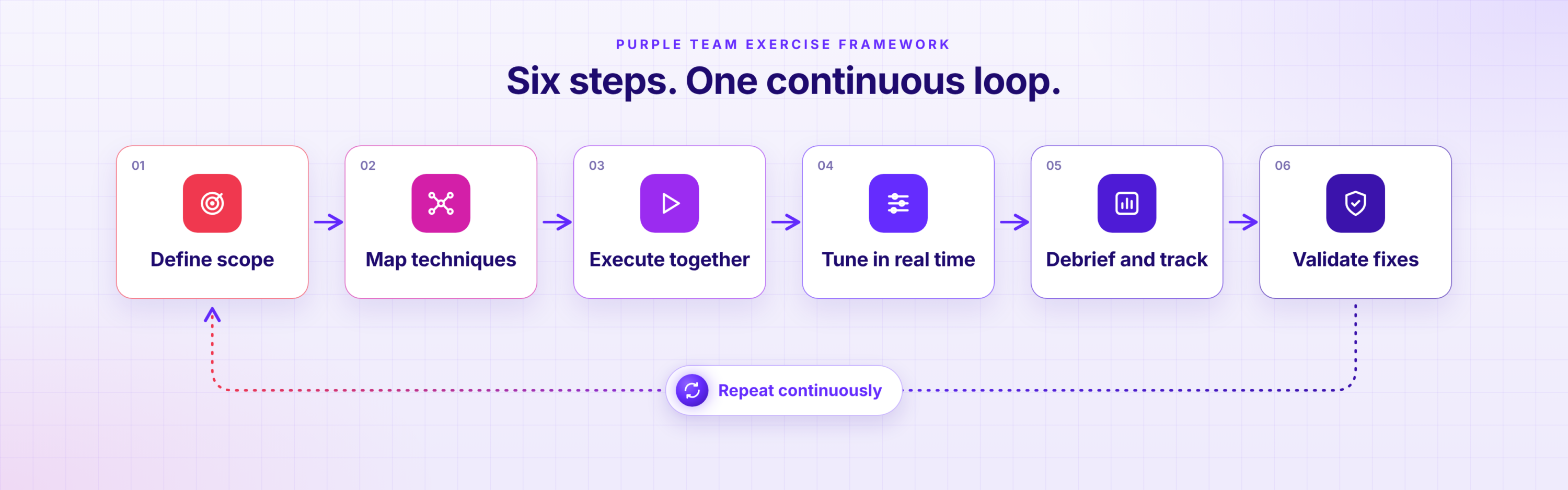
A purple team exercise is a planned session in which offensive and defensive practitioners execute selected attack simulations, examine the results and improve defenses together. Use the frameworks above and the following six steps to organize a practical exercise, then carry validated tests into a continuous program.
1. Define scope and objectives
Choose a specific outcome, such as validating detection of suspicious activity on a group of managed endpoints. Identify participating systems, accounts and teams. Document authorization, testing windows, stop conditions and cleanup responsibilities, and assign a coordinator who can keep the exercise moving.
Agree on success criteria before execution. “Improve detection” is too broad. “Generate an actionable alert for each selected behavior” gives the team something concrete to evaluate.
2. Select threat scenarios and map techniques
Choose scenarios that reflect your environment, important assets and relevant threat intelligence. This makes threat-informed defense practical: testing follows plausible attacker behavior.
Map the selected tactics, techniques and procedures (TTPs) to the MITRE ATT&CK framework. Record the specific behavior, its prerequisites and the evidence you expect defenders to observe. Start with a manageable scope, and treat ATT&CK mappings as context, not proof of complete coverage.
3. Execute with red and blue collaborating live
Run the approved attack simulations while defenders inspect endpoint, network or cloud telemetry. Record execution times so the team can connect test activity with logs and alerts.
Separate the outcomes: Did the action execute? Did a control prevent it? Did monitoring record it? Did an analyst receive a useful alert? Preserve the initial result before sharing additional clues. This gives you a baseline while allowing the team to investigate together afterward.
4. Tune detection and response in real time
When a test exposes a gap, identify its cause before changing a rule. Missing telemetry, incorrect detection logic and failed alert routing require different fixes.
Make approved adjustments and rerun the same test. Then check whether normal activity creates unwanted alerts. A rule that catches the exercise but overwhelms analysts needs more work. Test response procedures too, and route larger changes through normal change controls.
5. Debrief and track remediation
Summarize what happened, what changed and what remains unresolved. Give each finding an owner, a due date and a repeatable validation test. Keep evidence that supports the conclusion, including the tested behavior, relevant configuration and observed result.
Use the debrief to improve collaboration as well. Delayed access, unclear ownership or inconsistent timestamps can slow the next exercise even when the security tools work correctly.
6. Validate fixes and repeat continuously
Close findings only after successful retesting. Then rerun approved tests after relevant changes, automate stable checks and retain live sessions for unfamiliar scenarios and deeper investigation.
The Threat Exposure Validation Impact Report 2025 found a 20% reduction in breaches among organizations running exposure validation at least monthly. This finding covers broader exposure validation, not purple team exercises alone, but it supports a regular cadence matched to your risk, system changes and remediation capacity.
Why purple teaming must be continuous in the post-Mythos era
A periodic purple team exercise assumed attackers needed weeks to weaponize a weakness. That assumption no longer holds. In April 2026, Anthropic withheld Claude Mythos Preview from public release, citing its ability to find software vulnerabilities, and the UK AI Security Institute reported it could autonomously complete a 32-step simulated network attack.
When attackers move at machine speed, a quarterly exercise leaves months of untested exposure. A continuous purple teaming program pairs live, human-led sessions with automated attack simulation and exposure validation that re-test after every new threat, asset or control change, so defenders move at machine speed too.
Key benefits of a continuous purple teaming program
A continuous purple teaming program turns exercise findings into a maintained set of tests and improvements. Its value depends on what the team changes and verifies afterward.
Faster detection and security control tuning
Shared observation reduces the delay between executing a behavior and understanding a missed detection or prevention. Offensive practitioners explain what happened while defenders inspect the evidence. Track the time from identifying a gap to validating the fix to show whether collaboration is helping the team improve more quickly.
Shorter windows for undetected activity
Better alerts and practiced investigation help teams identify suspicious behavior sooner, and effective escalation and containment can reduce the time an attacker remains active. Measure these stages separately. Faster alert generation does not automatically mean faster containment.
Fewer blind spots between assessments
Continuous security validation helps teams identify when changes weaken previously tested defenses. Repeatable checks can reveal a logging interruption or a detection rule that no longer behaves as expected.
The Threat Exposure Validation Impact Report 2025 found that 67% of respondents using automated security control validation reported significant positive changes in security metrics. Among users who also measured cyber program effectiveness, 97% reported a positive impact. For your program, track tested behaviors, actionable detections, unresolved gaps and successful retests, and compare results across equivalent test conditions.
Key takeaways
- Purple teaming is a program, not just a team. It connects attack simulation, exposure validation, detection engineering and remediation into one holistic approach.
- Break the silo. Red and blue teams deliver the most value when they share evidence, tune detections and validate fixes together.
- Close findings only after re-testing. A finding isn’t fixed until the same attack simulation proves it.
- Defend at machine speed. Pair live purple team sessions with continuous, automated attack simulation through agentic cyber defense engineering.
How Cymulate brings red and blue teams together
Cymulate gives red and blue teams a shared place to work, so offensive testing and defensive improvement happen in the same loop instead of in separate silos. That loop follows three connected steps: Prove. Prioritize. Adapt.
Prove. The red team’s perspective becomes repeatable, automated attack simulations based on current threats. Blue teams see the results against their own controls, technique by technique, so both teams work from the same evidence instead of a report delivered weeks later.
Prioritize. Prevention and detection results are mapped to MITRE ATT&CK and ranked by exploitability and business impact, so red and blue teams agree on which gaps matter most and what to fix first.
Adapt. Blue teams get actionable mitigation and detection guidance for each gap, then re-test with the same attack to confirm the fix. The red team’s findings become the blue team’s improvements, and re-testing closes the risk-to-fix gap.
Automation handles the repeatable work within defined guardrails, with audit trails and human approval for high-risk actions, while practitioners on both sides set objectives, investigate unexpected results and decide what changes.
Ready to make purple teaming continuous?
Red teams find the gaps, and blue teams close them. With continuous purple teaming, both happen in the same loop. To explore the full operating model, download the Agentic Cyber Defense Engineering e-book. To see how Cymulate brings red and blue teams together around attack simulation, exposure validation and mitigation, schedule a demo.
Frequently asked questions
Purple teaming can be either. Some organizations staff a dedicated purple team, while others run purple teaming as a collaborative process between existing red and blue teams. The most effective approach treats it as an ongoing program that connects attack simulation, exposure validation, detection engineering and remediation.
Purple teaming is a collaborative security approach, not a certification. Courses and certifications can develop relevant skills, including attack simulation, detection engineering and ATT&CK application. An effective program also requires shared processes and practice in your environment.
Red teaming evaluates security through covert adversarial activity, often with limited defender knowledge. Purple teaming emphasizes open collaboration and improvement during testing. Both contribute to the same security program: red team findings become purple team test cases that defenders tune against and re-test.
Choose a cadence based on risk, staffing and environmental change. A practical starting point is a focused monthly exercise, supported by continuous automated attack simulation and exposure validation between sessions. Add targeted validation after significant control changes or new threats, and allow time to verify fixes.
Many repeatable activities can be automated, including threat profiling, attack simulation, detection validation, mitigation and re-testing. Human practitioners still lead objectives, investigate unexpected results and teach investigative reasoning. Cymulate runs the automated steps continuously within defined guardrails and shares every result with both teams, with human approval for consequential changes.

Featured Resources
View More Resources
Agentic Cyber Defense Engineering
This e-book explores the six stages of agentic cyber defense engineering and how they work together to strengthen cyber defenses.

2026 Gartner® Market Guide for Adversarial Exposure Validation
The guide covers AEV use cases, key features, and market trends to improve threat exposure visibility and defenses.
Red and Purple Teams
Automate security validation to map attack paths and execute custom attack chains, scaling offensive testing for advanced threats.