

What Is Detection Engineering?
Detection engineering is a specialized cybersecurity discipline focused on the structured process of designing, implementing, testing and maintaining detection logic that identifies malicious activity in an environment. In essence, it involves building reliable detection systems (rules, analytics and alerts) that catch threats in real time before they can cause damage while also minimizing false alarms.
This practice aligns security teams around continuously developing and tuning high-fidelity detection logic – the queries, signatures and algorithms that recognize adversary behaviors – so that Security Operations Centers (SOCs) can respond to threats swiftly and confidently.
Let’s review why threat detection engineering is so important and explore how it works within dynamic environments.
Key highlights:
- Detection engineering is the practice of designing, testing and maintaining detection logic that reliably identifies malicious behavior while minimizing false positives.
- A structured cyber threat detection approach improves alert accuracy, reduces analyst fatigue and increases overall SOC efficiency.
- Continuous validation is essential to ensure detections remain effective as attacker techniques, cloud environments and telemetry sources evolve.
- Cymulate strengthens threat detection engineering by continuously validating SIEM, EDR and XDR detections against real-world attack simulations to identify gaps and guide rapid tuning.
Importance of cyber threat detection engineering
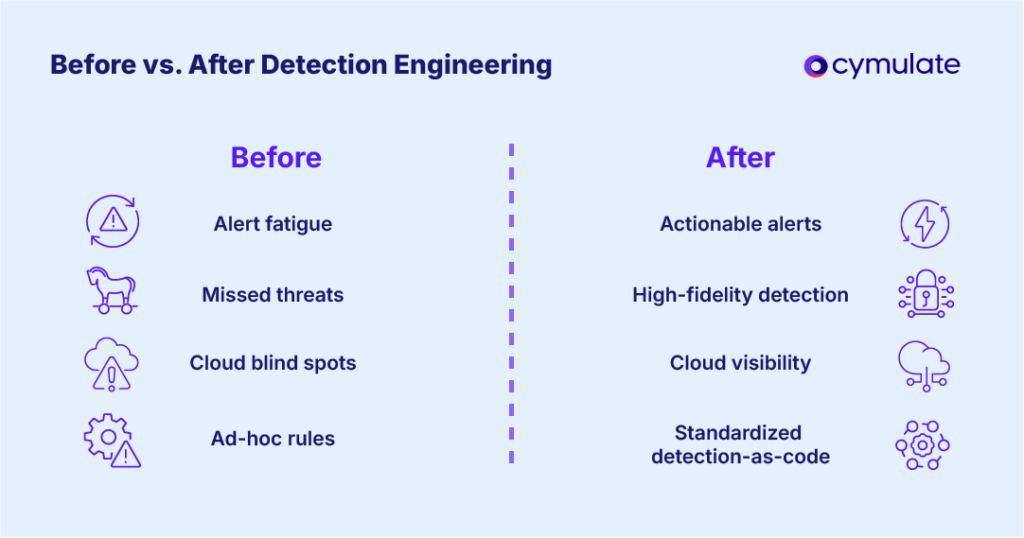
Traditional, ad-hoc detection methods struggle to keep up in current environments. Modern SOCs often complain of “drowning in alerts” or missing critical threats – symptoms of alert fatigue and detection gaps in complex environments. Detection engineering has emerged as a practical approach to address these challenges by systematically improving how threats are detected across on-premises and cloud systems.
In cloud and hybrid environments, security telemetry comes from dynamic sources (cloud APIs, containers, serverless functions, etc.), requiring structured engineering to data pipelines, log management and analytics.
By applying threat detection and response principles, security teams can adapt to new attacker tactics in these fast-moving landscapes, ensuring they have visibility into cloud control planes, ephemeral workloads and automated processes that were previously blind spots.
What are the objectives of detection engineering?
The primary objectives of detection engineering are to produce reliable, high-confidence alerts and to ensure security teams can detect meaningful attacker behavior early in the attack lifecycle. Rather than maximizing alert volume, this approach focuses on:
- Accuracy
- Context
- Repeatability
A high-fidelity detection capability improves the signal-to-noise ratio and helps reduce wasted effort on benign events. Cyber threat detection programs commonly align their content with frameworks like MITRE ATT&CK to ensure comprehensive coverage of adversary tactics, techniques and procedures (TTPs).
Every detection is designed with context and intelligence so that it’s immediately actionable – for example, an alert might map to a specific MITRE ATT&CK technique and include details on the affected host/user, enabling quick triage.
By properly mapping detection rules, teams can perform gap analysis to identify which techniques are not yet covered and prioritize developing those detections. Ultimately, the goal is a threat-informed defense: the SOC knows what threats matter, has the ability to identify them and can catch attackers early in the Cyber Kill Chain with confidence.
Key benefits of practical threat detection engineering
A mature detection engineering practice does more than improve alert quality. It fundamentally changes how security teams operate. By treating detection logic as an engineered system, organizations gain consistency, scalability and confidence in their ability to detect real threats early.
A practical threat detection engineering strategy delivers several important benefits for security teams:
- Reduced alert fatigue and noise: Structured detection engineering reduces false positives and redundant alerts by continually tuning detection rules, fine-tuning thresholds and enriching alerts with context. This prevents analyst overload, resulting in fewer but more meaningful alerts.
- Actionable alerts and faster response: High-quality, contextual alerts enable quicker investigation and containment, significantly reducing Mean Time To Detect (MTTD) and Mean Time to Respond (MTTR). Early threat identification allows teams to address incidents swiftly, minimizing their impact.
- Enabling proactive threat hunting: Effective detection automation frees security teams to focus on proactive threat hunting, investigating sophisticated threats beyond automated detection. Findings from threat hunting then inform detection rule improvements, continually enhancing coverage.
- Improved SOC efficiency and focus: Mature detection engineering programs reduce time spent on benign alerts and allow analysts to focus on investigations that matter. By managing detections as code, teams can scale their work, maintain consistency and apply changes without introducing operational friction.
- Continuous adaptation to evolving threats: Detection programs that are continuously updated stay aligned with how attackers actually operate, using threat intelligence and frameworks lto guide rule changes. Teams maintain visibility as cloud and DevOps environments change.
How threat detection engineering works: 5 main stages
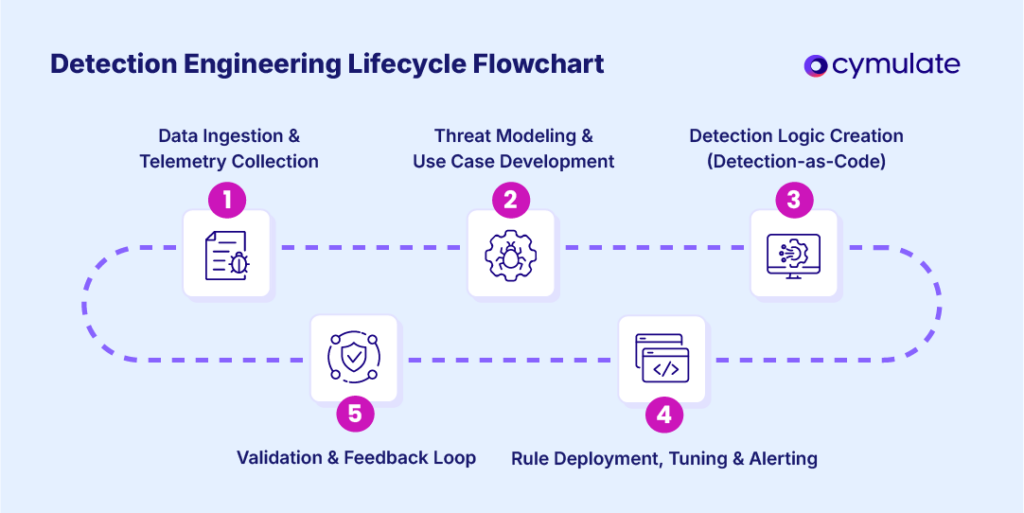
Detection engineering is an ongoing practice, not a one-time task. As threats and infrastructure change, detection work must adapt, with each step building on the last to keep detections accurate, relevant and actionable.
Here are the main stages of the detection engineering lifecycle:
Stage 1: Data ingestion and telemetry collection
Detection work starts with collecting and centralizing logs and telemetry from endpoints, servers, networks, cloud services and applications. This data is enriched with context such as asset importance, user roles and threat intelligence, then analyzed in centralized platforms like Splunk or ELK to support consistent visibility.
Stage 2: Threat modeling and use case development
Teams identify and prioritize threats relevant to their organization using frameworks like MITRE ATT&CK, performing gap analysis to uncover detection blind spots. This produces prioritized detection use cases and clear analytic requirements that target actual attacker behaviors.
Stage 3: Detection logic creation
Engineers create detection rules and analytics using standardized, platform-agnostic formats such as Sigma or YARA. These detections are managed using established engineering practices, including version control, testing and CI/CD pipelines. Before deployment, rules are tested against historical data to confirm they behave as expected and can be reused at scale.
Stage 4: Rule deployment, tuning and alerting
Detection rules are deployed into monitoring platforms (e.g., SIEMs, EDR solutions) and fine-tuned continuously based on production performance. Engineers adjust rules to minimize false positives and maximize accuracy, iteratively refining detection mechanisms and aligning alerts to actionable security events.
Stage 5: Validation and feedback loop
Detection content is regularly validated through red-team exercises, automated attack simulations and real-world incidents. Post-incident reviews provide critical feedback, guiding rule improvements. Teams continuously update detection logic, tracking performance metrics to evolve alongside changing threats.
Throughout this lifecycle, collaboration among detection engineers, threat intelligence teams, incident responders and threat hunters ensures comprehensive and up-to-date detection coverage.
Cyber threat detection tools and techniques
Effective detection engineering relies on the right mix of tools, frameworks and operational discipline. Together, these capabilities help teams build consistent detection logic, add meaningful context, test detections regularly and expand coverage across different environments.
Here are the tools and frameworks that support the detection engineering process:
SIEM and log management platforms
SIEM platforms like Splunk, Microsoft Sentinel, IBM QRadar or the open-source ELK Stack aggregate logs and execute detection rules in real-time. Cloud-native solutions, such as Azure Sentinel, handle cloud telemetry effectively and offer built-in threat detection rules that engineers can extend.
Rule and signature repositories (Sigma, YARA, etc.)
Sigma provides an open, YAML-based rule format easily converted to multiple SIEM languages, promoting rule-sharing and reuse across organizations. Similarly, YARA rules detect malware based on files or memory patterns. Managing these detections as code (using version control) facilitates collaboration and efficiency.
Behavioral analytics and UEBA
User and Entity Behavior Analytics (UEBA) tools use heuristics and machine learning to surface activity that static rules often miss, such as unusual login behavior. Detection engineers tune these models alongside rule-based detections to help identify subtle or previously unseen threats.
Threat intelligence integration
Threat detection engineering uses threat intelligence feeds (malicious IPs, file hashes, attacker TTPs) to enrich alerts and detection rules. This alignment ensures detections remain current against known adversaries and evolving threats, leveraging frameworks like MITRE ATT&CK.
Automation and CI/CD for detection (Detection-as-Code)
Teams increasingly use DevOps practices and automation for managing detection logic, employing CI/CD pipelines and infrastructure-as-code to deploy, test and iterate detection rules rapidly and reliably. This reduces human error and streamlines detection development.
By combining these tools and techniques, cyber threat detection becomes systematic, scalable and repeatable, leveraging community-shared rules, behavioral analytics and robust automation frameworks.
Challenges and shifts in cloud threat detection
In cloud environments, detection engineering must account for API activity, ephemeral workloads and rapidly changing infrastructure. This shifts detection strategies toward automation, reliable telemetry and ongoing validation.
Key complexities that have reshaped traditional detection methods include:
- API and control-plane visibility: In cloud environments (AWS, Azure, GCP), critical security events often occur via APIs, invisible to traditional monitoring. Detection engineers must focus on analyzing cloud audit logs (CloudTrail, Azure Activity Logs, GCP Audit Logs) to detect suspicious activities, such as unauthorized API actions or IAM changes, effectively addressing this new attack surface.
- Ephemeral and elastic resources: Cloud workloads (containers, serverless functions) can rapidly appear and disappear, complicating persistent monitoring. Engineers need to employ centralized, agentless logging (e.g., Kubernetes audit logs), real-time analytics and cloud-native security tools (AWS GuardDuty, Azure Defender), enhanced with custom detection logic to effectively monitor short-lived, dynamic resources.
- Behavioral baselines in cloud environments: Cloud applications typically exhibit predictable behavior, enabling detection engineers to build behavioral analytics that flag abnormal activities (e.g., unusual network requests from serverless functions). However, distinguishing legitimate changes from malicious behavior requires close collaboration with DevOps teams for contextual understanding.
- Multi-cloud and log integration: Operating across multiple cloud providers and on-premises infrastructure creates fragmented logging, complicating detection efforts. Engineers must centralize and normalize logs, using cloud-native SIEMs, data lakes or emerging standards (e.g., Open Cybersecurity Schema Framework) to correlate events across different cloud platforms and eliminate blind spots.
- Cloud-native tooling and techniques: Detection engineers utilize cloud-native security features (Azure Sentinel, AWS GuardDuty, Kubernetes monitoring tools) as a baseline, supplementing them with custom detections.
Infrastructure-as-code scanning and pre-runtime checks enhance detection capabilities. Automation, such as detection-as-code and continuous validation through simulated attacks, becomes critical for adapting to fast-moving cloud environments.
Despite advancements, challenges remain, including limited log retention periods and visibility gaps (e.g., encrypted traffic). Engineers must navigate these constraints by adopting creative solutions like traffic mirroring or sensor deployment when necessary.
Threat detection cybersecurity limitations
Detection engineering strengthens visibility, but it does not eliminate risk on its own. Understanding its limitations helps teams design detection programs that fit within a broader defense-in-depth approach.
Here are important limitations and ongoing challenges to acknowledge:
Evolving threats and detection gaps
Strategies must constantly adapt as attackers evolve new evasion techniques. Blind spots and unknown threats persist, highlighting the need for ongoing updates, threat hunting and intelligence efforts alongside detection engineering.
False negatives vs. false positives
Balancing sensitivity and precision can be challenging. Over-tuning detection rules to reduce false positives may inadvertently cause false negatives (missed threats). Continuous testing helps calibrate this balance to ensure critical threats are not overlooked.
Resource and overhead
Meeting detection engineering requirements demands skilled staff, significant time investment and substantial tooling infrastructure. Computational overhead from complex analytics can impact performance and incur costs. Organizations must foster the right culture and management support to sustain continuous detection improvement.
Integration and data quality issues
Effective detection relies heavily on high-quality, correctly integrated data. Problems such as missing log sources, parsing errors or siloed security tools can undermine detections. Establishing reliable data pipelines and integrating security platforms remain persistent challenges.
Alert overload if not done right
Deploying too many poorly tuned detection rules can overwhelm analysts and introduce alert fatigue into your workflow. Focusing on better detection quality, regularly removing ineffective rules and reviewing alert performance helps keep your workloads manageable.
How Cymulate enhances detection engineering
Detection engineering is only effective if it reliably triggers under real attack conditions. Continuous validation closes the gap between detection logic and real-world adversary behavior, verifying that alerts fire as expected, telemetry is captured correctly and coverage aligns with evolving threats.

Cymulate enhances your detection process by:
Validating detection logic
Cymulate is a continuous security validation platform that helps organizations test and improve their SIEM, EDR and XDR detection and response capabilities using simulated attacks. It acts as an automated feedback loop, helping engineers verify whether alerts are firing as expected during real-world attack scenarios.
Cymulate uses breach and attack simulation (BAS) and automated red teaming to run full attack chains such as credential dumping or cloud-based attacks. These simulations show whether detections trigger as expected and expose gaps in telemetry or rule logic.
Optimizing and tuning rules
Cymulate also assists in fine-tuning detection rules by analyzing how security tools respond to simulations. If alerts are too noisy or don’t trigger at all, engineers can adjust rule logic and immediately re-test.
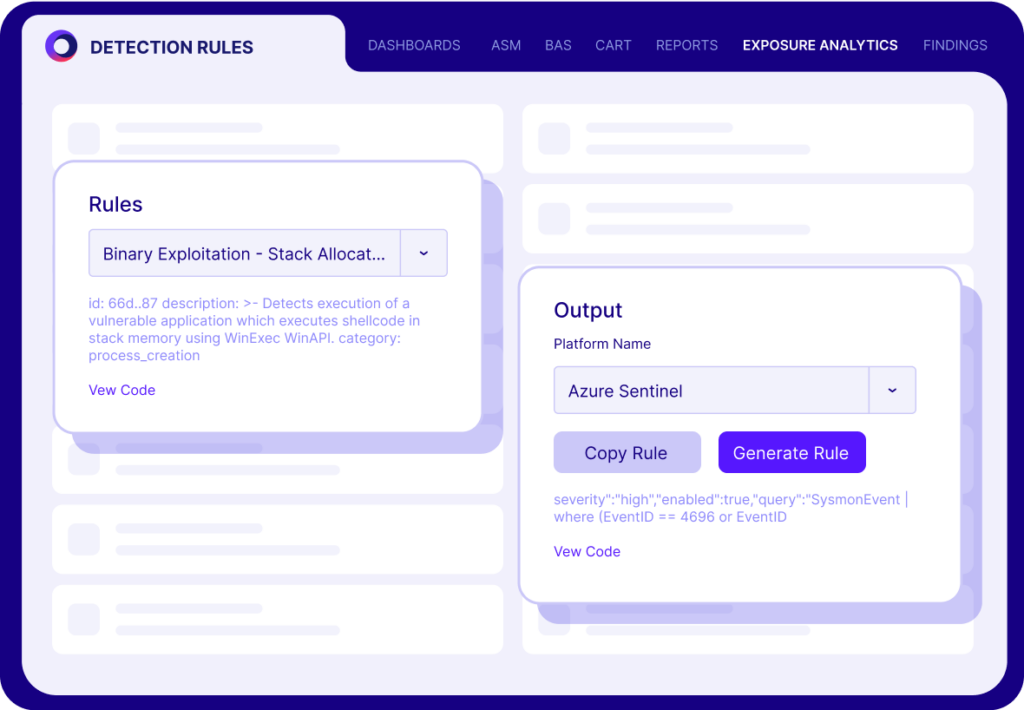
The Cymulate Exposure Validation Platform offers relevant IoCs, indicators of behavior, pre-built Sigma rules and EDR rules as part of its remediation guidance. This helps organizations focus on tuning logic instead of building it from scratch.
This means if a gap is found (say, no alert for a certain ransomware behavior), Cymulate might supply a Sigma rule to fill that gap, accelerating the detection engineering effort. Cymulate even offers translations of Sigma rules to vendor-specific systems, further increasing tuning efficiency and accuracy.
Supporting SOC and MSSP models
Cymulate enables your internal SOC team and MSSPs to validate detections through automated testing. Regular validation runs in a production-like environment, helping identify issues without needing to wait for scheduled red team activity.
For MSSPs, cross-platform integration with Cymulate powers consistent validation across client environments. The platform also supports purple team workflows, enabling red and blue teams work together during detection testing and improvement efforts.
Benchmarking detection maturity
Cymulate provides quantifiable insights into detection program effectiveness by mapping outcomes to frameworks. The platform can help identify detection gaps through actionable threat modeling and guide teams directly to where new detection rules are needed or where existing ones require improvement.
The platform generates heatmaps and resilience scores, tracks improvements over time and benchmarks performance against industry peers. With these insights, we can create reports that justify security investments and guide security focus.
Support advanced threat detection and response with Cymulate
The detection engineering solution from Cymulate helps SOC teams confirm that detection logic works reliably against real-world attacks and properly identifies the gaps that need tuning. By combining simulation, validation and integration with your existing tools, you can improve detections incrementally over time rather than relying on periodic testing cycles.
With Cymulate, organizations can move from static rule management to continuous detection assurance. This ensures detections work as intended across on-prem, cloud and hybrid environments.
Book a demo to see how Cymulate accelerates detection engineering at scale.
Frequently asked questions
The effectiveness of detection engineering is measured by combining coverage, accuracy and operational impact. Common metrics include:
- MITRE ATT&CK technique coverage
- False positive and false negative rates
- Mean time to detect
- Alert actionability
Many security teams also validate effectiveness by testing whether their detections reliably trigger during simulated or real-world attack scenarios and by tracking improvement over time.
Threat intelligence helps detection engineering teams prioritize which behaviors to detect by providing insight into active attacker techniques, tools and tactics. Intelligence sources inform detection logic, guide MITRE ATT&CK mapping and help teams focus on threats most relevant to their environment. When integrated properly, threat intelligence ensures detections stay aligned with evolving adversary behavior.
Detection engineering requirements are the foundational technical, operational and organizational capabilities needed to design, test and maintain effective threat detections. Core requirements include:
- Comprehensive telemetry from endpoints, networks, cloud platforms and identity systems
- Centralized log collection and normalization
- Defined detection objectives aligned to threat frameworks like MITRE ATT&CK
- Version-controlled detection logic
- Continuous validation processes to ensure detections remain accurate over time
Detection rules are validated by testing them against historical data, red team activity and automated attack simulations. Validation confirms that your alerts will trigger under realistic conditions and that the required telemetry is captured correctly.
Continuous testing helps teams:
- Identify detection gaps
- Tune rule logic
- Reduce false positives
In cloud and hybrid environments, threat detection cybersecurity is impactful in managing control plane activity, identity behavior, API usage and ephemeral workloads, where traditional endpoint-centric detections are often insufficient.
Effective threat detection requires centralized logging, cloud-native analytics and continuous validation to ensure visibility across dynamic infrastructure that changes faster than static detection rules can keep up.
Featured Resources
View More Resources
Accelerate Detection Engineering
Automate detection engineering with AI-powered attack simulations to close gaps, cut false positives, and stop threats faster.

RBI Validates and Optimizes SIEM Detection with Cymulate
Discover how the growing security department were able to increase their efficiency and improve their security by implementing Cymulate.

10 Best Practices for Preventing a Data Breach
Preventing data breaches requires layered defenses with MFA, endpoint protection, employee training, and continuous validation