

Top Pentera Competitors and Alternatives Compared
You don’t need another pen test. Proactively validate your controls and optimize security
| Pentera competitors | Solution category | Key features | Deployment | Pricing |
|---|---|---|---|---|
| Cymulate | Exposure validation and unified exposure management | Validated exposure scoring, automated offensive testing | SaaS/cloud-based, agents available | No-surprise asset-based pricing model |
| Picus Security | Breach and Attack Simulation (BAS) | Security controls integrations, automated testing | Cloud, on-premises, agents | Not public |
| NetSPI | Pen Testing as a Service (PTaaS) | BAS, ASM, CAASM | Cloud or professional services | Not public |
| AttackIQ | Adversarial Exposure Validation (AEV) | BAS, security control validation | Cloud or on-premises | Not public |
| Scythe | Adversary emulation and security validation | Cyber consulting company w/offensive testing tools | Cloud or professional services | Not public |
Top 5 enterprise Pentera alternatives
When evaluating alternatives to Pentera, it's essential to look beyond attack path validation and consider platforms that deliver complete exposure management, covering prevention, detection and response. The following five Pentera competitors: Cymulate, Picus Security, NetSPI, AttackIQ, and Scythe all offer unique approaches to breach and attack simulation (BAS), penetration testing, and exposure management.
This overview compares their strengths, limitations, and pricing transparency to help you identify which solution best aligns with your organization’s cybersecurity validation needs.
1. Cymulate
Cymulate is an Exposure Management platform designed to validate threats, prioritize validated exposures and optimize threat resilience. Instead of reacting to threats, Cymulate helps enterprises proactively build resilience against them.
Built for: Cymulate provides superior technology for threat prevention validation, accelerated detection engineering and vulnerability prioritization through exposure management.
Cymulate pricing: Custom pricing is based on a number of factors including assets to be covered. Contact our sales team for more info.
What makes Cymulate the best Pentera competitor?
- Cymulate provides depth to fully assess and strengthen defenses while Pentera only proves useful for identifying security gaps with attack path validation
- Cymulate offers a more comprehensive approach than Pentera to identifying and fixing security gaps through breach simulation and automated red teaming
- By testing the overall effectiveness of security controls, Cymulate reveals unmitigated exposures and provides actionable guidance to strengthen defenses before the next attack
Cymulate strengths
- Cymulate integrates with security controls to validate prevention and detection with average customers reporting a 30% increase in threat prevention within six months
- Cymulate provides exposure prioritization by aggregating exposure data from vulnerability scanners and other discovery then correlating validated prevention and detection for exposure
2. Picus Security
Picus Security offers a BAS product with separate modules and a complex interface that is difficult to deploy. It requires too many assessments because each control is evaluated individually. A basic test for ransomware best practices could require eight different assessments.
Built for: Organizations seeking an on-premises option for BAS. Picus provides basic BAS for repeatable testing and basic threat updates.
Picus Security pricing: Pricing for Picus Security is not publicly listed and typically depends on the number of endpoints, modules and scope of deployment.
Can Picus Security outperform Pentera?
These solutions provide different approaches to security testing. Pentera is useful for identifying security gaps with attack path validation, while Picus Security offers breach and attack simulation. Neither provides true exposure management by validating threats and providing automated remediation like Cymulate.
Picus Security strengths
- Many control integrations available
- Testing of cloud configurations
- Suitable if a BAS vendor with an on-prem option is required
Picus Security limitations
- Technical requirements for security control integrations are cumbersome
- Advanced, chained attacks are not realistic because each attack scenario executes without context of the previous scenario and realistic delay between actions
- Attack paths limited to basic lateral movement with user-defined scope
3. NetSPI
NetSPI has been highlighted for their penetration testing as a service offering. The company has expanded its capabilities to include elements of Breach & Attack Simulation (BAS), Attack Surface Management (ASM) and CAASM, giving customers a mix of manual verification and technology-driven discovery.
Built for: Organizations that require expert-verified penetration testing, compliance-oriented assessments, and external attack surface discovery commonly use NetSPI. Its model is well suited to teams that want manual validation from experienced testers alongside periodic automated checks.
NetSPI pricing: Pricing for NetSPI is not publicly listed and typically depends on the number of endpoints, modules and scope of deployment.
Can NetSPI outperform Pentera?
NetSPI is an excellent choice if you are looking for a penetration testing as a service (PTaaS) vendor. Pentera offers automated pen testing but doesn’t validate customers’ actual security policies or prove their threat resilience.
If you want to independently assess and strengthen your organization’s defenses, NetSPI’s approach to automated exposure validation will limit you. Cymulate helps fill the gaps presented by pen testing through exposure management.
NetSPI strengths
- NetSPI offers a penetration testing as a service solution
- NetSPI’s BAS product provides a blend of technology and human intelligence
- Their BAS is focused on testing core techniques, so it doesn’t need to provide daily threat updates
NetSPI limitations
- NetSPI does not deliver full integration with security technologies across the architecture and does not validate security policies in their ability to mitigate threats
- NetSPI does not allow for the creation of custom attacks, whereas Cymulate not only allows for attack scenario customization, but makes it very simple with user-friendly workbenches
- Unlike NetSPI, Cymulate makes security validation simple with extensive automation and AI as well as adds new attack tests daily based on the latest threat intelligence
4. AttackIQ
AttackIQ is a breach and attack simulation platform that helps organizations test their security controls against known adversary behaviors using MITRE ATT&CK-aligned scenarios. It focuses on helping teams validate detection and response effectiveness in a controlled, repeatable way.
Built for: AttackIQ is primarily designed for security operations centers (SOCs) and red teams that need to continuously assess detection efficacy, measure SOC performance and improve incident response readiness.
AttackIQ pricing: Pricing for AttackIQ is not publicly listed and typically depends on the number of endpoints, modules and scope of deployment.
Can AttackIQ outperform Pentera?
In most use cases, AttackIQ does not outperform Pentera, as it focuses on detection validation rather than offensive penetration testing or exploit simulation. Pentera focuses more on active exploitation capabilities, where AttackIQ is centered on blue-team readiness and defensive validation. In contrast, Cymulate provides clear exposure validation on actual threats and step-by-step remediation to ensure your environment stays protected.
AttackIQ strengths
- MITRE ATT&CK framework integration for coverage mapping
- Focus on detection and SOC performance measurement
- Support continuous control validation across various security layers
AttackIQ limitations
- Lacks advanced exploit simulation and lateral movement testing
- Limited visibility into full attack paths compared to an attack path discovery solution
- More useful for SOC maturity assessments than building threat resilience for known exposures
- Users report quality issues and frequent UI bugs that limit the scale of testing and trust in the results
5. Scythe
Scythe is an adversary emulation platform built for red teams and advanced threat emulation. It allows organizations to create, customize and execute simulated adversary campaigns with their environments to test security posture and detection capabilities.
Built for: Scythe is designed for red teams, purple teams and advanced security testers that want to replicate threat actor behavior and evaluate response procedures in real-world conditions.
Scythe pricing: Pricing for Scythe is not publicly listed and typically depends on the number of endpoints, modules and scope of deployment.
Can Scythe outperform Pentera?
Scythe is known for its adversary emulation capabilities but does not outperform Pentera in automated penetration testing or remediation prioritization. Pentera offers more of a focus on exploit-based testing delivering more automated risk validation compared to Scythe’s manual and red team-oriented approach, which is often considered too manual while risking the health and uptime of the environment it’s testing.
Scythe strengths
- Customizable adversary emulation campaigns
- Strong community and framework support for red-team operations
- Deep alignment with threat intelligence and MITRE ATT&CK tactics
Scythe limitations
- Requires significant manual setup and expertise to operate effectively
- Not optimized for automated risk scoring or remediation workflows
- Lacks native exposure management or continuous validation capabilities
- Aggressive testing with live exploits puts product systems at risk
How to choose the right Pentera competitors
| Factors to consider | What to evaluate in a Pentera competitor |
|---|---|
| Budget: Understand total cost of ownership, including licensing and support | Does the solution offer transparent pricing and fast ROI? |
| Feature set: Compare offensive testing, exposure management and validation depth | Does the solution include attack path management? |
| Compliance: Ensure support for frameworks like NIST, ISO, DORA or PCI DSS | Does the solution automate both threat emulation and risk prioritization? |
| Deployment model: Cloud-native vs. on-premises or hybrid flexibility | Does the solution support continuous exposure validation? |
| Integrations: Compatibility with SIEM, SOAR and vulnerability management tool | Does the solution integrate with existing detection and remediation tools? |
| Service and support: Look for responsive support and technical guidance | Is the solution backed by expert customer success and support teams? |
| Organization size: Match scalability to enterprise requirements. | Will the solution scale over time to meet our evolving business needs |
Cymulate: The best alternative to Pentera
Among Pentera alternatives, Cymulate is the only platform that combines attack path management, continuous validation and exposure management in one solution.
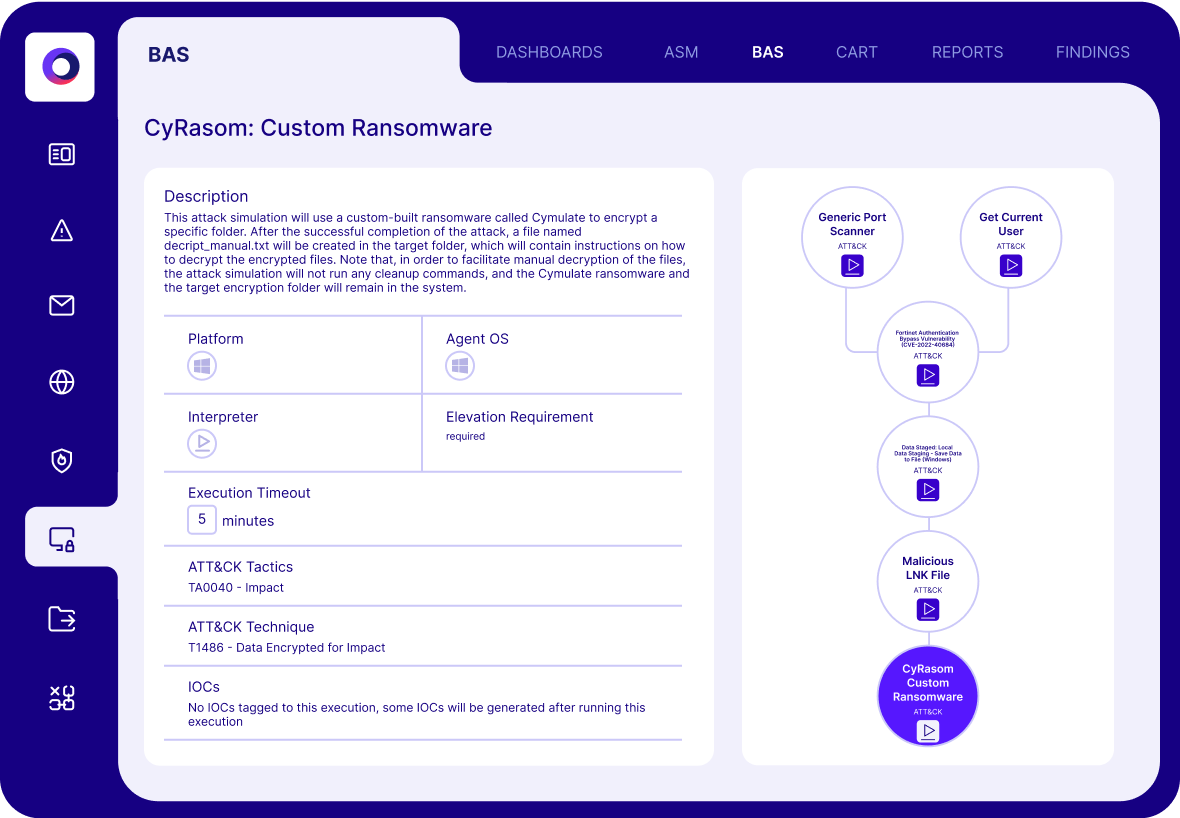
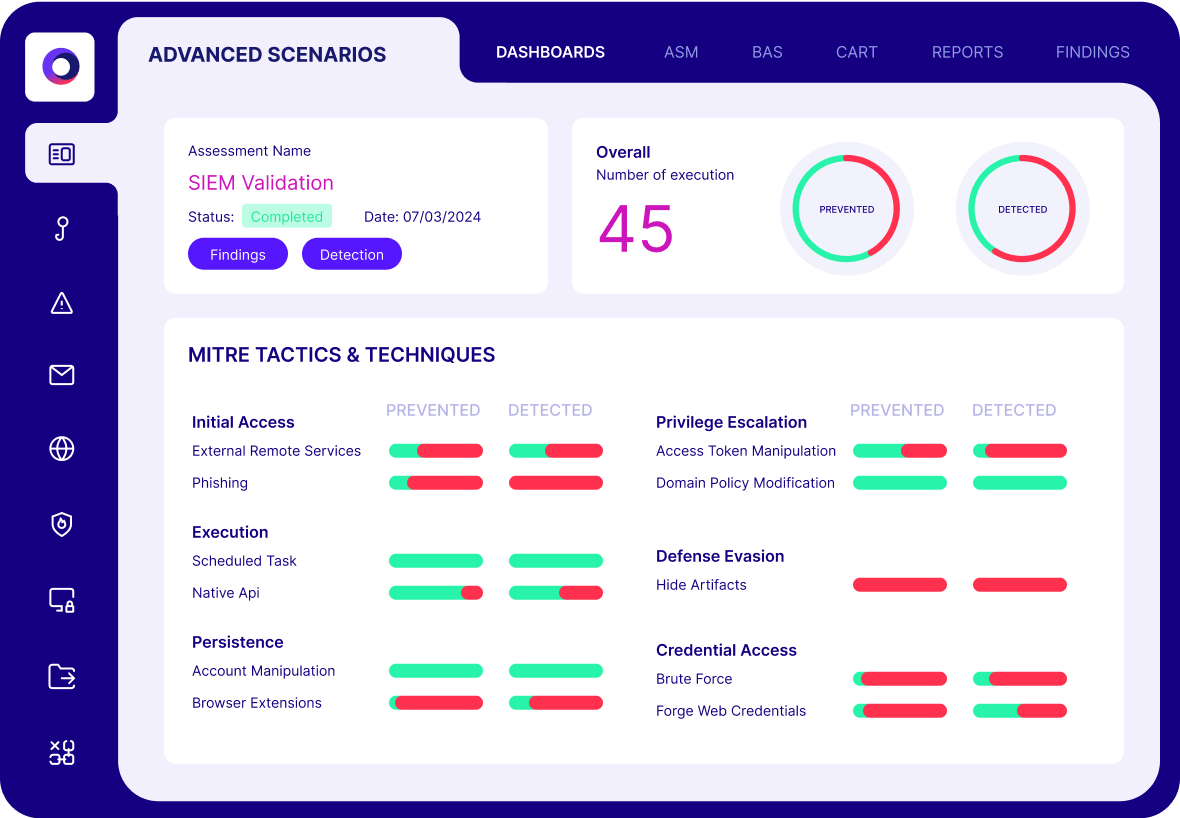
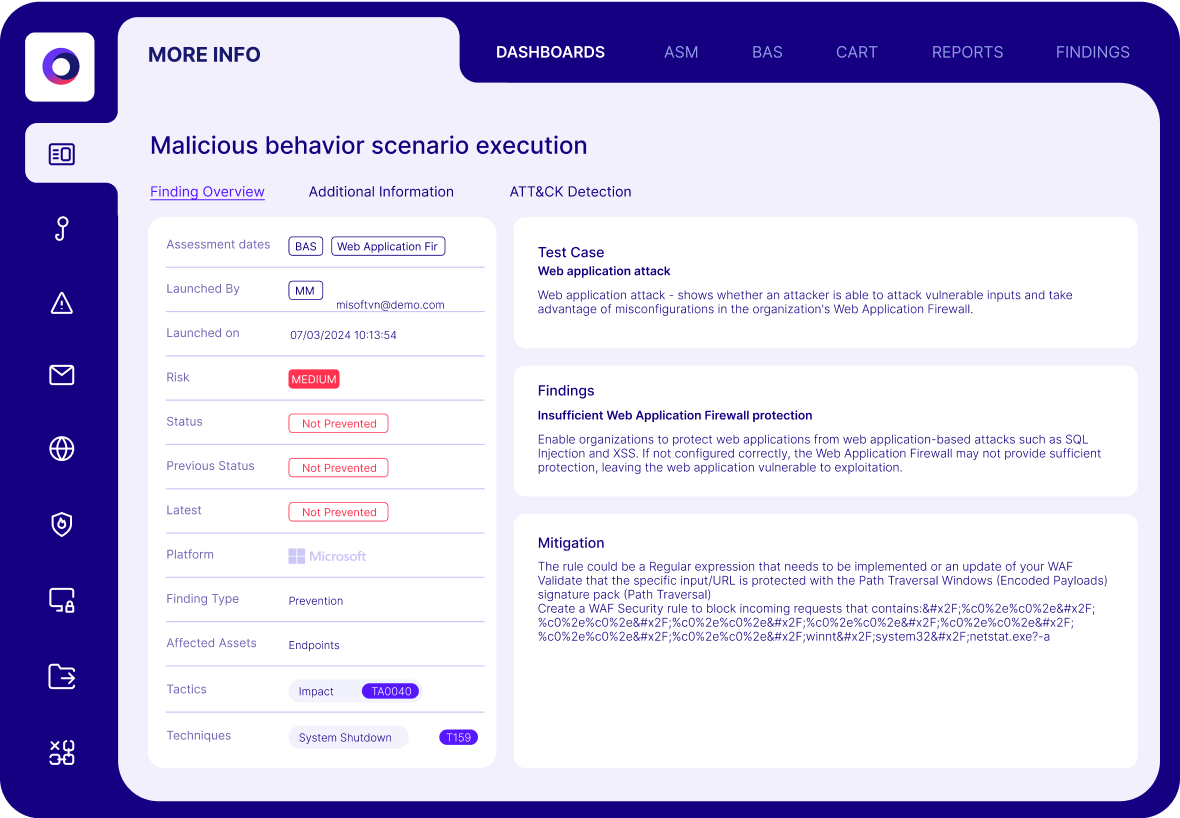
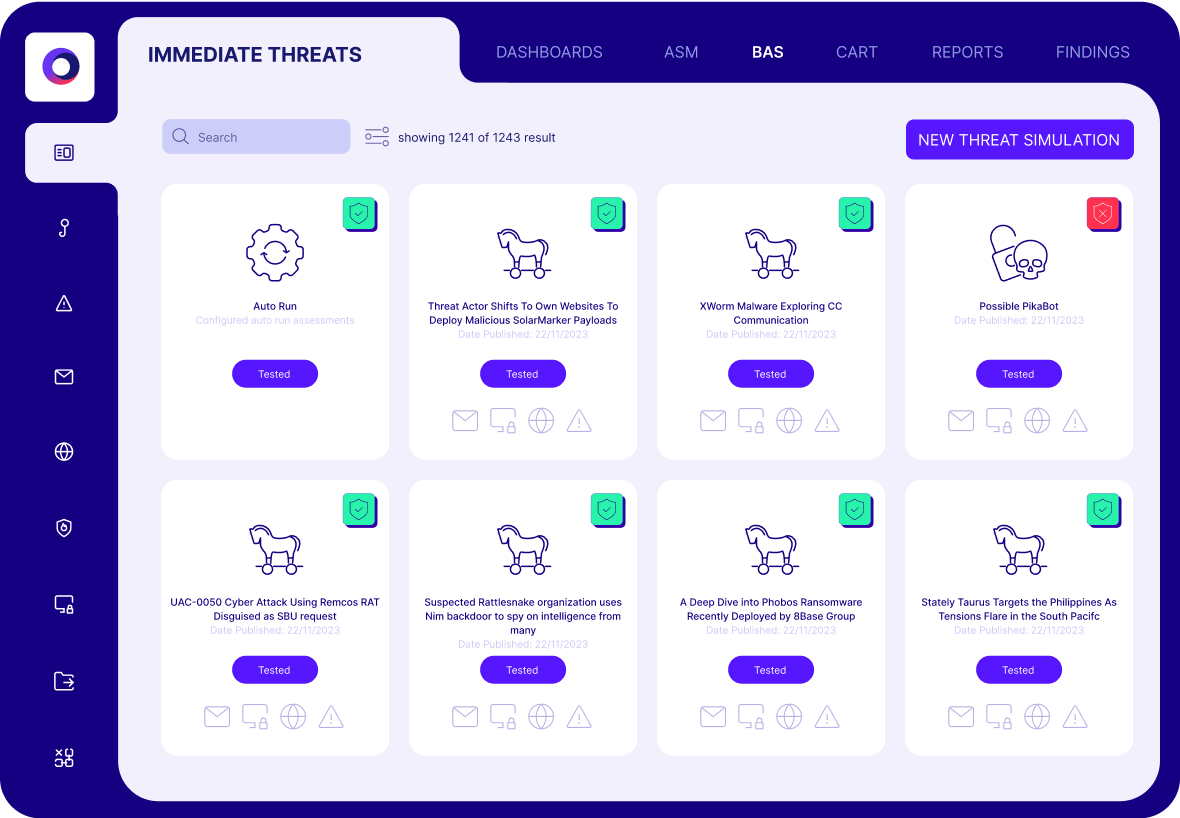
Cymulate delivers both offensive and defensive insights, automating red, blue and purple team functions to help organizations continuously test, measure and strengthen their resilience.
With Cymulate you’ll have superior tools to:
Upgrading from Pentera to Cymulate is easy.
We’ve helped numerous clients upgrade from Pentera to Cymulate. We’ll help you build and customize production-safe assessments for all your environments (adding to the ones that Pentera covered), optimize your controls and reduce exposure risk.

Frequently asked questions
Threat exposure validation requires optimizing defenses, scaling offensive testing and increasing exposure awareness. While Pentera is useful for identifying security gaps with automated penetration testing, it lacks the depth needed to fully assess and strengthen defenses.
Cymulate offers a more comprehensive approach to identifying and fixing security gaps through breach simulation and automated red teaming. By testing the overall effectiveness of security controls, it reveals unmitigated exposures and provides actionable guidance to strengthen defenses before the next attack.
Yes. Cymulate delivers greater value through unified threat exposure management, real-time validation and actionable remediation guidance.
While other Pentera competitors specialize in either attack simulation or detection testing, Cymulate bridges both, reducing operational complexity and improving ROI.
Organizations that benefit most from switching from Pentera to Cymulate are enterprises and mid-size organizations that need continuous security testing, rapid ROI and hybrid/cloud flexibility, not just point-in-time pentesting results.
Cymulate enables ongoing improvement, quantifiable risk reduction and readiness validation for compliance and resilience initiatives.
Cymulate stands out by offering continuous, automated exposure validation across the full attack surface including endpoint, email, network, web and cloud.
It unifies offensive and defensive testing in one platform, eliminating silos and providing actionable risk context for faster decision-making.
Cymulate integrates exposure validation, BAS and exposure management into a single platform.
Unlike other vendors that focus narrowly on one function (e.g., pentesting or detection validation), Cymulate provides a 360-degree view of cyber exposure, from threat simulation to prioritized remediation.
Cymulate continuously discovers, tests and validates the attack surface by mapping exposures, attack paths and control gaps dynamically.
While Pentera focuses on exploitation-driven testing, Cymulate correlates exposures across assets and controls to quantify and reduce risk in real time, supporting proactive exposure management across hybrid infrastructures.
Learn from our customers' success
View More Resources
RBI Optimizes SIEM Detection
Discover how RBI increased their efficiency and improved their security with Cymulate.

Globeleq Automates In-House Validation
Power company's team adds Cymulate for ongoing security validation between pen tests.

Bank Increases In-House Security Testing
Read how this bank uses Cymulate for automated pen testing and security control validation.