

Frequently Asked Questions

Product Overview & Purpose

What is Cymulate and what does it do?

Cymulate is a cybersecurity platform that empowers organizations to continuously assess and validate their security posture through automated Breach and Attack Simulation (BAS), exposure management, and threat validation. It helps identify vulnerabilities, optimize defenses, and stay ahead of evolving cyber threats. [Source]

What is Breach and Attack Simulation (BAS) and why is it important?

Breach and Attack Simulation (BAS) tools, like those offered by Cymulate, simulate real-world cyberattacks to validate the effectiveness of security controls and expose vulnerabilities. BAS is critical for closing security gaps before attackers can exploit them, ensuring organizations can proactively defend against sophisticated threats. [Source]

What is the primary purpose of Cymulate's platform?

The primary purpose of Cymulate's platform is to help organizations proactively validate their cybersecurity defenses, identify vulnerabilities, and optimize their security posture. It enables security teams to stay ahead of emerging threats and improve overall resilience. [Source]

How does Cymulate support exposure management?

Cymulate supports exposure management by integrating exposure validation, prioritization, and remediation into a unified platform. It enables organizations to focus on what’s exploitable in their environment and automate the validation of security controls across the full attack kill chain. [Source]

Features & Capabilities

What are the top use cases for Breach and Attack Simulation (BAS) with Cymulate?

Top BAS use cases with Cymulate include risk-based vulnerability management, measuring and improving security operations, testing security posture against emerging threats, optimizing SIEM, supporting red and purple team activities, due diligence for mergers and acquisitions, and assessing third-party cyber risk. [Source]

What key capabilities should a BAS platform like Cymulate offer?

A comprehensive BAS platform should provide a broad range of simulations, customizable attack scenarios, assessment history with mitigation guidance, MITRE ATT&CK mapping, automation (scheduling, workflows, APIs), and dynamic dashboards with automated report generation. [Source]

How does Cymulate help with risk-based vulnerability management?

Cymulate's BAS simulations prioritize patching efforts based on real-world exploitability, not just CVSS scores. By simulating exploitation attempts, Cymulate validates whether existing controls mitigate vulnerabilities, enabling smarter vulnerability prioritization and resource allocation. [Source]

How does Cymulate measure and improve security operations?

Cymulate enables organizations to benchmark and track improvements in detection rates, investigation timelines, and remediation speeds. Continuous BAS assessments identify security drift, demonstrate tool ROI, and optimize budgets by highlighting redundant or missing capabilities. [Source]

How does Cymulate test security posture against emerging threats?

Cymulate integrates with threat intelligence feeds to rapidly develop and deploy simulations of emerging threats. This allows organizations to validate their defenses against the latest attack techniques and identify control gaps in near real-time. [Source]

How does Cymulate optimize SIEM systems?

Cymulate's BAS generates high-fidelity event data, enabling security teams to identify detection gaps, false positives, and optimization opportunities in SIEM systems. Findings are used to refine correlation rules and machine learning models, improving threat alerting accuracy and reducing incident response burdens. [Source]

How does Cymulate support red and purple team activities?

Cymulate enables advanced adversarial simulations for red and purple teams, allowing them to test risky but realistic attacker behaviors in a safe environment. This fosters collaboration between offensive and defensive teams and helps develop effective playbooks for incident response. [Source]

How can Cymulate be used for due diligence in mergers and acquisitions?

Cymulate's BAS can baseline the security posture and risk level of acquisition targets without direct access to their systems. Focused assessments provide data-driven insights into inherited cyber risks, informing valuation and integration planning. [Source]

How does Cymulate assess third-party cyber risk?

Cymulate can perform controlled security assessments of third parties, such as suppliers and partners, to evaluate the risks they introduce. BAS assessments can be ongoing, providing transparency into vendor risks without compromising sensitive data. [Source]

What best practices should organizations follow when implementing BAS with Cymulate?

Best practices include promoting BAS as an ongoing program, involving executives, leveraging actionable insights for security improvements, and using BAS scenarios to train SOC teams. These strategies help maximize BAS capabilities and business impact. [Source]

What is Cymulate Exposure Validation?

Cymulate Exposure Validation is a solution that makes advanced security testing fast and easy. It allows users to build custom attack chains and access all necessary tools in one place, streamlining the process of validating security controls. [Source]

How does Cymulate empower organizations to stay ahead of cyber threats?

Cymulate empowers organizations by providing continuous assessment and validation of their security posture, leveraging threat simulation, comprehensive security assessments, and ongoing innovation to equip teams with the tools and insights needed to stay ahead of cyber threats. [Source]

What are the benefits of using Cymulate for security teams?

Cymulate enables security teams to validate controls, expose risks, and refine defenses against evolving threats. It provides actionable insights, supports skill development, and helps justify security investments with quantifiable metrics. [Source]

How does Cymulate integrate with existing security tools?

Cymulate integrates with a wide range of security technologies, including Akamai Guardicore, AWS GuardDuty, BlackBerry Cylance OPTICS, Carbon Black EDR, Check Point CloudGuard, Cisco Secure Endpoint, CrowdStrike Falcon, Wiz, SentinelOne, and more. For a complete list, visit the Partnerships and Integrations page.

What certifications and compliance standards does Cymulate meet?

Cymulate holds several key certifications, including SOC2 Type II, ISO 27001:2013, ISO 27701, ISO 27017, and CSA STAR Level 1. These certifications demonstrate Cymulate's commitment to robust security and compliance practices. [Source]

How does Cymulate ensure data security and privacy?

Cymulate ensures data security through encryption in transit (TLS 1.2+) and at rest (AES-256), secure AWS-hosted data centers, a tested disaster recovery plan, and compliance with GDPR. The platform also includes mandatory 2FA, RBAC, and IP address restrictions. [Source]

How easy is it to implement Cymulate and get started?

Cymulate is designed for quick and easy implementation, operating in agentless mode with no need for additional hardware or complex configurations. Customers can start running simulations almost immediately, with comprehensive support and educational resources available. [Source]

What feedback have customers given about Cymulate's ease of use?

Customers consistently praise Cymulate for its intuitive interface and ease of use. Testimonials highlight the platform's user-friendly dashboard, accessible support, and immediate value in identifying security gaps and mitigation options. [Source]

Use Cases & Benefits

Who can benefit from using Cymulate?

Cymulate is designed for CISOs, security leaders, SecOps teams, red teams, and vulnerability management teams in organizations of all sizes and industries, including finance, healthcare, retail, media, transportation, and manufacturing. [Source]

What business impact can customers expect from Cymulate?

Customers can expect up to a 52% reduction in critical exposures, a 60% increase in team efficiency, 40X faster threat validation, and an 81% reduction in cyber risk within four months. These outcomes are supported by customer case studies and measurable metrics. [Source]

What are some real-world case studies demonstrating Cymulate's value?

Examples include Hertz Israel reducing cyber risk by 81% in four months, a sustainable energy company scaling penetration testing, and Nemours Children's Health improving detection in hybrid environments. See more at the Cymulate Case Studies page.

What pain points does Cymulate address for security teams?

Cymulate addresses fragmented security tools, resource constraints, unclear risk prioritization, cloud complexity, communication barriers, inadequate threat simulation, operational inefficiencies, and post-breach recovery challenges. [Source]

How does Cymulate tailor solutions for different personas?

Cymulate provides quantifiable metrics for CISOs, automates processes for SecOps teams, offers advanced offensive testing for red teams, and streamlines vulnerability management for dedicated teams. Solutions are tailored to each role's unique challenges. [Source]

Pricing & Plans

What is Cymulate's pricing model?

Cymulate uses a subscription-based pricing model tailored to each organization's requirements. Pricing depends on the chosen package, number of assets, and scenarios selected. For a detailed quote, schedule a demo with the Cymulate team. [Source]

Competition & Comparison

How does Cymulate differ from other BAS and exposure management platforms?

Cymulate stands out with its unified platform combining BAS, Continuous Automated Red Teaming (CART), and Exposure Analytics. It offers continuous threat validation, AI-powered optimization, complete kill chain coverage, ease of use, and an extensive threat library updated daily. [Source]

What measurable outcomes have Cymulate customers achieved?

Customers have reported a 52% reduction in critical exposures, a 60% increase in team efficiency, and an 81% reduction in cyber risk within four months. These results are supported by case studies and customer testimonials. [Source]

Support & Resources

What support options are available for Cymulate customers?

Cymulate offers email and chat support, a knowledge base with technical articles and videos, webinars, e-books, and an AI chatbot for quick answers and guidance. [Source]

Where can I find Cymulate's blog, newsroom, and resource hub?

You can find the latest insights, research, and company news on the Cymulate Blog, Newsroom, and Resource Hub.

Does Cymulate offer resources for learning about security validation best practices?

Yes, Cymulate provides webinars, e-books, and a knowledge base with best practices for security validation. These resources help organizations optimize their use of the platform and improve their security posture. [Source]

Where can I read about Cymulate's latest research and threat analysis?

You can stay up to date with Cymulate's latest research, threat analysis, and product updates by visiting the Cymulate Blog.

Does Cymulate have a blog post about preventing lateral movement attacks?

Yes, Cymulate has a blog post titled 'Stopping Attackers in Their Tracks' that discusses common lateral movement attacks and prevention strategies. Read it on our blog.

New: 2026 Gartner® Market Guide for Adversarial Exposure Validation
Learn More
Cymulate named a Customers' Choice in 2025 Gartner® Peer Insights™
Learn More
New Research: The Security Tradeoffs Behind AI Tooling
Learn More
An Inside Look at the Technology Behind Cymulate
Learn More

Maximizing the Value of Breach and Attack Simulation

By: Cymulate

Last Updated: July 22, 2025

image

Breach and attack simulation (BAS) tools have emerged as a critical component of a modern cybersecurity program. As threats continue to increase in sophistication, solutions capable of validating security controls’ efficacy and exposing potential vulnerabilities are key to closing security gaps before attackers exploit them.

Top BAS Use Cases

While validating security controls and assessing overall posture are the primary applications, advanced organizations can get additional value from tailored BAS programs.

1. Risk-based vulnerability management

BAS simulations are instrumental in prioritizing patching efforts based on real-world exploitability rather than just CVSS scores. Leveraging BAS to simulate the exploitation of known vulnerabilities yields actionable insights into which vulnerabilities are likely to be successfully exploited within their environment despite the security measures in place. This enables smarter vulnerability prioritization and the allocation of resources to vulnerabilities, misconfigurations, and other security gaps that pose the highest contextual risk.

By testing vulnerabilities against the specific compensating controls implemented, BAS validates whether firewalls, network segmentation, endpoint security, and other defenses sufficiently mitigate each vulnerability’s exposure risk. If the simulation succeeds in exploiting a vulnerability despite controls, it is prioritized for patching, while vulnerabilities blocked by existing security measures are deprioritized.

How it works: Ready-made or customized attack scenarios can be scheduled or launched ad-hoc to simulate exploitation techniques. These scenarios attempt to exploit vulnerabilities, challenging the efficacy of security controls like web application firewalls and endpoint detection.
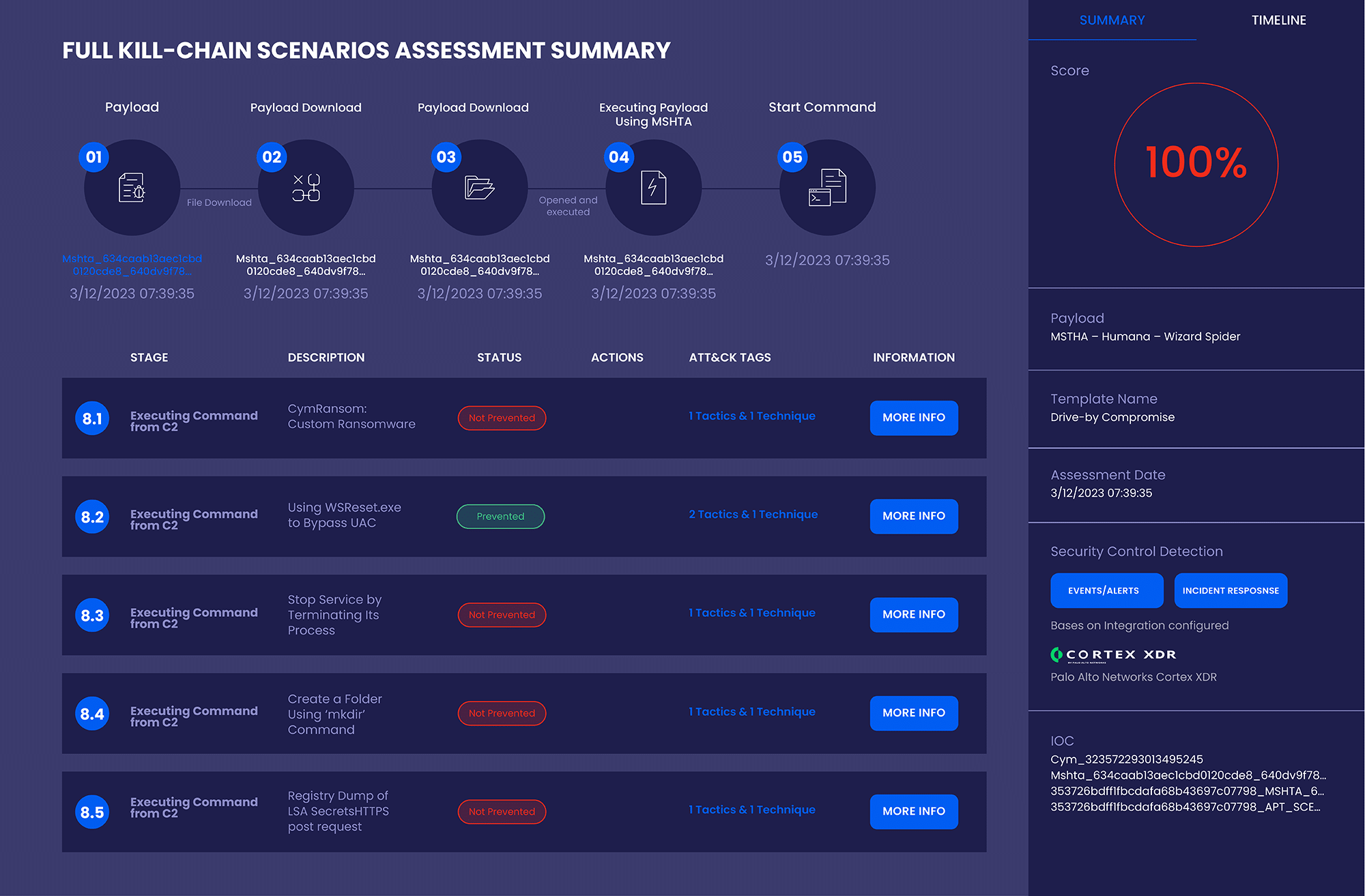
Breach and Attack Simulation - Full Kill-chain - Cymulate
Test the full stack of cyber controls vs. simulated full kill-chain APT attacks – from attack delivery to exploitation and post-exploitation.

2. Measure and improve security operations

BAS is effective in moving from security baselining to quantifying cyber performance by benchmarking and tracking improvements in key performance metrics. BAS data quantifies changes in detection rates, investigation timelines, and remediation speeds. These continuous and objective measurements identify security drift early, prompting early remediation action. They also demonstrate each tool stack component’s ROI and identify redundant tools and missing capabilities, which facilitate budget optimization and request for further investment.

How it works: The first run of attack simulation provides baseline metrics to evaluate the exposure of each assessed security control type (i.e., Endpoints, WAF, firewalls). Subsequent launches of similar or emerging attack simulation scenarios provide visibility into each security control cyber-resilience evolution, and granularly identify the tools’ ability to detect and/or respond to raise alarm or stop the launched attack scenarios.

3. Test security posture against emerging threats

By Integrating with threat intelligence feeds, BAS can assess organizational resilience against new and emerging threats. The more advanced BAS solutions can rapidly develop and deploy simulations of emerging threat techniques and adversary campaigns. This enables security teams to validate, in near real-time, whether their existing controls and detections can withstand the latest attack behaviors.

How it works: BAS vendors develop new tactics or scenarios to defend against new malware, exploits, and adversary TTPs as soon as they are reported by threat intel sources.  Scheduling and running these simulations as soon as they are released assesses the defenses’ effectiveness against these emerging threats. Findings identify control gaps and detect blind spots to be addressed.
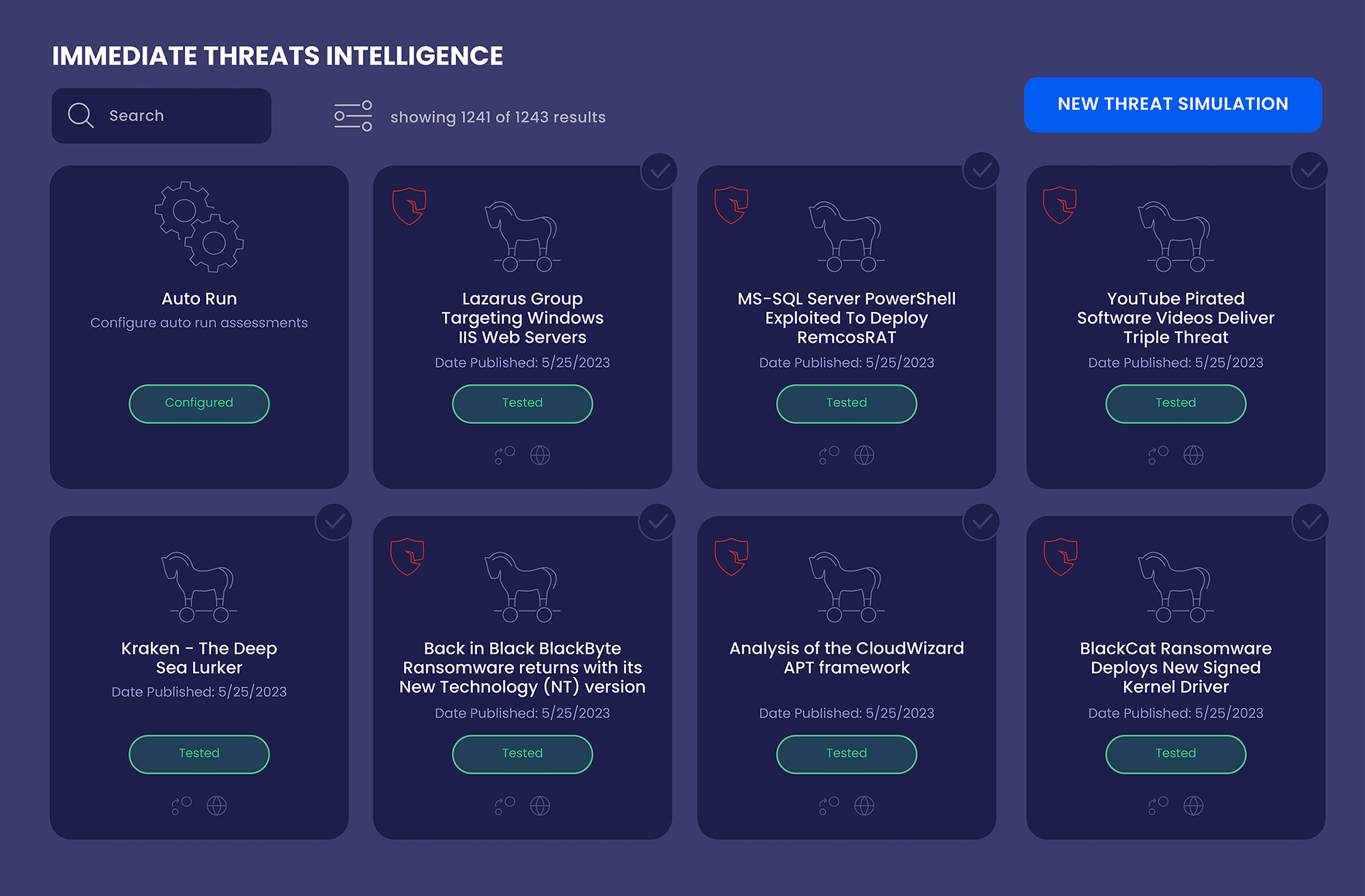
Breach Attack and Simulation - Immediate Threats - Cymulate
Immediate Threats - Validate security architecture against APT attacks - Cymulate

4. Optimize SIEM

Security Information and Event Management (SIEM) systems collect and analyze log and event data from across an organization’s infrastructure to enable real-time detection and response to threats. However, SIEMs require extensive expert configuration and continuous fine-tuning to maximize value. BAS provides a robust methodology for validating and optimizing SIEM detection efficacy.

Most SIEMs come with default rules and algorithms to identify potential attacks. But these generic detections result in poor signal-to-noise ratio and threat coverage gaps in the unique environment of each organization. Properly configuring correlation rules and machine learning models to the specific infrastructure, behaviors, and threat landscape is challenging.

How it works: BAS simulates real-world threats generating high-fidelity event data tailored to the environment. Security teams analyze BAS telemetry to identify detection gaps, false positives, and optimization opportunities. New correlation rules and ML refinements are developed based on BAS findings and validated with additional simulations, rapidly improving SIEM threat alerting accuracy and coverage. This ultimately reduces mean-time-to-detect and incident response burdens.

5. Red team and purple team activities

Organizations with a more mature cybersecurity infrastructure and in-house advanced security teams may want to conduct sophisticated adversarial simulations that would be too risky for real red team engagement. BAS supports activities like red team operations and purple team exercises, fostering collaboration between offensive and defensive teams to identify and address vulnerabilities effectively. These simulations incorporate advanced techniques like anti-forensics and defense evasion without jeopardizing production environments.

BAS frees up red teams to focus on high-quality assignments and enables blue teamers to re-run an assessment following remediation.

How it works: BAS gives red teams an environment to build template-based or custom scenarios incorporating risky but realistic attacker behaviors. These targeted simulations enable assessing systems’ resilience to cutting-edge techniques, yet without operational risk or impact. This leads to palliating exposure or developing playbooks to accelerate response.
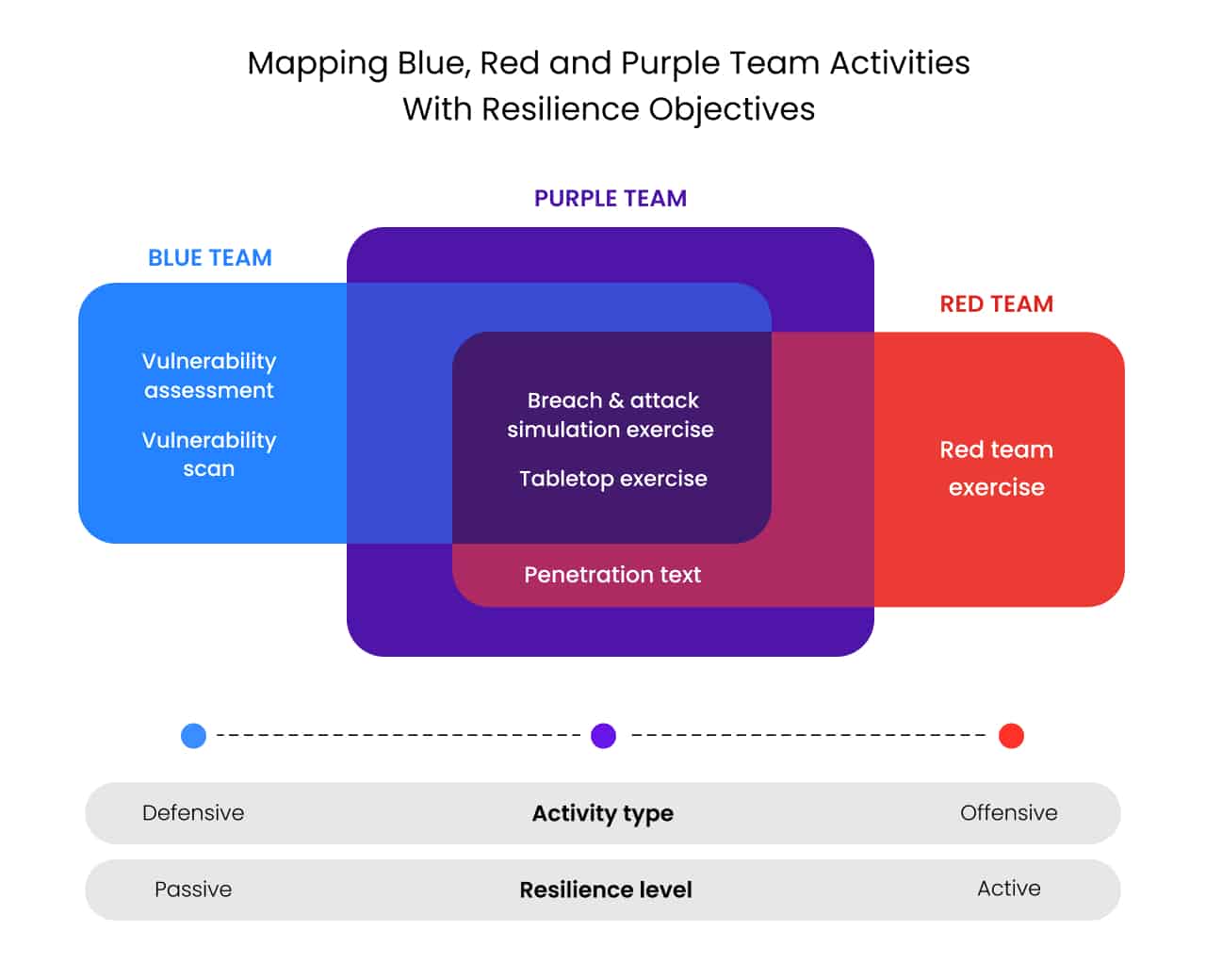
Mapping Blue, Red and Purple team activities with resilience objectivies

6. Due diligence for mergers & acquisitions

In acquisition scenarios, BAS delivers an efficient way to baseline the security posture and risk level of targets without needing any access to the target’s systems and networks. By running focused BAS assessments pre-acquisition, organizations gain data-driven insights into the cyber risks being inherited through the merger that can inform valuation and security integration planning.

How it works: BAS attack scenarios are configured to simulate attacks against the intended partner or acquisition systems. This resulting quantitative risk assessment informs financial valuation and security integration planning without directly accessing the target’s environment.

7. Assess third-party cyber risk

BAS can perform some level of controlled security assessments of third parties such as suppliers and partners and a more extensive evaluation of the added risks potentially introduced by new suppliers. By providing a non-intrusive way to continuously evaluate security controls, BAS enables transparency into potential vendor risks without compromising sensitive data. BAS assessments can also be ongoing to continuously validate controls as partnerships evolve.

How it works: Depending on the level of authorization obtained from the supplier or partner, either BAS is deployed in an isolated environment mirroring the target vendor infrastructure or attack simulations are launched directly on the vendor or partner production infrastructure to evaluate their cyber-resilience.

Top BAS Capabilities

To find a comprehensive BAS platform, the following elements should be considered:

  • Breadth of simulations- BAS tools should include a variety of pre-built templates across at least email and web gateways, WAF, endpoint security, and data exfiltration network, cloud, and more. The larger the library, the more security layers you can validate.
  • Customizable attack scenarios - BAS tools should provide the flexibility to create new simulations tailored to your environment and emerging threats.
  • Assessment history and mitigation guidance - BAS tools should enable viewing the history of all assessments and drill down further per assessment to access results and remediation guidance.
  • MITRE ATT&CK mapping - BAS tools should link findings or remediation guidance to MITRE tactics and techniques for contextual prioritization and insights.
  • Automation - Seek BAS solutions with scheduling, workflows, and APIs to enable continuous testing.
  • Dynamic dashboards and automated report generation - BAS tools should enable immediate visualization with customizable dashboards and reports.

Best Practices for BAS Implementation and Adoption

Follow these best practices to gain full advantage from your investment in BAS:

  1. Promote continuity - Position BAS as an ongoing program, not a one-time project. Build it into processes like vulnerability management instead of a separate entity.
  2. Include executives - Educate leadership on BAS value to secure alignment on objectives and include them in assessments and reporting.
  3. Leverage actionable insights - Focus on using BAS findings to drive security hygiene improvements. Do not just collect data.
  4. Promote skill development - Leverage BAS scenarios to train SOC teams through practical lessons on detecting and responding to threats.

BAS solutions empower organizations to validate controls, expose risks, and refine defenses against ever-evolving threats. Following the strategies outlined here will help you maximize their capabilities and business impact. Reach out if you would like to discuss further.




Cymulate Exposure Validation makes advanced security testing fast and easy. When it comes to building custom attack chains, it's all right in front of you in one place.
Mike Humbert, Cybersecurity Engineer
DARLING INGREDIENTS INC.
Learn More
Book a Demo