

Frequently Asked Questions

Automated Penetration Testing Basics

What is automated penetration testing?

Automated penetration testing is a process where software tools simulate cyber attacks against an organization’s network, applications, and systems to identify security weaknesses. Unlike manual pen testing, which relies on human expertise, automated pen testing leverages automation to execute repetitive and complex tasks quickly and efficiently, helping organizations identify vulnerabilities faster and more securely.

How does automated penetration testing differ from manual penetration testing?

Automated penetration testing is ideal for quick assessments, large-scale environments, and repetitive checks of common vulnerabilities. It is faster, more cost-effective, and easily scalable. Manual penetration testing, on the other hand, is best for deep, thorough testing in complex environments, offering high accuracy and the ability to uncover sophisticated vulnerabilities, but it is more time-consuming and costly due to the need for human expertise.

What are the main advantages of automated penetration testing?

Automated penetration testing offers speed, scalability, and cost-effectiveness. It enables organizations to quickly scan for known vulnerabilities across large environments, perform repetitive checks, and continuously monitor their security posture. Automation also reduces the risk of human error in repetitive tasks.

What are the limitations or challenges of automated penetration testing?

Challenges include false positives and negatives, limited customization for advanced or targeted attacks, integration difficulties with existing workflows, tool compatibility issues, and the need for ongoing employee training. Automated tools may miss complex vulnerabilities that require human judgment and may not adapt well to unique business logic or environments.

Can automated penetration testing replace manual testing?

No, automated penetration testing should complement, not replace, manual testing. While automation excels at wide coverage and efficiency, manual testing is necessary for uncovering sophisticated vulnerabilities and adapting to complex scenarios that require human expertise.

What types of vulnerabilities can automated penetration testing detect?

Automated penetration testing is effective at detecting common and known vulnerabilities, such as misconfigurations, missing patches, and weaknesses in network and application security. However, it may not detect complex or context-specific vulnerabilities that require human analysis.

What are some popular automated penetration testing tools?

Popular tools include Burp Suite (web application testing), Nessus (vulnerability scanning), Metasploit (penetration testing framework), Qualys (broad scanning capabilities), and Acunetix (website vulnerability scanning). Each tool offers unique features for different environments and use cases.

What features should I look for in an automated penetration testing tool?

Key features include compatibility with various environments (cloud, on-premises, hybrid), actionable reporting with prioritized recommendations, regular updates for evolving threats, and scalability to support both small and large IT environments.

How does Cymulate support automated penetration testing?

Cymulate provides a leading security validation platform that enables continuous, real-time testing of security controls through automated penetration testing. The platform simulates real-world attacks, validates exposures, and delivers actionable reports to help organizations strengthen their security posture and prioritize remediation efforts.

What is continuous exposure validation in the context of automated penetration testing?

Continuous exposure validation refers to the ongoing process of identifying vulnerabilities across networks, endpoints, and security tools. Cymulate’s platform performs this validation in real-time, allowing organizations to detect and address security gaps before attackers can exploit them.

Features & Capabilities

What are the key capabilities of Cymulate’s automated penetration testing platform?

Cymulate’s platform offers continuous threat validation, unified Breach and Attack Simulation (BAS), automated red teaming, exposure analytics, attack path discovery, automated mitigation, AI-powered optimization, and an extensive threat library with over 100,000 attack actions updated daily. These features enable organizations to validate defenses, prioritize exposures, and improve operational efficiency. Learn more.

Does Cymulate integrate with other security tools?

Yes, Cymulate integrates with a wide range of security technologies, including Akamai Guardicore, AWS GuardDuty, BlackBerry Cylance OPTICS, Carbon Black EDR, Check Point CloudGuard, Cisco Secure Endpoint, CrowdStrike Falcon, Wiz, SentinelOne, and more. For a complete list, visit our Partnerships and Integrations page.

How does Cymulate help prioritize vulnerabilities?

Cymulate validates exploitability and ranks exposures based on prevention and detection capabilities, business context, and threat intelligence. This helps organizations focus on the most critical vulnerabilities and optimize remediation efforts. Learn more.

What reporting capabilities does Cymulate offer?

Cymulate provides detailed reports with actionable recommendations, enabling organizations to prioritize security fixes based on severity, risk level, and potential business impact. Reports are designed to be clear and actionable for both technical and executive audiences.

How does Cymulate keep its threat simulations up to date?

Cymulate’s threat library is updated daily with the latest attack techniques and intelligence, ensuring that simulations reflect current threats and vulnerabilities. This helps organizations stay ahead of emerging risks.

Is Cymulate easy to implement and use?

Yes, Cymulate is designed for quick and easy implementation. It operates in agentless mode, requires minimal setup, and integrates seamlessly into existing workflows. Customers consistently praise its intuitive interface and ease of use. Schedule a demo to see it in action.

What educational resources does Cymulate provide?

Cymulate offers a comprehensive Resource Hub, blog, webinars, e-books, and a continuously updated cybersecurity glossary. These resources help users stay informed about the latest threats, best practices, and platform capabilities. Explore resources.

Does Cymulate support continuous security validation?

Yes, Cymulate’s platform is built for continuous security validation, enabling organizations to test and validate their defenses in real-time and on an ongoing basis. This approach helps maintain a strong security posture as threats evolve.

Use Cases & Benefits

Who can benefit from automated penetration testing with Cymulate?

Cymulate’s solutions are designed for CISOs, security leaders, SecOps teams, red teams, and vulnerability management teams in organizations of all sizes and industries, including finance, healthcare, retail, media, transportation, and manufacturing. Learn more.

What business impact can organizations expect from using Cymulate?

Organizations using Cymulate have reported up to a 52% reduction in critical exposures, a 60% increase in team efficiency, and an 81% reduction in cyber risk within four months. The platform also enables faster threat validation (up to 40x faster than manual methods) and cost savings by consolidating multiple tools. See more.

Are there real-world examples of Cymulate’s impact?

Yes. For example, Hertz Israel reduced cyber risk by 81% in four months, and a sustainable energy company scaled penetration testing cost-effectively with Cymulate. More case studies are available on our Case Studies page.

What pain points does Cymulate address for security teams?

Cymulate addresses fragmented security tools, resource constraints, unclear risk prioritization, cloud complexity, communication barriers, inadequate threat simulation, operational inefficiencies in vulnerability management, and post-breach recovery challenges. The platform integrates exposure data, automates validation, and provides actionable insights to solve these issues.

How does Cymulate’s solution differ for different user roles?

Cymulate tailors its solutions for CISOs (metrics and risk prioritization), SecOps teams (automation and efficiency), red teams (automated offensive testing), and vulnerability management teams (in-house validation and prioritization). Each persona receives features and insights relevant to their responsibilities. Learn more.

How does Cymulate help with cloud security validation?

Cymulate secures hybrid and cloud infrastructures through automated compliance and regulatory testing, integrating with leading cloud security tools like AWS GuardDuty, Check Point CloudGuard, and Wiz. This ensures comprehensive validation across all environments. Learn more.

What is the primary purpose of Cymulate’s automated penetration testing?

The primary purpose is to proactively validate cybersecurity defenses, identify vulnerabilities, and optimize security posture. Cymulate empowers security teams to stay ahead of emerging threats and improve overall resilience through continuous, automated testing and actionable insights.

How does Cymulate support collaboration across security teams?

Cymulate’s unified platform enables collaboration between SecOps, red teams, and vulnerability management teams by providing a shared view of exposures, prioritized action plans, and quantifiable metrics. This unified approach helps break down silos and drive effective security programs.

Security, Compliance & Implementation

What security and compliance certifications does Cymulate hold?

Cymulate holds SOC2 Type II, ISO 27001:2013, ISO 27701, ISO 27017, and CSA STAR Level 1 certifications. These attest to Cymulate’s robust security practices, data protection, and compliance with international standards. See details.

How does Cymulate ensure data security and privacy?

Cymulate ensures data security through encryption in transit (TLS 1.2+) and at rest (AES-256), secure AWS-hosted data centers, a tested disaster recovery plan, and compliance with GDPR. The platform also features 2FA, RBAC, IP restrictions, and a dedicated privacy and security team.

How long does it take to implement Cymulate?

Cymulate is designed for rapid deployment. Operating in agentless mode, it requires no additional hardware or complex configuration. Customers can typically start running simulations almost immediately after deployment. Comprehensive support and educational resources are available to assist with onboarding.

What support options are available for Cymulate users?

Cymulate offers email support, real-time chat support, a knowledge base with technical articles and videos, webinars, e-books, and an AI chatbot for quick answers. These resources help users maximize the platform’s value and resolve issues efficiently.

Is Cymulate compliant with GDPR?

Yes, Cymulate incorporates data protection by design and maintains a dedicated privacy and security team, including a Data Protection Officer (DPO) and Chief Information Security Officer (CISO), to ensure GDPR compliance.

What is Cymulate’s pricing model?

Cymulate operates on a subscription-based pricing model tailored to each organization’s requirements. Pricing depends on the chosen package, number of assets, and scenarios selected. For a detailed quote, schedule a demo with the Cymulate team.

Where can I find a glossary of cybersecurity terms?

Cymulate provides a continuously updated glossary of cybersecurity terms, acronyms, and jargon. You can access it at our Glossary page.

How does Cymulate compare to other automated penetration testing solutions?

Cymulate stands out with its unified platform combining BAS, automated red teaming, and exposure analytics, continuous threat validation, AI-powered optimization, and daily threat intelligence updates. It is recognized for ease of use, rapid implementation, and measurable business outcomes, such as significant reductions in cyber risk and operational costs. See comparison.

New: 2026 Gartner® Market Guide for Adversarial Exposure Validation
Learn More
Cymulate named a Customers' Choice in 2025 Gartner® Peer Insights™
Learn More
New Research: Azure Arc Privilege Escalation & Identity Takeover
Learn More
An Inside Look at the Technology Behind Cymulate
Learn More

Automated Penetration Testing

When organizations face security threats daily, they continually seek innovative ways to protect their data, networks and systems. One protective approach is automated penetration (aka pen) testing. By applying an automated pen test, organizations are able to save valuable resources in all forms, gain vital operational efficiencies and most importantly identify vulnerabilities quickly and securely. There is no question that this automated approach far outpaces its manual predecessor. 

What is Automated Penetration Testing? 

Originally, automating penetration testing entailed replacing most of the repetitive tasks performed by a human pen tester with automation. Yet, as complexity grew beyond the ability of any human to keep an overarching view of the entire cyber-criminal capabilities, the generic field of automated pen testing had to evolve and become what is now known as Continuous Security Validation.  

Automated pen tests simulate cyber attacks against an organization’s network, applications and systems to identify security weaknesses, unlike manual pen testing, which relies on human expertise and effort. Automated penetration testing leverages software to execute repetitive and complex tasks quickly and efficiently, whereas manual pen testing introduces opportunity for errors and is a great deal more time consuming. 

What are the Key Differences Between Automated and Manual Penetration Testing? 

Both approaches have their place, and many organizations use them together to get the best of both worlds: automated tests for wide coverage and quick checks, and manual testing for thoroughness and discovery of sophisticated vulnerabilities. 

  • Automated Penetration Testing is ideal for quick assessments, large-scale environments, and repetitive checks of common vulnerabilities. It's faster, more cost-effective, and can handle high-volume scanning. 
  • Manual Penetration Testing is best suited for deep, thorough testing, especially in complex environments. It's highly adaptable, accurate, and capable of uncovering hidden vulnerabilities, but it takes more time and expertise. 
Aspect Automated Pen Testing Manual Pen Testing 
Speed Fast; Scans can be completed quickly for known vulnerabilities Slower; Requires time to explore and test various attack vectors 
Scope Limited by pre-configured tools; mainly focuses on common vulnerabilities Broad; testers can explore new and complex attack vectors, using creativity 
Cost Generally, less expensive due to automation More costly due to human expertise and time 
Accuracy Can miss complex vulnerabilities or ones that require context or manual inspection High accuracy, especially for complex or unique vulnerabilities 
Scalability Easily scalable to test large networks or applications Less scalable due to manual effort required 

Automated Penetration Testing has Challenges too 

Even significant technological advancements can come with imperfections and automated penetration testing is no exception. Here are some key challenges organizations face when relying on automated pen testing: 

  1. False Positives and Negatives: Automated penetration testing tools can sometimes produce inaccurate results. These tools are designed to scan for known vulnerabilities and issues, but their automated nature can lead to: 
  2. False Positives: Automated tools may flag harmless or non-critical issues as vulnerabilities. For example, a tool might identify a misconfigured setting or a missing header as a serious security flaw when it actually poses little to no risk in the given context. 
  3. False Negatives: On the flip side, automated tools might miss more sophisticated or subtle vulnerabilities, especially those that require an understanding of the system’s business logic or more advanced techniques. For example, a zero-day vulnerability, a complex chain of attacks, or an issue that depends on user roles might not be detected by basic automation. 
  4. Limited Customization: Automated pen testing tools work well for detecting known vulnerabilities but lack flexibility when it comes to simulating advanced or highly targeted attacks. Tools often operate based on predefined rules or attack patterns, which means they may not easily adjust to unique or customized environments. Specific systems or business logic may require more tailored attacks, which automated tools might not replicate effectively. 
  5. Over-reliance on Tools: Just as tools can be a major operational relief, there is still risk in overuse and does not replace the need for nuanced human skills that come with experience and judgment.  
  6. Integration Challenges: Integrating automated penetration testing tools into an organization’s existing security processes, workflows and environments can require individual sets of tools or configurations for platforms, applications or infrastructures.  
  7. Tool compatibility: not all automated testing tools are compatible with each type of environment or system. 
  8. Workflow integration: Continuous integration/continuous deployment (CI/CD) pipelines and vulnerability management processes are automated tests that must align with existing security operations, which can be complicated and time-consuming.  
  9. Skills gap: Ongoing training for internal employees is a critical component of ensuring new technology is maintained. Lack of familiarity with automated testing tools can result in underutilization and improper configuration. 

Automated Penetration Testing and Software 

The right tools can make a hard job easy and a time-consuming job quick. With automated penetration testing tools organizations can quickly identify vulnerabilities, misconfigurations, and weaknesses in their systems. The right tool can enhance security posture, accelerate vulnerability detection, and ensure that defenses are continuously tested.  

With so many tools in the market it’s critical to narrow down the most favorable ones with key features like compatibility, reporting capabilities, executing regular updates and scalability. These widely popular tools include:  

  • Burp Suite: Excellent for web application testing, offering features like proxy interception, spidering, intruder, and repeater for manual manipulation of requests and payloads. 
  • Nessus: A well-known vulnerability scanner that can scan various systems and networks for potential vulnerabilities. 
  • Metasploit: A powerful penetration testing framework with a large library of exploits and modules for various vulnerabilities. 
  • Qualys: Offers broad scanning capabilities across different environments including cloud and internal networks. 
  • Acunetix: Focused on website vulnerability scanning, providing detailed reports on identified vulnerabilities. 

Key features to look for in an automated penetration testing tool include: 

  • Compatibility with various environments: Ensure the tool supports multiple deployment options, including cloud, on-premises, and hybrid environments, to align with your organization's infrastructure. 
  • Actionable reporting and recommendations: Look for tools that offer detailed, clear and actionable reports with prioritized recommendations for remediation. This helps security teams focus on critical vulnerabilities first. 
  • Regular updates for evolving threats: An effective automated testing tool should continuously update its vulnerability database and attack simulations to reflect the latest security trends, exploits, and threat intelligence. 
  • Scalability and flexibility: The tool should scale to meet the needs of your organization, whether you're testing a few systems or a large, complex IT environment.  

What Makes Cymulate a Leading Security Validation Provider? 

As a leading automated penetration testing and security validation platform provider, Cymulate focuses on continuous security testing and validation across a wide variety of environments. By validating the effectiveness of an organization’s existing defenses, the leading platform can not only proactively assess an organization’s security posture in real-time by simulating real-world attacks but also strengthen its security posture. 

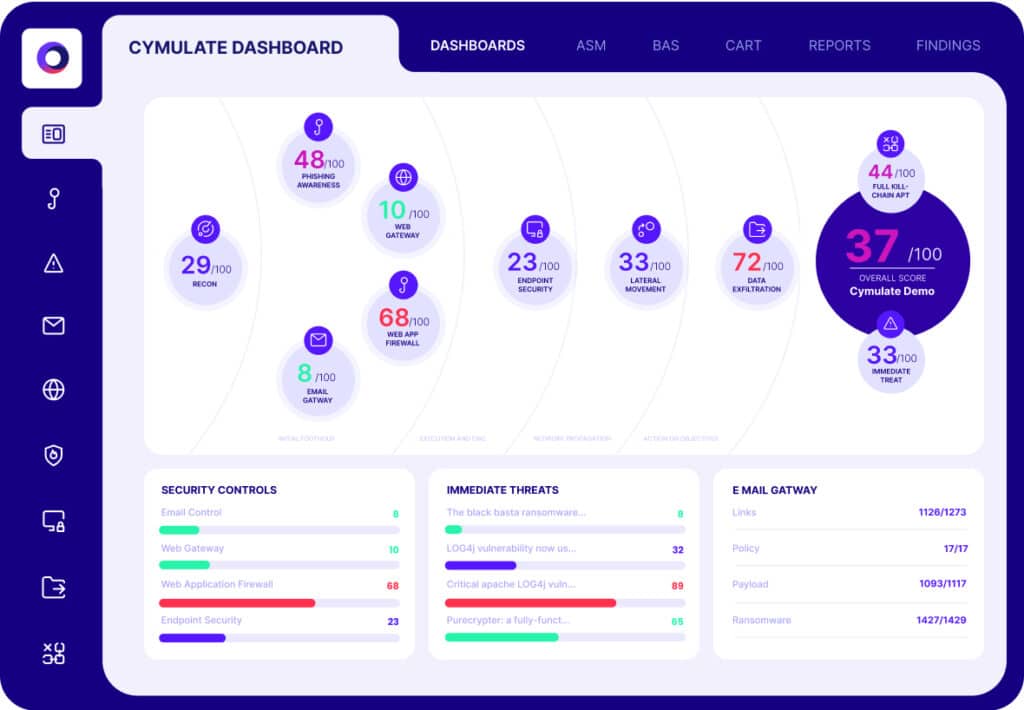
With real-time testing of security controls Cymulate provides a constant stream of real-time security feedback to help teams ensure their security controls are functioning as expected. Cymulate performs continuous exposure validation, allowing organizations to identify vulnerabilities across networks, endpoints and security tools on an ongoing basis. This is a crucial feature for identifying gaps in security before attackers can exploit them.  

Through simulating real-world attacks, including multi-stage and sophisticated attack paths, organizations can test how well their security controls can handle real-world attack chains. Every organization and leader needs to know about their results and next steps. The Cymulate platform provides detailed reports with actionable recommendations, enabling organizations to prioritize security fixes based on severity, risk level and potential impact to business operations.
Key Takeaways 

It’s become clear that automated penetration testing is an essential part of modern cybersecurity efforts and strategy. By leveraging automation, organizations can identify vulnerabilities more efficiently, scale their testing across multiple systems, and continuously monitor their security posture.  

However, organizations must approach automated penetration testing as a complement to, rather than a replacement for, human expertise, as every technological advancement comes with challenges and will always need skilled human experts by its side to pave the way. 

Book a Demo