

Frequently Asked Questions

Red Team Automation & Efficiency

What challenges do red teams typically face in cybersecurity operations?

Red teams often struggle with repetitive, time-consuming tasks, workforce shortages, budget constraints, and the need to keep up with constantly evolving indicators of compromise (IoCs) and tactics, techniques, and procedures (TTPs). These challenges limit their ability to focus on high-value, strategic security testing and can lead to operational inefficiencies.

How does automation improve red team efficiency?

Automation enables red teams to scale operations, reduce manual labor, and focus on complex, high-impact engagements. By automating repetitive tasks, assessment scripts, and reporting, red teams can run continuous assessments, create customized attack scenarios, and deliver actionable insights more efficiently.

What is the impact of the short shelf-life of testing results for red teams?

Because cybersecurity environments and threats change rapidly, annual or infrequent pen tests only provide a point-in-time snapshot. Without continuous assessments, organizations risk security drift and may not be protected against new or evolving threats. Automation allows for scheduled, ongoing testing to maintain up-to-date security validation.

How does Cymulate support continuous red team assessments?

Cymulate enables red teams to schedule and run assessments on a daily, weekly, or monthly basis. The platform automatically generates technical and executive reports with remediation guidance, ensuring that organizations can continuously monitor and improve their security posture.

What are the benefits of automating repetitive red team tasks?

Automating repetitive tasks allows red teams to focus on strategic, high-value activities such as complex attack simulations and threat emulation. This not only increases productivity but also boosts team morale and enhances the overall effectiveness of security operations.

How does Cymulate help red teams create customized attack scenarios?

Cymulate's platform enables red teams to build complex, customized scenarios using pre-built resources and custom binaries. Each step in a scenario can be linked, allowing outputs from one assessment to feed into the next, supporting advanced threat emulation and proactive threat hunting.

What is the role of External Attack Surface Management (EASM) in red team automation?

External Attack Surface Management (EASM) emulates real attackers to continuously discover and enumerate externally accessible digital assets, such as domains and IP addresses. EASM identifies vulnerabilities and exploits them to map out an organization's external attack surface, providing critical business context for red team operations.

How does Cymulate automate phishing awareness campaigns?

Cymulate's Phishing Awareness module allows organizations to automate internal phishing campaigns, reducing the manual effort required and enabling regular testing of employee awareness. This helps identify and mitigate social engineering risks more efficiently.

What is the importance of lateral movement simulation in red team automation?

Lateral movement simulation emulates how attackers move within a network after gaining an initial foothold. Cymulate's automation of this process helps organizations continuously uncover misconfigurations and weaknesses, ensuring network segmentation and isolation are effective against real-world attack techniques.

How does Cymulate validate the full cyber kill-chain?

Cymulate's Full Kill-Chain Campaign module validates an organization's security stack against real-world cyberattacks by simulating techniques across the entire kill-chain, from initial delivery to exploitation and post-exploitation, ensuring comprehensive defense validation.

What are the key modules included in Cymulate's red team automation platform?

Cymulate's red team automation platform includes modules for Attack Surface Management (ASM), Phishing Awareness, Lateral Movement, Full-Kill Chain Campaigns, and Advanced Scenarios, providing a comprehensive suite for red team operations.

How does Cymulate facilitate collaboration between red and blue teams?

Cymulate promotes purple team capabilities by enabling red teams to run simulated assessments that train blue teams to recognize attacker behaviors. Automated reporting and remediation guidance support continuous improvement and effective collaboration between teams.

How does Cymulate keep its assessment templates up to date?

Cymulate updates its assessment templates 24/7 based on newly discovered threats, ensuring that red teams can quickly test for the latest vulnerabilities and attack techniques without manual development effort.

Can Cymulate's automation help junior red team members?

Yes, Cymulate's automation allows junior red team members to run advanced attack scenarios and assessments at the level of more experienced team members, supporting skill development and operational scalability.

How does Cymulate integrate with other security tools?

Cymulate integrates with a wide range of security technologies, including Akamai Guardicore, AWS GuardDuty, BlackBerry Cylance OPTICS, Carbon Black EDR, Check Point CloudGuard, Cisco Secure Endpoint, CrowdStrike Falcon, Wiz, and SentinelOne. For a full list, visit the Cymulate Partnerships and Integrations page.

What is Cymulate's approach to production-safe assessments?

Cymulate's platform is designed to run assessments in a production-safe environment, ensuring that security testing does not disrupt business operations or compromise system availability.

How does Cymulate automate reporting for red team assessments?

Cymulate automatically generates technical and executive reports after each assessment, providing easy-to-digest remediation guidance tailored to both technical teams and leadership, streamlining communication and action planning.

How does Cymulate support validation of blue team remediation efforts?

After remediation guidance is provided, blue teams can re-run the same automated assessments independently to verify the effectiveness of their mitigation efforts, ensuring continuous improvement and risk reduction.

What is the main benefit of using Cymulate for red team automation?

Cymulate boosts red team productivity by automating routine tasks, enabling focus on high-impact engagements, and providing continuous, up-to-date security validation to strengthen organizational defenses.

Features & Capabilities

What features does Cymulate offer for red team automation?

Cymulate offers features such as automated attack simulations, customizable scenarios, continuous assessments, External Attack Surface Management (EASM), Phishing Awareness, Lateral Movement simulation, Full Kill-Chain Campaigns, and advanced reporting. These capabilities help red teams scale operations and focus on strategic security improvements.

Does Cymulate support integration with MITRE ATT&CK?

Yes, Cymulate's threat library and attack simulations are aligned with the MITRE ATT&CK framework, ensuring comprehensive coverage of real-world tactics and techniques.

How does Cymulate help with exposure prioritization?

Cymulate validates the exploitability of exposures and ranks them based on prevention and detection capabilities, business context, and threat intelligence, enabling organizations to focus on the most critical vulnerabilities.

What is Cymulate's approach to continuous threat validation?

Cymulate runs 24/7 automated attack simulations to validate security defenses in real-time, ensuring organizations stay ahead of emerging threats and maintain a strong security posture.

How does Cymulate support operational efficiency for security teams?

By automating processes and providing actionable insights, Cymulate allows security teams to focus on strategic initiatives, improving overall efficiency and reducing manual workload.

What is the size and scope of Cymulate's threat library?

Cymulate provides an extensive threat library with over 100,000 attack actions, updated daily, to ensure comprehensive and current threat simulation capabilities.

How does Cymulate automate mitigation after threat detection?

Cymulate integrates with security controls to push updates for immediate prevention of threats, streamlining the mitigation process and reducing exposure time.

What is Cymulate's approach to user experience and ease of use?

Cymulate is designed to be intuitive and user-friendly, with minimal setup required. Customers consistently praise its ease of use, quick implementation, and actionable insights, making it accessible for users of all skill levels.

How quickly can Cymulate be implemented?

Cymulate is agentless and requires no additional hardware or complex configurations. Customers can start running simulations almost immediately after deployment, with comprehensive support and educational resources available to assist with onboarding.

What support resources are available for Cymulate users?

Cymulate offers email and chat support, a knowledge base with technical articles and videos, webinars, e-books, and an AI chatbot for real-time assistance and best practices.

What compliance certifications does Cymulate hold?

Cymulate holds SOC2 Type II, ISO 27001:2013, ISO 27701, ISO 27017, and CSA STAR Level 1 certifications, demonstrating adherence to industry-leading security and privacy standards. For more details, visit the Security at Cymulate page.

How does Cymulate ensure data security and privacy?

Cymulate uses encryption for data in transit (TLS 1.2+) and at rest (AES-256), hosts data in secure AWS data centers, and follows a strict Secure Development Lifecycle (SDLC) with continuous vulnerability scanning and third-party penetration testing. The platform is GDPR-compliant and includes mandatory 2FA, RBAC, and IP restrictions.

What is Cymulate's pricing model?

Cymulate operates on a subscription-based pricing model tailored to each organization's requirements. Pricing depends on the chosen package, number of assets, and scenarios selected. For a detailed quote, you can schedule a demo with the Cymulate team.

Use Cases & Business Impact

Who can benefit from Cymulate's red team automation platform?

Cymulate is designed for CISOs, security leaders, SecOps teams, red teams, and vulnerability management teams in organizations of all sizes and industries, including finance, healthcare, retail, media, transportation, and manufacturing.

What business impact can organizations expect from using Cymulate?

Organizations using Cymulate have reported up to a 52% reduction in critical exposures, a 60% increase in team efficiency, and an 81% reduction in cyber risk within four months. The platform also enables faster threat validation and cost savings by consolidating multiple tools.

Are there real-world case studies demonstrating Cymulate's effectiveness?

Yes, for example, Hertz Israel reduced cyber risk by 81% in four months using Cymulate. Additional case studies are available for industries such as finance, energy, healthcare, and more. See the Cymulate Customers page for details.

How does Cymulate address the pain point of fragmented security tools?

Cymulate integrates exposure data and automates validation, providing a unified view of the security posture and reducing gaps caused by disconnected tools.

How does Cymulate help organizations with resource constraints?

Cymulate automates manual tasks and prioritizes remediation, improving efficiency and allowing security teams to focus on strategic initiatives despite limited resources.

How does Cymulate support organizations facing cloud complexity?

Cymulate secures hybrid and cloud infrastructures through automated compliance and regulatory testing, increasing visibility and improving detection and response capabilities in dynamic environments.

How does Cymulate help with communication barriers for CISOs and security leaders?

Cymulate provides quantifiable metrics and insights tailored to different roles, enabling CISOs and security leaders to justify investments and communicate risks effectively to stakeholders.

How does Cymulate address operational inefficiencies in vulnerability management?

Cymulate automates in-house validation between pen tests and prioritizes vulnerabilities, improving efficiency and ensuring that the most critical exposures are addressed promptly.

How does Cymulate help organizations recover after a breach?

Cymulate enhances visibility and detection capabilities post-breach, enabling faster recovery and improved protection by replacing manual processes with automated assessments.

What is Cymulate's mission and vision?

Cymulate's mission is to transform cybersecurity practices by enabling organizations to proactively validate defenses, identify vulnerabilities, and optimize their security posture. The vision is to create a collaborative environment for lasting improvements in cybersecurity strategies. Learn more.

Where can I find Cymulate's blog, newsroom, and resources?

You can stay updated on the latest threats, research, and company news through the Cymulate Blog, Newsroom, and Resource Hub.

Cymulate named a Customers' Choice in 2025 Gartner® Peer Insights™
Learn More
New Case Study: Credit Union Boosts Threat Prevention & Detection with Cymulate
Learn More
New Research: Cymulate Research Labs Discovers Token Validation Flaw
Learn More
An Inside Look at the Technology Behind Cymulate
Learn More

Red Team Automation: Boost Efficiency and Focus on High-Value Tasks

By: Cymulate

Last Updated: December 31, 2025

As cybersecurity threats grow more sophisticated, red teams are under increasing pressure to keep pace while dealing with intense workloads, limited resources, and repetitive tasks. Red team automation is emerging as a game-changer, transforming operational efficiency by handling routine processes, freeing up time for red teams to focus on the high-stakes, complex engagements that strengthen an organization’s defense.

With automation, red teams can run continuous assessments, create customized attack scenarios, and shift their efforts from tedious manual work to impactful security insights, enhancing the overall security posture.

Key Red Team Challenges 

Red teams face unique pressures that limit their effectiveness and consume valuable resources. Persistent challenges like workforce shortages and budget constraints only add to the complexity, but a red team’s core responsibilities introduce additional obstacles.

1. Repetitive Tasks 

The red team’s responsibilities are time-consuming and labor-intensive, which leaves them less time for high-value tasks if they don’t automate the simple stuff. Internal red teams need to keep up with the latest indicators of compromise (IoCs) and tactics, techniques, and procedures (TTPs) by coding new attack simulations every day.

These new simulations are difficult to develop and not easily incorporated without heavy coding and QA skills. Additionally, following each assessment, they may need to write up their results for two different audiences – technical results for the blue team, so they know what they need to remediate, and executive results for the leadership team so they understand how their security gaps impact the business. 

Frameworks like The Pyramid of Pain can help red teams prioritize their focus. The Pyramid of Pain categorizes IoCs based on how difficult they are for attackers to alter, from hashes and IP addresses at the bottom to TTPs at the top. By concentrating on higher-level IoCs like TTPs, red teams can focus on meaningful threat emulation that disrupts adversaries’ operations, rather than spending excessive time coding simulations for easily changed IoCs.

However, this prioritization doesn't address the sheer volume of IoCs that red teams must process or the repetitive nature of their tasks. This is where automation becomes indispensable, enabling red teams to scale their operations, automate lower-level IoC assessments, and dedicate their time to strategic, high-value activities.

2. Limited by Scope and Resources 

Attackers are unlimited in time and resources when they try and infiltrate an organization; they will do anything to gain an initial foothold and reach the crown jewels. Pen testers do their best to emulate an attacker, but they are limited by the scope of the engagement and minimizing the impact on the availability of systems. Attackers don’t care about knocking over that business-critical server if it gets them to their ultimate goal.

Offensive security posture assessments often cannot mimic attacker techniques in breadth and depth. For example, they may be unable to test all the different steps of the entire kill-chain due to client restrictions, or they do not have opportunistic capabilities when they reach a dead end to try and find other ways in. As mentioned above, new IoCs and TTPs come out daily, and it can be difficult to keep up and create proof of concept exploits to test for these weaknesses while in an engagement. 

3. The Short Shelf-Life of Testing Results

To make sure your organization is protected, your red team needs to run assessments on a continual basis. Your annual pen test reports give you a point-in-time snapshot of your security, but cybersecurity is fast-moving.  Dynamic IT environments and the continuously changing threat landscape lead to security drift; things change so quickly that if you aren’t testing repeatedly, you won’t know if you are actually protected against any new (or old) threat. Manually running these assessments is labor-intensive and time-consuming. 

How Automated Red Teaming Tools Address These Challenges

Red team automation tools provide a platform to increase red teams’ operational efficiency and optimize their adversarial activities in a production-safe environment. Red team automation enables red teams to: 

1. Automate, Scale, and Customize  Red Team Activities

Red team automation platforms reduce manual labor for red teamers by automating assessment scripts, repetitive tasks, and reporting in a centralized location. Red teamers can simply choose which out-of-the-box assessments they want to run based on their expertise, or easily create new templates which are made available to the entire team.

This capability enables teams with junior members who are still learning on the job to scale and run hundreds of attacks at the level of their most seasoned team members. Think of trying to hike a new trail having a map to guide you versus just stumbling through on your own.

2. Continuous Assessments to Reduce Security Drift

Red teams also have the option to continuously run their assessments on a scheduled cadence – daily, weekly, or monthly – to prevent drift and lower risk. Following each assessment, technical and executive reports with easy-to-digest remediation guidance are automatically created based on the data generated during the assessment, relieving red teams of that responsibility. 

The assessment templates also promote continuous improvement and purple team capabilities which should be used to increase collaboration with blue teams. Training blue teamers to recognize the behaviors and signatures of an attacker through simulated assessments run by the red teamers is kind of like practicing before the big game.  

Additionally, these platforms update their assessments 24/7 based on newly discovered threats so that red teamers with limited resources can hit the ground running sooner. Production-safe assessments are available for testing quickly after a new threat is discovered.   

3. Customizable Complex Scenarios

Red team automation platforms enable red teams to create complex customized scenarios from pre-built resources and custom binaries and executions, without any limits or restrictions. Each step in the scenario is connected, so a previous assessment output can be used as part of the upcoming assessment input.

Custom scenarios can be used for pro-active threat hunting and health checks. It is also an effective way for blue teams to continuously test mitigation efforts following a pen test; by automating pen test assessments to see if the blue team’s remediation reduced risk, red teams don’t need to spend their time manually running the same assessments.

Once an assessment is run and blue teamers receive remediation guidance, they can re-run the same assessment as often as they want, independent of the red team, to see if their mitigation efforts are effective. Additionally, the framework launches attacks and correlates them to security control findings through API integrations to provide actionable detection and mitigation guidance for security analysts. 

Additional Features in a Red Team Automation Platform 

It’s important to note that when choosing a red team automation platform, you may want to make sure it includes these additional helpful capabilities: 

1. External Attack Surface Management (EASM) 

The reconnaissance phase entails a comprehensive analysis of an organization, which can mean days or weeks before red teamers even begin an attack, depending on the scope of the engagement. External Attack Surface Management (EASM) technology emulates real attackers to continuously discover and enumerate externally accessible digital assets (such as domains and IP addresses). Taking it a step further to give important business context, EASM can identify vulnerabilities and exploit them to truly map out the organization’s external attack surface. 
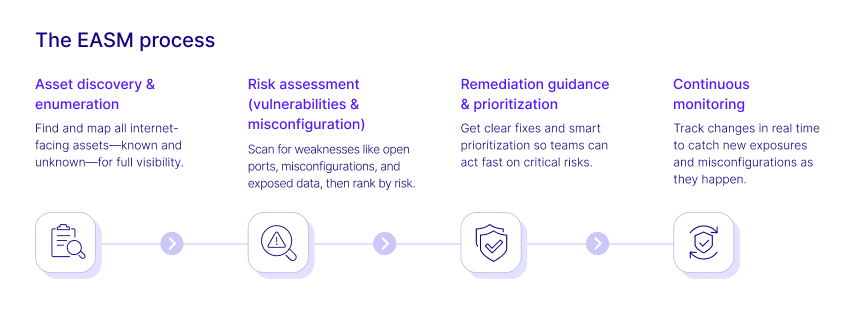
The EASM process

2. Phishing Awareness 

Testing phishing awareness is an important aspect of assessing an organization’s security posture but manually running phishing campaigns is labor intensive and time-consuming. Pen testing often doesn’t include social engineering in scope, but a large percentage of the hacks you read about on the news start with a phish. The Phishing Awareness capability provides the resources to create an automated internal phishing campaign. 

3. Lateral Movement 

Continuously assessing network configuration and segmentation policies through escalating privileges and exploiting misconfigurations on multiple machines can be time-consuming for red teams when done manually. The Lateral Movement capability emulates a real-life hacker that has gained an initial foothold in a company’s network and shows how the hacker can move laterally from the originating workstation in search of valuable assets. It runs automatically and applies “living off the land” non-destructive hacking tactics and techniques to continuously uncover infrastructure misconfigurations and weaknesses. This allows you to verify your environments are properly isolated with evidence.  

4. Full Kill-Chain Scenarios

The full kill-chain campaign capability validates an organization’s security stack against real-world cyberattacks that attempt to bypass security controls and execute techniques from across the kill-chain, from attack delivery to exploitation and post-exploitation
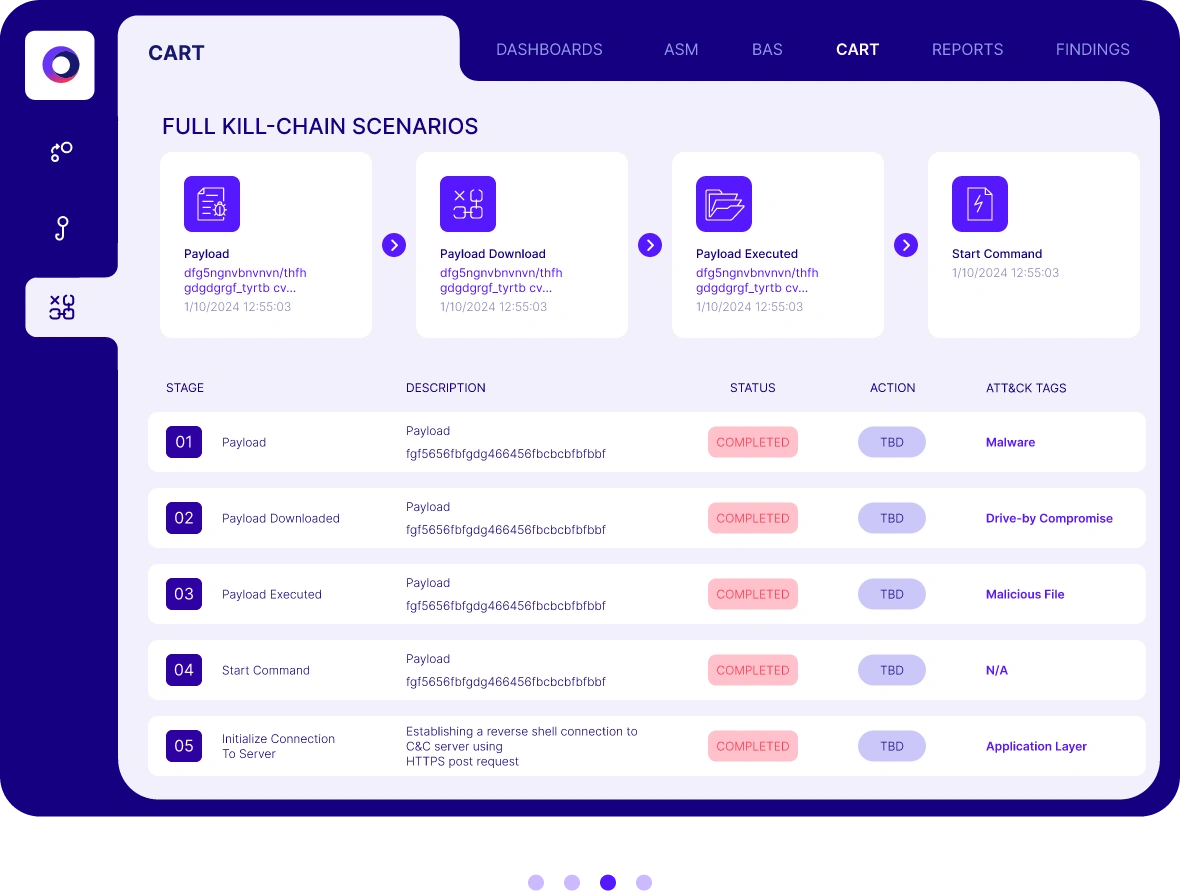
Cymulate Automated Red Teaming

Cymulate provides red teams a platform to increase their operational efficiency and optimize their adversarial activities in a production-safe environment. Cymulate’s red team capabilities include the modules Attack Surface Management (ASM), Phishing Awareness, Lateral Movement, Full-Kill Chain Campaign, and Advanced Scenarios

Key Takeaways

Implementing an automated red teaming tool not only enhances productivity but boosts red team morale by reducing manual, time-consuming tasks. With automation, your red team can focus on high-impact, complex engagements, ultimately strengthening your organization’s security posture.

Ready to take your red team’s efficiency to the next level? Book a demo to see how Cymulate​ Continuous
Automated Red Teaming
can strengthen your organization’s security posture with a hands-on approach.

Cymulate Exposure Validation makes advanced security testing fast and easy. When it comes to building custom attack chains, it's all right in front of you in one place.
Mike Humbert, Cybersecurity Engineer
DARLING INGREDIENTS INC.
Learn More
Book a Demo