

Frequently Asked Questions

Cyber Risk Measurement & Board Reporting

How does Cymulate help answer the board's question: "Are we secure from cyber attacks?"

Cymulate enables security leaders to move beyond a simple yes/no answer by quantifying cyber risk exposure on a scale from 0 to 100. This provides concrete, evidence-based responses to board-level questions, allowing organizations to demonstrate their current security posture and justify investments in security controls. (Source: Cymulate Blog)

What is considered an acceptable level of cyber risk according to Cymulate?

Based on Cymulate's analysis, organizations that achieve an overall score of 33 or less are typically considered to have an acceptable level of cyber risk. Scores in the 0–33 range are regarded as minimal to low risk, while scores above 33 indicate medium to high risk and the need for further improvement. (Source: Cymulate Blog)

How does Cymulate quantify and communicate cyber risk to executives and the board?

Cymulate provides a quantifiable risk score (0–100) and detailed dashboards that allow security leaders to present concrete evidence of their organization's exposure level. This enables clear communication of risk, supports investment decisions, and demonstrates the effectiveness of security programs. (Source: Cymulate Blog)

What kind of evidence does Cymulate provide for board-level reporting?

Cymulate delivers executive summaries, risk scores, and prioritized mitigation plans based on frequent automated attack simulations. These outputs validate security controls, highlight areas of concern, and provide actionable recommendations for reducing risk. (Source: Cymulate Blog)

How quickly can Cymulate deliver results for executive reporting?

According to Haim Inger, CTO of Clal, "within 24 hours, Cymulate enabled us to check our security systems and report the results to our CEO." This demonstrates the platform's ability to provide rapid, actionable insights for leadership. (Source: Cymulate Blog)

How does Cymulate help justify cybersecurity investments to the board?

Cymulate provides quantifiable data that shows the direct correlation between security investments and risk reduction. As Avinash Dharmadhikari, CISO of Persistent Systems, stated, "With Cymulate, we can present quantifiable data to the board and show a direct correlation between investments and the reduction in risk." (Source: Cymulate Blog)

How does Cymulate support continuous improvement in cybersecurity?

Cymulate enables organizations to establish a baseline risk score and continuously improve their security posture through ongoing assessments, daily threat validation, and weekly control validation. This approach helps organizations adapt to evolving threats and maintain an acceptable risk level over time. (Source: Cymulate Blog)

What best practices does Cymulate recommend for security validation?

Cymulate recommends continuous validation of security controls, immediate threats, and operational responses. This includes validating email gateways, web gateways, web application firewalls, endpoint security, cloud security, data loss prevention, and SIEM observability, as well as running SOC exercises and purple teaming. (Source: Cymulate Blog)

How does Cymulate help organizations prioritize vulnerabilities and exposures?

Cymulate enables organizations to prioritize vulnerabilities and exposures by mapping them to preferred security frameworks such as MITRE ATT&CK and NIST. The platform provides actionable insights and a prioritized mitigation plan to reduce exposure levels efficiently. (Source: Cymulate Blog)

Why is continuous security validation important compared to annual penetration tests?

Annual or semi-annual penetration tests are no longer sufficient due to the speed at which adversaries operate. Cymulate advocates for continuous security and exposure validation to keep pace with daily emerging threats and weekly changes to security controls. (Source: Cymulate Blog)

Features & Capabilities

What is Cymulate and what does it do?

Cymulate is a leading exposure management and security validation platform. It enables organizations to simulate real-world cyberattacks, identify security gaps, optimize resilience, and integrate seamlessly with existing security infrastructure. Over 1,000 customers worldwide use Cymulate to baseline their security posture and continuously improve cyber resilience. (Source: Cymulate Press Release)

What are the key features of the Cymulate platform?

Key features include continuous threat validation, exposure awareness, defensive posture optimization, attack path discovery, automated mitigation, comprehensive integration with SIEM/EDR tools, and dedicated cloud security validation. (Source: Cymulate)

What integrations does Cymulate support?

Cymulate integrates with leading security tools across endpoint security (e.g., CrowdStrike Falcon, SentinelOne), cloud security (AWS GuardDuty, Wiz), SIEM (Splunk), vulnerability management (Rapid7 InsightVM), and more. For a full list, visit the Cymulate Partnerships and Integrations page.

How does Cymulate help organizations prioritize remediation efforts?

Cymulate uses AI and machine learning to deliver actionable insights, ranking vulnerabilities based on exploitability, business context, and threat intelligence. This enables organizations to focus on the most critical exposures and optimize remediation. (Source: EM Platform Message Guide.pdf)

What technical documentation is available for Cymulate?

Cymulate provides whitepapers, data sheets, and integration guides covering platform architecture, automated remediation, custom attack simulations, and alignment with the MITRE ATT&CK framework. Access these resources at the Cymulate Resources page.

How easy is Cymulate to implement and use?

Cymulate is known for its quick, agentless deployment and intuitive interface. Customers report being able to run simulations and generate insights within hours, with minimal configuration required. (Source: Cymulate)

What feedback have customers given about Cymulate's ease of use?

Customers consistently praise Cymulate for its intuitive, user-friendly design. Testimonials highlight the ease of implementation, dashboard navigation, and actionable insights. (Source: Cymulate)

What security and compliance certifications does Cymulate hold?

Cymulate is certified for SOC2 Type II, ISO 27001:2013, ISO 27701, ISO 27017, and CSA STAR Level 1. These certifications demonstrate adherence to industry-leading security and privacy standards. (Source: Cymulate Security)

How does Cymulate ensure data security and privacy?

Cymulate's platform is hosted in secure AWS data centers with ISO 27001, PCI DSS, and SOC 2/3 compliance. Data is encrypted in transit (TLS 1.2+) and at rest (AES-256). The company follows a strict Secure Development Lifecycle and provides GDPR compliance. (Source: Cymulate Security)

Use Cases & Business Impact

Who can benefit from using Cymulate?

Cymulate is designed for CISOs, Security Operations (SecOps), Red Teams, Detection Engineers, and Vulnerability Management Teams in organizations where cybersecurity is a critical concern. (Source: EM Platform Message Guide.pdf)

What business impact can organizations expect from Cymulate?

Organizations using Cymulate report a 52% reduction in critical exposures, a 60% increase in team efficiency, and an 81% reduction in cyber risk within four months. Threat validation is 40X faster, and threat detection accuracy improves by 85%. (Source: Cymulate)

What problems does Cymulate solve for security teams?

Cymulate addresses overwhelming threat volumes, lack of visibility, unclear prioritization, operational inefficiencies, fragmented tools, cloud complexity, and communication barriers between security teams and executives. (Source: manual)

How does Cymulate help with cloud security validation?

Cymulate provides dedicated validation features for hybrid and cloud environments, helping organizations address new attack surfaces and validation challenges introduced by cloud adoption. (Source: manual)

How does Cymulate support communication between CISOs and the board?

Cymulate provides validated exposure scoring, quantifiable metrics, and executive dashboards, enabling CISOs to communicate risk and justify investments with up-to-date, actionable data. (Source: EM Platform Message Guide.pdf)

What are some real-world case studies demonstrating Cymulate's value?

Case studies include Hertz Israel reducing cyber risk by 81% in four months, Nemours Children's Health improving detection and response, and Nedbank focusing on critical vulnerabilities. See more at the Cymulate Customers page.

How does Cymulate address the needs of different security personas?

For Red Teams, Cymulate automates offensive testing and provides a continuously updated attack library. For Detection Engineers, it helps close SIEM coverage gaps and validate detection rules. For Vulnerability Management, it consolidates exposure data for efficient prioritization. (Source: EM Platform Message Guide.pdf)

What feedback have security leaders given about Cymulate's impact on board confidence?

Security leaders report increased board confidence in their security posture and ability to protect against threats after implementing Cymulate. (Source: Cymulate Case Study)

How does Cymulate help organizations rationalize cybersecurity spending?

Cymulate provides evidence-based metrics and prioritized mitigation plans, enabling organizations to rationalize cybersecurity investments and manage costs effectively. (Source: Cymulate Blog)

Competition & Comparison

How does Cymulate compare to AttackIQ?

Cymulate offers the industry's leading threat scenario library and AI-powered capabilities for streamlined workflows and accelerated security posture improvement. AttackIQ does not match Cymulate's innovation, threat coverage, or ease of use. (Read more)

How does Cymulate compare to Mandiant Security Validation?

Mandiant's platform has seen minimal innovation in recent years, while Cymulate continually innovates with AI and automation, expanding into exposure management as a recognized market leader. (Read more)

How does Cymulate compare to Pentera?

Pentera focuses on attack path validation but lacks Cymulate's depth in defense assessment and strengthening. Cymulate optimizes defense, scales offensive testing, and increases exposure awareness. (Read more)

How does Cymulate compare to Picus Security?

Picus is suitable for on-premise BAS needs but lacks Cymulate's comprehensive exposure validation, which covers the full kill chain and includes cloud control validation. (Read more)

How does Cymulate compare to SafeBreach?

Cymulate outpaces SafeBreach with unmatched innovation, precision, and automation. It offers the industry's largest attack library, a full CTEM solution, and comprehensive exposure validation. (Read more)

How does Cymulate compare to Scythe?

Scythe is suitable for advanced red teams but lacks Cymulate's ease of use, daily threat updates, and comprehensive control validation. Cymulate provides actionable remediation and automated mitigation. (Read more)

How does Cymulate compare to NetSPI?

NetSPI is a PTaaS vendor, while Cymulate offers a platform for continuous, independent assessment and defense strengthening. Cymulate is recognized as a leader in exposure validation by Gartner and G2. (Read more)

Pricing & Plans

What is Cymulate's pricing model?

Cymulate uses a subscription-based pricing model tailored to each organization's needs. Pricing depends on the chosen package, number of assets, and scenarios required. For a custom quote, schedule a demo with the Cymulate team. (Source: manual)

How can I get a Cymulate pricing quote?

You can receive a personalized pricing quote by scheduling a demo with Cymulate's team, who will assess your organization's requirements and recommend the best package. (Schedule a demo)

Company & Trust

When was Cymulate founded and how large is the company?

Cymulate was founded in 2016 and has a global presence with offices in eight locations, serving over 1,000 customers in 50 countries. (Source: Cymulate About Us)

What is Cymulate's mission and vision?

Cymulate's vision is to lead the way in how companies implement cybersecurity strategies, making the world safer. Its mission is to empower organizations worldwide against threats and make advanced cybersecurity as simple as sending an email. (Source: Cymulate About Us)

Where can I find Cymulate's latest research and blog posts?

You can stay updated on the latest threats, research, and company news by visiting the Cymulate Blog and Newsroom.

How can I contact Cymulate support?

Cymulate offers email support at [email protected] and real-time chat support via their chat support page. Educational resources are also available. (Source: manual)

New: 2026 Gartner® Market Guide for Adversarial Exposure Validation
Learn More
Cymulate named a Customers' Choice in 2025 Gartner® Peer Insights™
Learn More
New Research: The Security Tradeoffs Behind AI Tooling
Learn More
An Inside Look at the Technology Behind Cymulate
Learn More

When the Board Asks: Is Our Business Secure from Cyber Attacks?

By: Brian Moran, VP of Product Marketing

Last Updated: January 5, 2026

cymulate blog

How security leaders can quantify risk and respond with confidence

For any cybersecurity leaders who have ever had to sit in front of their executive committee or members of their board and answer the question: “Are We Secure?”, they know the answer to that question is not that simple. 

 When it comes to cybersecurity, “Are we secure?” is not a binary yes or no answer.  

There is no such thing as “Yes, we are 100% secure from cyber attacks”. So, by default, the answer can only be “no”. But no, is not an answer any executive leader or board member wants to hear. 

So, the real question that needs to be asked here is: “How exposed are we?”. 

Measuring Cyber Risk Exposure 

image

Answering the question of cyber risk exposure does not happen on a simple Yes or No scale. Here at Cymulate, we measure an organization’s overall risk on a scale from 0 – 100 to provide an accurate reflection of their current security posture.

Now, when an executive asks: “How exposed are we? 

You can confidently answer with: 

  • We have minimal risk and exposure to cyber attacks. 
  • We have a low risk of being breached by a cyber attack. 
  • Well, we do have medium risk and need to make some changes to avoid becoming the next breach victim. 
  • Sorry to inform you, but we currently are at high risk of a cyber breach and need to make some immediate investments to better protect our business. 

As you look your executives in the eye and answer the question with conviction, you will need real concrete evidence and belief that your security program is effective, and that your organization has an “acceptable level of cyber risk” given your business context. 

So, what is considered “acceptable” when it comes to cyber risk exposure. 

Since 2016, more than 500 enterprises have turned to Cymulate for an easy-to-deploy, SaaS-based platform for continuous security and exposure validation of their cybersecurity controls. The platform assesses security controls and immediate threats by running a comprehensive suite of attack simulations. The output of these assessments quantifies the organization’s exposure level and provides the evidence required to go to the board with confidence and justify the need for further investments to improve security controls and mitigate risk. 

“With Cymulate, we can present quantifiable data to the board and show a direct correlation between investments and the reduction in risk.” said Avinash Dharmadhikari, CISO, Persistent Systems.

Cymulate customers can track their results and quantify the exposure level using their overall score and the scores for the individual security controls as shown in the example dashboard above.  

“The best thing is that within 24 hours, Cymulate enabled us to check our security systems and report the results to our CEO.” said Haim Inger, CTO, Clal. 

Achieving an Acceptable Level of Risk 

Based on an analysis of scores across the Cymulate platform, we recognize that organizations that achieve an overall score of 33 or less typically have an acceptable level of cyber risk. Of course, this can vary from organization to organization depending on their business context and the nature of the information they are trying to protect, but in general minimal risk to low risk is considered acceptable risk and scores in that range (0 – 33) are what organizations aspire to achieve and maintain. 

For those organizations that fall into the medium risk to high risk category (34 – 100), they have work to do to reduce their risk and bring their score down over time to a level they would regard as “acceptable”. 

Providing Concrete Evidence of the Need for More Cyber Investments 

Once you have quantified the level of risk exposure to executives, their next likely question is: “How do we know?”. 

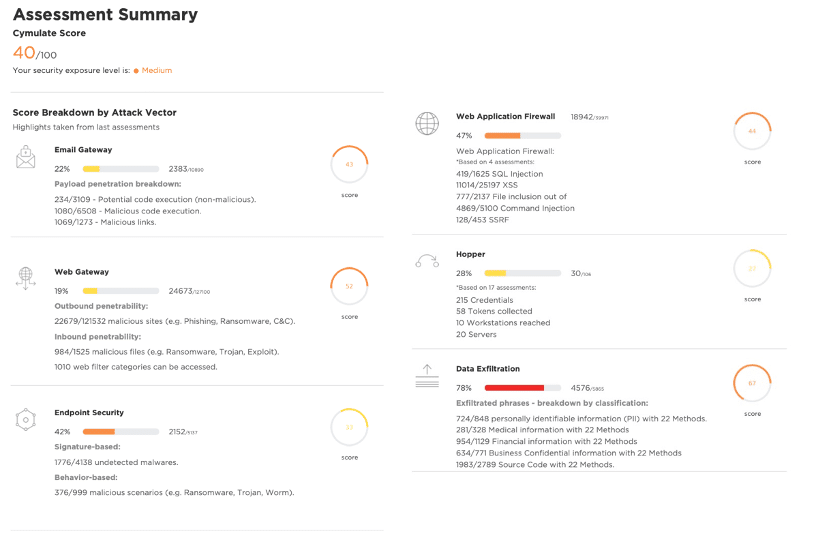
By running frequent automated attack simulations against your security controls, you will always be armed with the latest results as proof and evidence as shown in the executive summary example below. 
image

The results of these offensive security tests validate your security controls and highlight areas of concern and exposure that need to be addressed to get to an acceptable level of risk. The executive summary clearly shows the current security posture of your controls and the areas of weakness that require improvement. 

In addition to the assessment summary, you will also be armed with a prioritized mitigation plan created to reduce your security exposure level and get you better protected, faster. 

Cyber Security is a Game of Continuous Improvement  

Regardless of your score, we know that cyber security is a game of continuous improvement that starts with a baseline score of where you are today and continues to make improvements over time to enhance your security posture and ultimately reduce your risk profile as measured by your Cymulate score.  

And even when you do get down to an acceptable level of risk, you still need continuous validation (daily assessments of immediate threats and weekly assessments of security controls) to avoid experiencing drift resulting from the constant changes to your IT environment and the ever-evolving threat landscape and new tactics by threat actors. 

Organizations are always going to have vulnerabilities (and most will have lots of them) due to the dynamic nature of the IT environment and the latest tactics and techniques being used by threat actors to exploit those vulnerabilities. 


Security and Exposure Validation Improves Your Security Posture 

Conducting pen tests or red team exercises on an annual or even semi-annual basis is no longer sufficient to keep pace with the speed at which adversaries operate these days.  

You need continuous security and exposure validation against immediate threats that are discovered on a daily basis and changes that are made to your security controls every week. 

Cymulate has established the following security validation best practices to validate security controls, immediate threats, and operational responses. 

validate controlsvalidate threatsvalidate response
Email GatewaysImmediate ThreatsSOC Exercise
Web GatewaysLateral MovementPurple Teaming
Web Application FirewallFull Kill Chain Attacks
Endpoint Security
Cloud Security
Data Loss Prevention
SIEM Observability

The Cymulate platform enables continuous validation and improvement across your cybersecurity program so you can:  

  • Continuously measure and convey cyber effectiveness and risks to your leadership 
  • Validate controls, discover security drift, and understand your emergent threat risk 
  • Prioritize your vulnerabilities and understand exposures mapped to your preferred security frameworks (MITRE ATT&CK, NIST) 
  • Rationalize cyber security spend and manage your costs. 

So, the next time you are scheduled to meet with your executive committee or members of the board to answer questions about the level of cybersecurity exposure of your organization, answer with confidence (and evidence) with the Cymulate platform.  

Don’t wait, schedule your demo today.

 

Cymulate Exposure Validation makes advanced security testing fast and easy. When it comes to building custom attack chains, it's all right in front of you in one place.
Mike Humbert, Cybersecurity Engineer
DARLING INGREDIENTS INC.
Learn More
Book a Demo