Frequently Asked Questions
Product Information & Attack Path Management
What is Cymulate's Attack Path Management Platform?
Cymulate's Attack Path Management Platform is designed to halt lateral movement and remediate misconfigurations by automatically mapping attack paths, validating privilege escalation, and assessing how attackers could exploit exposures to reach critical data. It provides automated offensive testing, validated segmentation, and actionable mitigation guidance to improve threat resilience. Learn more.
How does Cymulate map attack paths in my environment?
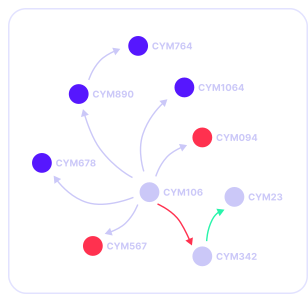
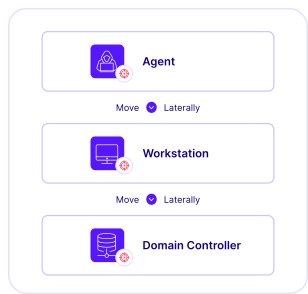
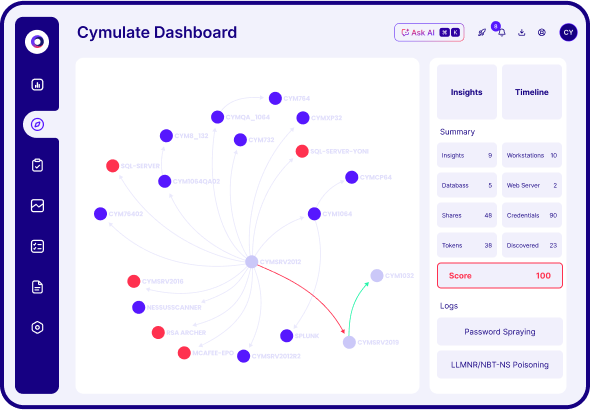
Cymulate automatically generates attack path maps from the initial agent to every asset reached, uncovering how attackers could advance within the network across machines, servers, and domain controllers before they do. This helps organizations visualize and address potential lateral movement risks. Source.
What types of exposures does Cymulate's platform reveal?
The platform identifies access control misconfigurations, weak credentials, and trust relationship exposures that could be exploited for lateral movement or privilege escalation. Source.
How does Cymulate validate network segmentation?
Cymulate assesses attack paths across the entire architecture to validate security controls for each segment, ensuring that segmentation policies are effective and up-to-date. Source.
What is the difference between attack path and attack surface?
An attack path is the specific route or chain of vulnerabilities/misconfigurations an attacker could follow after entry to move inside an environment and reach a critical asset. An attack surface covers all possible entry points an attacker could exploit or affect in a system. Source.
What is attack path management (APM)?
Attack path management is the continuous practice of discovering, analyzing, and remediating attack paths. It involves mapping all possible attack paths, validating which are exploitable, prioritizing them by risk, and systematically mitigating high-risk paths to minimize exposure. Source.
What are the three steps involved in attack path management?
The three core steps are: 1) Discovery and mapping of all attack paths, 2) Analysis and prioritization to identify the riskiest routes, and 3) Remediation with continuous monitoring to eliminate or mitigate paths while adapting to environmental changes. Source.
Is Active Directory (AD) part of attack path management?
Yes. Active Directory is often central to attack path management because many attack paths rely on misconfigurations, excessive privileges, or delegation within AD. Monitoring and hardening AD can eliminate high-risk choke points attackers exploit to gain domain dominance. Source.
How does Cymulate help prioritize mitigations?
Cymulate assesses, prioritizes, and mitigates security gaps to improve protection for high-risk assets, helping organizations focus remediation efforts where they matter most. Source.
What are the benefits of attack path management?
Attack path management helps organizations focus remediation on the most critical risks, reduces the blast radius of breaches, strengthens identity and privilege hygiene, and makes security operations more efficient. It leads to stronger resilience, faster detection, and better compliance readiness. Source.
How does Cymulate's platform support continuous resilience?
Cymulate validates access control and segmentation policies, strengthens threat resilience, and monitors for drift from the security baseline, ensuring organizations remain protected as their environment evolves. Source.
What types of attack techniques does Cymulate simulate?
Cymulate provides out-of-the-box templates for common techniques such as SMB Pass-the-Hash and LLMNR Poisoning, enabling organizations to test their defenses against real-world lateral movement and privilege escalation attacks. Source.
How does Cymulate help with privilege escalation testing?
Cymulate validates how effective security policies are at limiting or preventing privilege escalation, helping organizations identify and remediate weaknesses before attackers can exploit them. Source.
What is the role of attack path discovery in exposure validation?
Attack Path Discovery is a core component of exposure validation, using simulation tools to validate security controls, identify weaknesses, and provide policy tuning guidance, automated control updates, and custom mitigation rules. Read the data sheet.
How does Cymulate support different security domains?
Cymulate's platform supports validation across endpoint security (AV/EDR), cloud security (CWPP), containers/Kubernetes, secure email and web gateways, web application firewalls, network security (IPS/IDS), data loss prevention, and SIEM/SOAR detections. Source.
What customer feedback has Cymulate received about attack path management?
Customers have praised Cymulate for making it easy to validate controls against emerging threats and for providing comprehensive, realistic validation from both internal and external threats. See all reviews.
How does Cymulate help organizations prove continuous resilience?
Cymulate enables organizations to validate access control and segmentation policies, strengthen threat resilience, and monitor for drift from the security baseline, ensuring ongoing protection. Source.
What is the primary purpose of Cymulate's platform?
The primary purpose of Cymulate's platform is to help organizations proactively validate their cybersecurity defenses, identify vulnerabilities, and optimize their security posture to stay ahead of emerging threats and improve overall resilience. Source.
Features & Capabilities
What are the key capabilities of Cymulate's platform?
Cymulate offers continuous threat validation, unified exposure management, attack path discovery, automated mitigation, AI-powered optimization, complete kill chain coverage, ease of use, and an extensive threat library with over 100,000 attack actions updated daily. Source.
Does Cymulate integrate with other security technologies?
Yes, Cymulate integrates with a wide range of security technologies, including Akamai Guardicore, AWS GuardDuty, BlackBerry Cylance OPTICS, Carbon Black EDR, Check Point CloudGuard, Cisco Secure Endpoint, CrowdStrike Falcon, Wiz, SentinelOne, and more. For a complete list, visit the Partnerships and Integrations page.
What technical documentation is available for Cymulate?
Cymulate provides guides, whitepapers, solution briefs, and data sheets covering topics like vulnerability management, detection engineering, exposure validation, automated mitigation, and attack path discovery. Access these resources at the Resource Hub.
How easy is Cymulate to implement and use?
Cymulate is designed for quick, agentless deployment with no need for additional hardware or complex configurations. Customers can start running simulations almost immediately, and the platform is praised for its intuitive, user-friendly interface. Schedule a demo to see it in action.
What feedback have customers given about Cymulate's ease of use?
Customers consistently praise Cymulate for its ease of use, intuitive dashboard, and actionable insights. For example, Raphael Ferreira, Cybersecurity Manager, said, "Cymulate is easy to implement and use—all you need to do is click a few buttons, and you receive a lot of practical insights into how you can improve your security posture." Read more testimonials.
Use Cases & Benefits
Who can benefit from Cymulate's Attack Path Management Platform?
Cymulate's platform is designed for CISOs, security leaders, SecOps teams, red teams, and vulnerability management teams in organizations of all sizes and industries, including finance, healthcare, retail, media, transportation, and manufacturing. Learn more.
What business impact can customers expect from using Cymulate?
Customers can expect up to a 52% reduction in critical exposures, a 60% increase in team efficiency, and an 81% reduction in cyber risk within four months. The platform also enables faster threat validation and cost savings by consolidating tools. Source.
What are some real-world case studies demonstrating Cymulate's value?
Hertz Israel reduced cyber risk by 81% in four months using Cymulate. Nemours Children's Health improved detection and response in hybrid and cloud environments. Saffron Building Society proved compliance with regulators and improved governance. See more case studies.
How does Cymulate address fragmented security tools?
Cymulate integrates exposure data and automates validation to provide a unified view of the security posture, addressing gaps caused by disconnected tools. Source.
How does Cymulate help with resource constraints in security teams?
Cymulate automates processes, improving efficiency and operational effectiveness, so security teams can focus on strategic initiatives rather than manual tasks. Source.
How does Cymulate support vulnerability management teams?
Cymulate automates in-house validation between pen tests and prioritizes vulnerabilities effectively, enabling efficient vulnerability management. Learn more.
How does Cymulate help with post-breach recovery?
Cymulate enhances visibility and detection capabilities after a breach, ensuring faster recovery and improved protection. Read the case study.
Security, Compliance & Technical Requirements
What security and compliance certifications does Cymulate hold?
Cymulate holds SOC2 Type II, ISO 27001:2013, ISO 27701, ISO 27017, and CSA STAR Level 1 certifications, demonstrating adherence to industry-leading security and privacy standards. Learn more.
How does Cymulate ensure data security?
Cymulate ensures data security through encryption for data in transit (TLS 1.2+) and at rest (AES-256), secure AWS-hosted data centers, and a tested disaster recovery plan. Source.
What application security measures does Cymulate use?
The platform is developed using a strict Secure Development Lifecycle (SDLC), including secure code training, continuous vulnerability scanning, and annual third-party penetration tests. Source.
Is Cymulate GDPR compliant?
Yes, Cymulate incorporates data protection by design and has a dedicated privacy and security team, including a Data Protection Officer (DPO) and Chief Information Security Officer (CISO). Source.
What product security features does Cymulate offer?
Cymulate includes mandatory 2-Factor Authentication (2FA), Role-Based Access Controls (RBAC), IP address restrictions, and TLS encryption for its Help Center. Source.
Pricing & Plans
What is Cymulate's pricing model?
Cymulate operates on a subscription-based pricing model tailored to each organization's requirements. Pricing depends on the chosen package, number of assets, and scenarios selected. For a detailed quote, schedule a demo.
Competition & Comparison
How does Cymulate compare to AttackIQ?
Cymulate surpasses AttackIQ in innovation, threat coverage, and ease of use, offering an industry-leading threat scenario library and AI-powered capabilities to streamline workflows and accelerate security posture improvement. Read more.
How does Cymulate compare to Mandiant Security Validation?
Mandiant Security Validation is an original BAS platform but has seen little innovation in recent years. Cymulate continually innovates with AI and automation, expanding into exposure management as a grid leader. Read more.
How does Cymulate compare to Pentera?
Pentera focuses on attack path validation but lacks the depth Cymulate provides to fully assess and strengthen defenses. Cymulate optimizes defense, scales offensive testing, and increases exposure awareness. Read more.
How does Cymulate compare to Picus Security?
Picus Security offers an on-premise BAS option but lacks the comprehensive exposure validation platform Cymulate provides, which covers the full kill-chain and includes cloud control validation. Read more.
How does Cymulate compare to SafeBreach?
Cymulate outpaces SafeBreach with unmatched innovation, precision, and automation, offering the industry’s largest attack library, a full CTEM solution, and comprehensive exposure validation. Read more.
How does Cymulate compare to Scythe?
Scythe is suitable for advanced red teams building custom attack campaigns, but Cymulate provides a more comprehensive exposure validation platform with actionable remediation and automated mitigation. Read more.